

The primary constraint in traditional kinetic operations has always been the biological limitation of the human analyst. Analysts are error-prone, subject to cognitive degradation under sustained load, and incapable of maintaining vigilance across fifteen hours of continuous drone footage or synthesizing hundreds of thousands of data points without accumulating error. The integration of AI through automated targeting architecture has resolved this bottleneck, transitioning military targeting from artisanal, labor-intensive workflows to a high-volume industrial output model.
Scaling Target Prosecution#
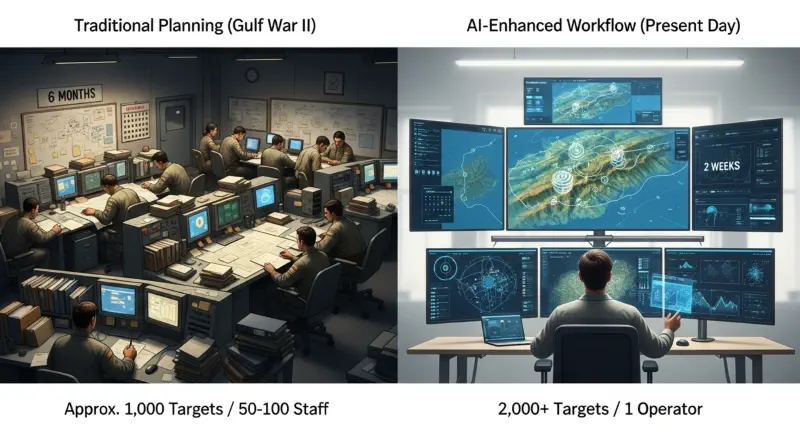
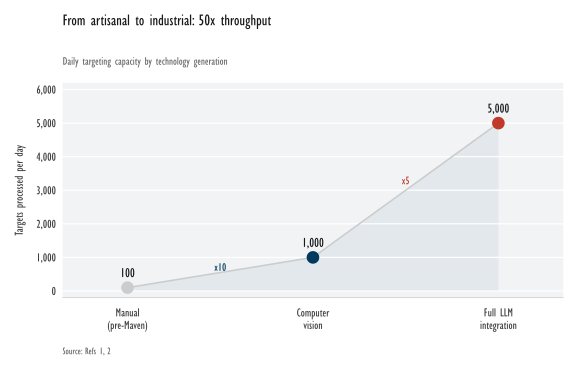
The productivity gains are documented. Prior to algorithmic targeting, U.S. forces processed fewer than 100 targets per day. Computer vision applied to satellite and drone feeds raised that figure to 1,000. Subsequent integration of large language models to automate the administrative and planning phases of the targeting cycle raised throughput to 5,000 targets per day, a 50-fold increase over the baseline manual model.¹
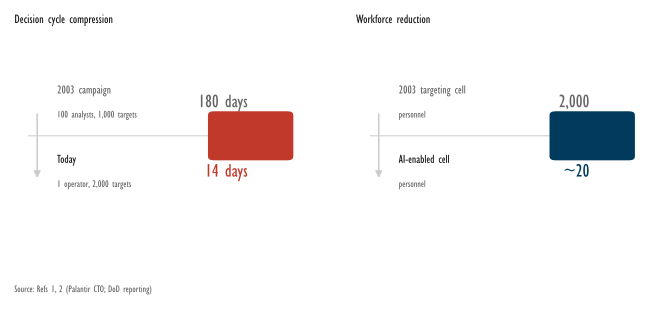
For comparative scale: the Gulf War II campaign processed approximately 1,000 targets over six months with a planning staff of 50 to 100 people. Current AI-enabled workflows achieve twice that target volume with a single operator over two weeks.² In Palantir's own public characterization, the system makes operators 50 times more productive than their predecessors.²
Compressing the Decision Cycle#
Operational efficiency is measured by cycle compression. By 2024, end-to-end targeting cycles in exercise conditions had been reduced to under one minute.¹ In active theaters, the Find-Fix-Finish cycle was compressed to under ten minutes; the National Geospatial-Intelligence Agency publicly disclosed this performance figure for Maven's deployment in Ukraine.³
A senior targeting officer of the XVIII Airborne Corps estimated that Maven-assisted workflows allowed an individual analyst to process approximately 80 potential targets per hour, against 30 per hour under legacy workflows.⁴ NGA Director Vice Admiral Frank Whitworth subsequently confirmed at a public conference in 2025 that the system was generating 1,000 targeting recommendations per hour.⁵
Workforce Reduction and Unit Cost#
The labor economics follow directly from automation. A targeting cell of 20 personnel now produces output previously requiring 2,000.¹ Four of the six stages in the kill chain, identification, location, filtering, and prioritization, are fully automated or substantially accelerated.¹
flowchart LR
    %% ============================================
    %% 1. NODE STYLES (Dark fills + light strokes)
    %% ============================================
    classDef automated fill:#E3120B,stroke:#FF6B6B,stroke-width:2px,color:#fff
    classDef human fill:#B0B0B0,stroke:#E0E0E0,stroke-width:2px,color:#000

    %% ============================================
    %% 2. NODES
    %% ============================================
    A(["Find"]):::automated
    B(["Fix"]):::automated
    C(["Track"]):::automated
    D(["Target"]):::automated
    E(["Engage"]):::human
    F(["Assess"]):::human

    %% ============================================
    %% 3. EDGES (Arrows)
    %% ============================================
    A --> B --> C --> D --> E --> F

    %% ============================================
    %% 4. SUBGRAPHS (Groupings)
    %% ============================================
    subgraph Machine_speed["Machine targeting loop"]
        direction LR
        A
        B
        C
        D
    end

    subgraph Human_authorisation["Human authorisation"]
        direction LR
        E
        F
    end

    %% ============================================
    %% 5. SUBGRAPH STYLES (Transparent fill)
    %% ============================================
    style Machine_speed fill:none,stroke:#E3120B,stroke-width:2px,stroke-dasharray:5 5
    style Human_authorisation fill:none,stroke:#666666,stroke-width:2px,stroke-dasharray:5 5
Human operators function as order-confirmation terminals at the end of the production line. The targeting officer's own description of the workflow is a single phrase: "Accept. Accept. Accept." 4
The operator does not architect the output. The operator authorizes it.
The Battlefield as Managed Data Stream#
The operational environment is modeled as a real-time digital feed. By 2024, CENTCOM reported the system fused 179 live data sources into a single operating picture supporting command-and-control, fires, force protection, and sustainment workflows.1, 10
Execution is reduced to a sequential confirmation interface. The procedural distance between operator and physical outcome is a designed property of the system, not a side effect. At machine speed, operator cognitive engagement with individual outputs constitutes a rate-limiting step.
The Incomplete Ledger#
Any efficiency model that omits cost externalization is incomplete. The throughput figures above represent one side of the ledger. The excluded variables follow.
Civilian damage ratios. Algorithmic targeting optimizes for identification confidence against defined parameters. Collateral output is logged as a separate category, not as a cost against the efficiency metric. The first documented civilian death in a strike where AI-assisted targeting was acknowledged occurred in Al-Qaim, Iraq, in February 2024.⁶
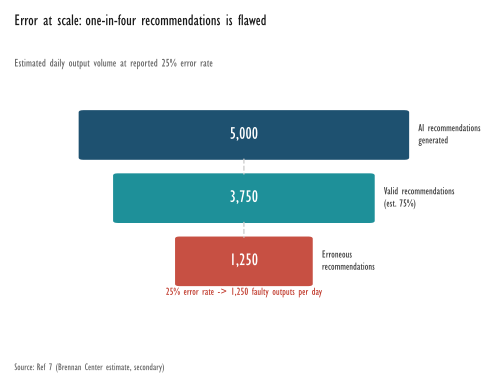
Error propagation at scale. Analysis has quantified AI-assisted targeting error rates at approximately 25% under variable environmental conditions.⁷ At 5,000 target outputs per day, a 25% error rate produces 1,250 erroneous targeting recommendations daily. The same speed that compresses the decision cycle compresses the time available to identify errors before execution.
Post-strike intelligence degradation. Elimination of a target node disrupts but does not terminate the network. Replacement recruitment and operational adaptation are downstream costs not captured in throughput calculations.
Accountability distribution. When four of six kill-chain steps are automated, legal and institutional responsibility for each strike is distributed across software architecture, procurement chains, and command authorization structures. No single accountable node exists at the point of output. A distributed accountability structure is, from a liability standpoint, more resilient than a centralized one.
The Enabling Condition#
The scaling described above is structurally contingent on a single variable: the absence of an external compliance function with enforcement capacity.
The operator does not recognize the jurisdiction of the primary international body empowered to adjudicate the legality of targeting outputs. Filed rulings function as compliance notices without a delivery mechanism. The institutional response at the legislative level has confirmed that non-recognition of this jurisdiction is policy, not oversight failure.
The Pentagon has publicly argued at the United Nations that human control of autonomous weapons is not required by international law.⁸ A coalition of international law experts warned in a 2025 UN submission that current frameworks fail to address the risks that AI-assisted targeting poses to international humanitarian law and to meaningful human judgment in targeting decisions.⁶
The system is, therefore, self-auditing. Efficiency is defined by the operator. Outputs are evaluated by the operator. Cost accounting is performed by the operator.

This is not a regulatory gap. A regulatory gap implies an absent function that was intended to exist. The correct classification is a regulatory null, a system designed to operate without external constraint as a baseline condition.
The Private-Sector Node#
The kill chain is not a purely governmental function. Defense software contractors, publicly traded firms with shareholder obligations, provide, maintain, and iterate the algorithmic infrastructure. Targeting throughput is, at the firm level, a product performance metric. Increased lethality per unit cost is a competitive advantage in a procurement market with a contract ceiling of $1.3 billion through 2029 and a broader framework agreement reaching $10 billion.⁵
This replicates the structural logic Davis and Huttenback identified at the imperial level: the industrialization of force is poor economics for the public treasury, rational economics for the entities holding the contracts.⁹
Conclusion#
The transition from hardware-centric military operations to a software-defined targeting architecture represents the completion of one optimization cycle. The throughput figures are internally consistent. The efficiency gains are real.
The model remains incomplete. A production system that externalizes its waste, civilian damage ratios, accountability vacuums, error propagation at scale, and operates without an auditor external to the system is not optimized. It has transferred its costs to parties outside the accounting perimeter.
The Operating System of War runs without error-checking that originates from outside itself. That is not a performance metric. It is the enabling condition.
References#
Wikipedia contributors. (2026). Project Maven. In Wikipedia. https://en.wikipedia.org/wiki/Project_Maven
Democracy Now! (2026, March 31). The AI war on Iran: Project Maven, a secretive Palantir-run system, helps Pentagon pick bomb targets [Transcript, includes statement by Palantir CTO Shyam Sankar]. https://www.democracynow.org/2026/3/31/project_maven_manson_bloomberg_ai_warfare
Observer Research Foundation. (2025, December 30). AI in real-time warfare: Lessons from Project Maven. ORF Expert Speak. https://www.orfonline.org/english/expert-speak/ai-in-real-time-warfare-lessons-from-project-maven
Manson, K. (2024, February 28). AI warfare becomes real for US military with Project Maven. Bloomberg. https://www.bloomberg.com/features/2024-ai-warfare-project-maven/
GlobalSecurity.org. (2026). Algorithmic Warfare Cross-Functional Team (AWCFT) / Project Maven. https://www.globalsecurity.org/intell/systems/maven.htm
Morrison, S., & Sabbagh, D. (2026, March 10). 'We want to use it for everything': How Project Maven became central to America's AI-powered warfare. The Independent / AOL. https://www.aol.com/articles/want-everything-project-maven-became-112734550.html
Brennan Center for Justice. (2026, March). The business of military AI [cited in Tom's Hardware coverage]. https://www.tomshardware.com/tech-industry/artificial-intelligence/pentagon-formalizes-palantirs-maven-ai-as-a-core-military-system-with-multi-year-funding-platforms-investment-grows-to-usd13-billion-from-usd480-million-in-2024
Interesting Engineering. (2024, March 2). Project Maven: The epicenter of US' AI military efforts. https://interestingengineering.com/military/project-maven-the-epicenter-of-us-ai-military-efforts
Davis, L. E., & Huttenback, R. A. (1986). Mammon and the pursuit of empire: The political economy of British imperialism, 1860–1912. Cambridge University Press.
Manson, K. (2026). Project Maven : a Marine colonel, his team, and the dawn of AI warfare (First edition). W.W. Norton and Company.