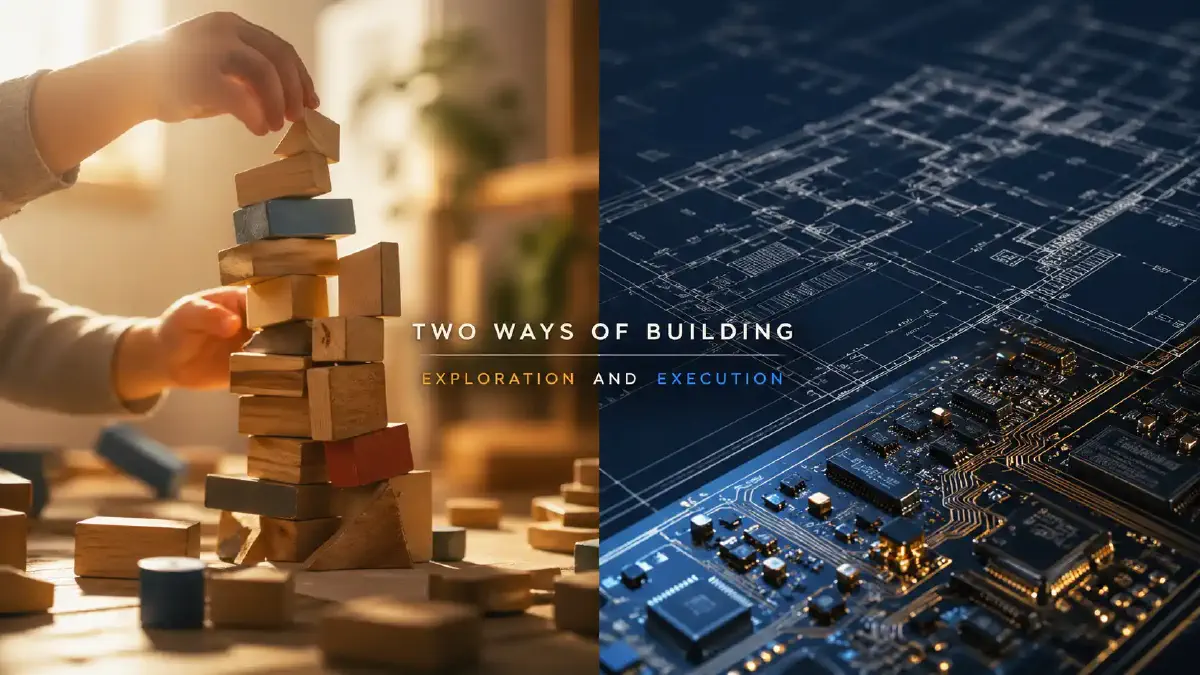
Every successful organization eventually faces a quiet civil war. On one side stand the innovatorspeople who ask embarrassing questions, break prototypes, and treat constraints as suggestions. On the other side stand the expertspeople who build supply chains, enforce quality control, and turn fragile ideas into repeatable revenue.
Neither side respects the other. The innovators call the experts bureaucrats. The experts call the innovators children.
Both are correct. And both are necessary.
In April 2025, Apple reported $391 billion in annual revenue, a machine of staggering efficiency built by Tim Cook's supply chain discipline. Yet that machine would not exist without Steve Jobs's earlier refusal to accept that a phone needed a stylus or that a computer couldn't fit in an envelope. The tension between these two mindsets is not a bug. It is the engine of durable success.
This essay argues that the "child" mindset, optimized for exploration, counterfactual thinking, and low-stakes play, and the "expert" mindset, optimized for execution, risk mitigation, and structural discipline, form a necessary polarity. Organizations that privilege only one eventually collapse into either creative chaos or sterile optimization. The winners learn to cycle between both.
The Two Brains of Human Progress#
To understand why this tension exists, start with a toddler.
Psychologist Alison Gopnik, in a landmark body of research summarized in her 2016 book The Gardener and the Carpenter, demonstrated that the human juvenile period, the longest of any species, serves a specific evolutionary function. Childhood is not practice for adulthood. It is a distinct cognitive niche optimized for learning.
Gopnik's experiments reveal that young children learn like scientists. They use Bayesian inference to update causal models of the world. They explore more when the environment is uncertain. They generate counterfactual possibilities, imagining what didn't happen, at rates that exceed many adults. In controlled studies, preschoolers have outperformed college students at figuring out unusual causal relationships from ambiguous data, precisely because they lack the expert's overconfidence in prior assumptions.
This is the "R&D division of the human species," as Gopnik phrases it. A child's brain is broadband, rich with synaptic connections, inefficient in execution, but brilliant at exploration.
The Expert's Narrow-Band Advantage#
Adulthood, by contrast, prunes those connections. The adult brain is optimized for exploitation. Myelination speeds transmission along established pathways. What is lost in flexibility is gained in speed and reliability. An expert doesn't need to explore ten ways to drive a car. They need to drive safely for fifty years.
This is not inferior. It is essential. The neurosurgeon who hesitated to explore alternative approaches mid-surgery would kill the patient. The pilot who treated emergency checklists as suggestions would crash the plane. Expertise is the ability to execute reliably under uncertainty, but only within the domain where that expertise was built.
The tragedy is that organizations mistake expertise for wisdom. They promote the neurosurgeon to run the research lab, then wonder why no one asks radical questions. They hire the logistics expert to lead product design, then complain about incrementalism.
The Historical Record of Forced Polarity#
Consider two Apple eras. From 1997 to 2010, Steve Jobs ran the company like a provocateur. He demanded a phone with no keyboard when every expert said it was impossible. He pushed for unibody aluminum manufacturing when suppliers said it couldn't be done at scale. He rejected market research entirely. "People don't know what they want until you show it to them" he said.
This was the child-mindset at an industrial scale. It produced the iMac, iPod, iPhone, and iPad, four category-defining products in thirteen years.
Then Jobs died. Tim Cook, the supply chain genius who had spent a decade building the operational machine, took over. Under Cook, Apple's innovation slowed. New categories became rare. Instead, the company optimized. It extracted nearly $20 billion annually from Google just to keep Safari as the default search engine. It squeezed suppliers until margins became engineering problems. It turned the iPhone into a predictable upgrade treadmill.
Critics called this decline. They were wrong. Between 2011 and 2024, Apple's market capitalization grew from $350 billion to over $2.5 trillion. Cook did not destroy Apple. He harvested what Jobs planted.
The lesson is not that one man was better. The lesson is that the same organization needs both phases. Jobs without Cook would have produced beautiful prototypes that never shipped. Cook without Jobs would have produced a perfectly optimized supply chain for a product nobody needed.
Where the Tension Breaks Down#
If both mindsets are necessary, why do organizations so consistently fail to hold them together?
The answer lies in three compounding forces: status asymmetries, time-horizon mismatches, and the tyranny of the measurable.
The Status Trap#
In most hierarchies, experts win. They have credentials. They have institutional memory. They have the vocabulary to explain why a radical proposal will fail, and often they are correct. Experience feels like evidence.
The innovator, by contrast, looks like a fool. They break things that work. They ask questions that have already been answered. They produce low-fidelity prototypes that embarrass the brand. In any given meeting, the expert, s objections sound more reasonable than the innovator, s hunches.
But this status asymmetry creates a predictable pathology. Organizations gradually filter out the child-mindset. The people who ask uncomfortable questions get promoted away from decision-making, or they leave. Over a decade, a once-creative company becomes a machine for optimizing legacy products.
Blockbuster is the canonical example. In 2000, Blockbuster executives rejected an offer to buy Netflix for $50 million. Their experts had run the numbers. The late-fee business model generated predictable cash flow. Streaming was a technical fantasy. They were not stupid. They were experts, trapped in a framework that could not see beyond its own assumptions.
Time Horizons That Cannot Align#
The second force is time.
Child-mindset innovation operates on a ten-year horizon. The iPhone took three years from initial concept to launch, but the foundational research into multitouch displays began decades earlier. Pixar's Toy Story required four years of technical and narrative experimentation before a single profitable frame was rendered.
Expert-mindset optimization operates on a quarterly horizon. Public markets demand predictable earnings. Supply chain contracts are renegotiated annually. Performance reviews measure what happened in the last twelve months.
These horizons are not merely different. They are hostile. Every dollar spent on speculative R&D is a dollar not spent on share buybacks. Every engineer assigned to a moonshot is an engineer not optimizing conversion rates. The short horizon always wins in corporate budgeting because its returns are visible and its risks are low.
Measuring the Wrong Things#
This leads to the third force: measurability.
Expert work is easy to measure. Units shipped. Cost per unit. Inventory turns. Customer satisfaction scores. These metrics are precise, comparable, and defensible.
Innovator work is nearly impossible to measure in real time. What is the ROI of asking , What if the phone had no buttons?, How do you track progress on a problem whose solution you cannot yet imagine?
Organizations measure what they can, then optimize what they measure. This algorithmic logic inevitably starves the unmeasurable. Over time, the , child, work migrates to the periphery, skunkworks, hackathons, weekend projects, while the , expert, work consumes the core.
The result is a company that is exquisitely good at doing the wrong thing slightly better each quarter.
The Organizations That Bridge the Divide#
A few institutions have solved this problem. Not perfectly, but sustainably. Their solutions offer a template.
Pixar's Braintrust#
Pixar's internal process, documented by co-founder Ed Catmull in Creativity, Inc., is the most deliberate bridge between child and expert mindsets yet designed.
The Braintrust is a group of senior directors who meet every few months to review a film in progress. They watch a rough cut. Then they give notes. The notes are candid, often brutal. They point out structural weaknesses, character inconsistencies, narrative dead ends.
Crucially, the Braintrust has no authority. It cannot mandate changes. The film, s director can accept or reject every note.
This structure solves the status problem. The experts (Braintrust members) provide their hard-won pattern recognition. But they cannot impose it. The director, the , child, in that moment, retains ownership of the exploration. The result is safety without complacency, candor without command.
Catmull estimated that every Pixar film goes through five to seven terrible cuts before it becomes good. That failure is baked into the timeline. The Braintrust normalizes it.
The Jobs-Cook Handoff as a Model, Not a Fluke#
Apple under Jobs and Cook appears, superficially, to be a story of two incompatible people. But a deeper reading suggests that Apple, s board understood the polarity better than most.
Jobs was kept until he could not continue. His mandate was exploration. Cook had been hired in 1998 specifically to build the exploitation machine. The succession was not a crisis. It was a planned transition from one cognitive mode to the other.
This implies a radical proposition: organizations should not try to find leaders who are both child and expert. That person does not exist. Instead, they should plan for alternating regimes, five years of exploration, then five years of exploitation, then back again.
Most boards reject this because it feels unstable. But the evidence suggests that permanent hybrid leaders either burn out or default to one mode. The safer path is rotation.
The Gardener, Not the Carpenter#
Gopnik, s metaphor is worth returning to. A carpenter measures twice, cuts once, and produces a chair. A carpenter cannot tolerate surprise. A gardener plants seeds, waters, weeds, and accepts that a late frost might kill the tomatoes. A gardener, s job is to create conditions for emergence, not to control outcomes.
Most organizations are run by carpenters. They mistake precision for competence. They demand Gantt charts for innovation, then punish the inevitable slippage.
The organizations that last, IBM, s research division (seven Nobel Prizes), Bell Labs (transistor, laser, solar cell), the Human Genome Project, were run by gardeners. They protected long time horizons. They insulated explorers from quarterly metrics. They accepted that most seeds would die.
And then they harvested the few that changed the world.
The Rhythm of Renewal#
This analysis leads to a counterintuitive conclusion. The problem is not that organizations have too many experts. The problem is that they lack a deliberate rhythm for cycling between modes.
Every organization should be able to answer three questions:
First, which phase are we in right now, exploration or exploitation? Most cannot answer because they pretend to do both simultaneously. That pretense guarantees failure in both.
Second, how long will this phase last? A fixed horizon, two years, five years, forces discipline. Without a horizon, exploration drifts into aimlessness and exploitation hardens into rigidity.
Third, who is empowered to declare the switch? In healthy systems, this authority belongs to a small group insulated from quarterly pressure: a board committee, a founding team, an independent research council.
Pixar, s Braintrust works because it meets on a fixed schedule. Apple, s succession worked because Jobs and Cook each knew their role. The rhythm matters more than the individuals.
The companies that die are the ones that lose the ability to hear the child. They fire the engineers who ask embarrassing questions. They promote the logistics experts to every leadership role. They replace , What if?, with , Show me the ROI.,
They become very efficient at producing products nobody wants.
The alternative is not chaos. It is structure that protects chaos in one room while enforcing discipline in another. The alternative is admitting that the fool asking obvious questions might, this time, be right.
The alternative is growing up without forgetting how to play.
References#
Gopnik, A. (2016). The Gardener and the Carpenter: What the New Science of Child Development Tells Us About the Relationship Between Parents and Children. Farrar, Straus and Giroux.
Catmull, E., & Wallace, A. (2014). Creativity, Inc.: Overcoming the Unseen Forces That Stand in the Way of True Inspiration. Random House.
Isaacson, W. (2011). Steve Jobs. Simon & Schuster.
Gopnik, A., Meltzoff, A. N., & Kuhl, P. K. (1999). The Scientist in the Crib: What Early Learning Tells Us About the Mind. William Morrow.
Christensen, C. M. (1997). The Innovator, s Dilemma: When New Technologies Cause Great Firms to Fail. Harvard Business Review Press.