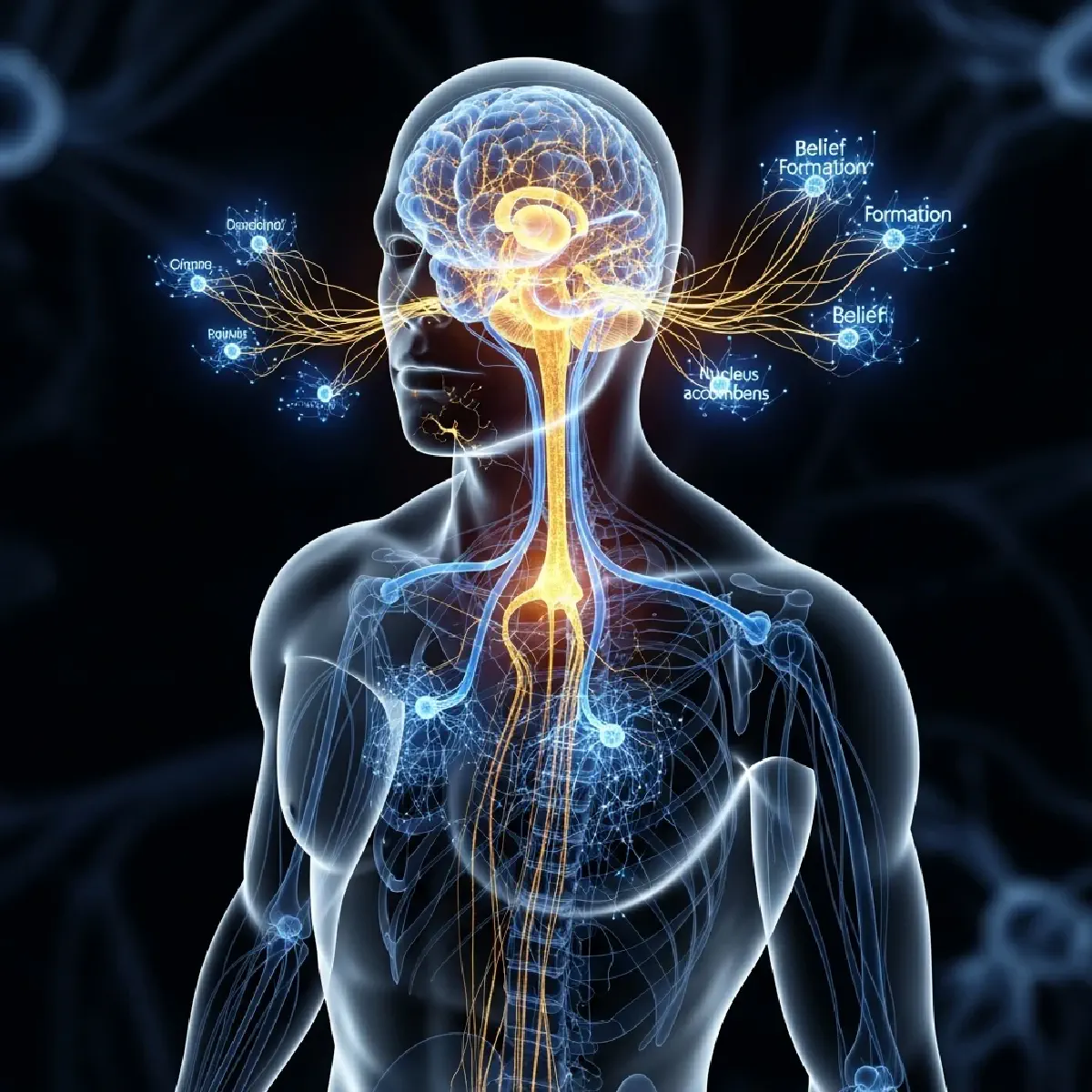
The Algorithm of Desire: Why We Are Wired to Be Swindled#
Imagine that you have just made a major decision—say, choosing an expensive new car or committing to a particular investment portfolio. After the choice is finalized, you feel a distinct surge of certainty; your belief in the correctness of the decision improves significantly, irrespective of any new evidence. This visceral conviction, which often flies in the face of objective facts or sound reason, presents a profound psychological paradox. Why does the human mind, ostensibly dedicated to logic and truth, so often prioritize emotional comfort and self-justification when assessing reality? The answer lies in recognizing that our deepest convictions are not born of pure thought but are rather the computational output of ancient, powerful biochemical systems. These systems evolved not to find truth in the abstract but to ensure survival by guiding the organism toward agreeable states and away from danger. When reason and feeling clash, the emotional engine of the mind invariably wins, making the brain highly receptive to emotional manipulation and persuasion.
The Emotional Compass: Defining the Default Logic of the Mind#
The central claim is that conviction is predominantly the result of hardwired, biochemical algorithms designed for immediate survival, not truth-seeking, thereby rendering the brain easily manipulated. These non-conscious decision engines operate through fixed action patterns, turning the complex human experience into an easily executable program. This inherent wiring defines the emotional landscape of political and commercial success, where campaigns compete effectively in the marketplace of emotions, leaving the domain of dispassionate ideas perpetually undersold. Our conscious capacity for deliberation is merely a “thin veneer” covering primitive neural structures that guide our most profound motivations. Understanding this fundamental architectural choice—the biological imperative to feel good—is essential to grasping why we are often persuaded against our better judgment.
From Neural Circuits to Predictive Belief#
Foundation & Mechanism: The Biochemistry of Agreement#
At the deepest level, emotions are quantifiable algorithms that are absolutely vital for survival and reproduction across all mammals. The brain itself functions as a calculator, converting variables and probabilities (such as risk vs. reward) into felt sensations. When an animal seeks food or social status, the brain generates agreeable sensations of excitement or bliss to drive effort. Conversely, unpleasant sensations signal risks to be avoided. This dynamic creates a powerful mechanism for control, demonstrating that emotional conviction can be scientifically reduced to reinforcing a neural pathway.
In laboratory studies with rats, scientists successfully connected electrodes to reward centers, enabling the animals to generate sensations of excitement simply by pressing a pedal. Faced with a choice between pressing the pedal or eating tasty food, the rats continuously chose the pedal until collapsing from hunger and exhaustion. This dramatically illustrates that biological survival itself can be secondary to the reward circuit. By extension, the state has a clear interest in regulating this biochemical pursuit of happiness, separating “bad” manipulations (like criminal drug use) from “good” manipulations (like psychiatric drugs for soldiers) that strengthen political stability and social order.
In human political judgment, this principle surfaces as motivated reasoning, a psychological process where information is warped to reach emotionally satisfying conclusions. A study of committed political partisans showed that when confronted with emotionally threatening contradictions about their preferred candidate, specific neural circuits produced distress. However, reasoning circuits quickly engaged to eliminate this conflict, not by using logical reflection, but by recruiting beliefs that rationalized the contradictions away. Crucially, once partisans arrived at their desired—though false—conclusions, reward circuits turned on, delivering a jolt of positive reinforcement for their biased thinking. The brain actively bribes us to maintain convictions that feel good, giving new meaning to the term “political junkie”.
The Crucible of Context: Consistency and the Aversion to Thought#
The tendency toward emotionally derived convictions is amplified by psychological needs that discourage conscious deliberation. One fundamental psychological mechanism exploited by influence professionals is the compulsive human need to be, and appear, consistent with prior choices and commitments. Once a stand is taken, powerful personal and interpersonal pressures arise to behave consistently with that original commitment, often overriding clear self-interest. A key advantage of this automatic consistency is that it acts as a shield against thought, allowing people to evade the “real labor of thinking”.
For compliance professionals, the “click, whirr” mechanism—a mechanical, unthinking response triggered by a minimal cue—is a gold mine. The trigger for activating this powerful internal mechanism is commitment. This is why simple, inconsequential replies to a superficial inquiry (e.g., admitting one feels “fine” in response to “How are you feeling?”) can trap individuals into later compliance, particularly if declining would make them appear inconsistent or stingy. The temptation is not intellectual; it is the instinctive urge to protect one’s self-image and avoid internal dissonance.
The modern environment compounds this vulnerability. As our lives become saturated with intricate stimuli, we are increasingly forced to rely on mental shortcuts and automatic patterns, enhancing our reliance on these emotional default settings. This environment fosters political campaigns that successfully manage emotional associations—a realm where logic is secondary to feelings of trust, values, and shared identity. The failure to integrate reason and emotion, or the inability to reconcile conscious logic with deep-seated feeling, exposes individuals to being steered by external forces that are experts in human emotional vulnerability.
Cascade of Effects: The Automation of Political Identity#
When political appeals successfully tap into these emotional mechanisms, the result is the profound polarization and rigidity of political beliefs seen in contemporary democracies. The political brain is an emotional brain, and high partisans are remarkably effective at letting their emotions overrule their rational judgments, often showing virtually no cognitive constraint in their belief systems. This emotional rigidity explains why providing facts alone often fails: if facts do not fit a preexisting neural frame in the brain, the frame remains intact, and the facts are ignored or dismissed.
The consequences of successfully manipulating these systems extend to the foundation of political success, where candidates are judged not on policy but on character, trust, and shared values. Successful political leaders understand that emotion provides the “fuel” that drives moral actions, and they create narratives that frame their core moral principles using evocative, emotional language. For instance, narratives that frame issues in terms of care, responsibility, and empathy activate strong progressive moral systems, appealing directly to the voter’s gut sense of what is right.
Conversely, when one side cedes the emotional narrative—allowing the opposition to define core terms like “values” or “character”—the emotional infrastructure of public opinion shifts against them. The failure of Democrats to contest issues like abortion and security on moral grounds allowed Republicans to successfully brand themselves as the party of strong values, reinforcing their position even among voters whose economic self-interest should have dictated otherwise. The entire process culminates in a struggle over whether human decisions are free choices or predictable computational outcomes subject to biochemical rigging, ultimately positioning the manipulation of core psychological functions as essential to maintaining social order and commercial profit.
Trading Autonomy for Certainty#
The human preference for convenience, emotional comfort, and the elimination of cognitive labor makes us acutely susceptible to the political and commercial exploitation of our own minds. Our convictions, which we perceive as expressions of free will, are often the logical and quantifiable result of electrochemical processes optimizing for immediate emotional satisfaction. This predictability challenges the core liberal humanist ideal that the individual self is the ultimate source of meaning and authority. When external algorithms can calculate, design, and potentially outsmart our feelings, the concept of individual freedom over our own choices becomes heavily challenged.
The convergence of cognitive science and technology means that human minds, previously considered a mysterious “black box,” are increasingly exposed as an assemblage of predictable biochemical mechanisms. This knowledge empowers those who seek total certainty—whether governments seeking social order or surveillance capitalists seeking guaranteed commercial outcomes—to manipulate the very essence of human behavior through precise, non-conscious appeals. If we wish to protect the integrity of autonomous choice, we must first accept the difficult truth that our current beliefs are often merely products of well-meaning neural wiring designed for survival, not necessarily truth, and we must persistently apply awareness to transcend our biological defaults.