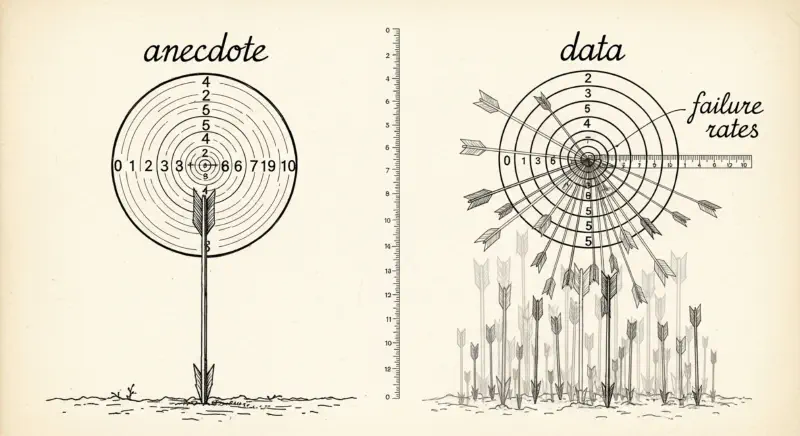
Imagine standing in an open field, watching a woman draw a bow. She releases the arrow, and it strikes the absolute center of the target. A perfect bullseye. You are impressed. You might even conclude that she is a master of her craft. But before you crown her a champion, you must ask one question. How many times did she miss? If that single bullseye was preceded by nine hundred and ninety-nine arrows that flew into the dirt, your conclusion changes instantly. In the world of logic, a single data point is not proof. It is an anecdote. And anecdotes are where sound reasoning goes to die.
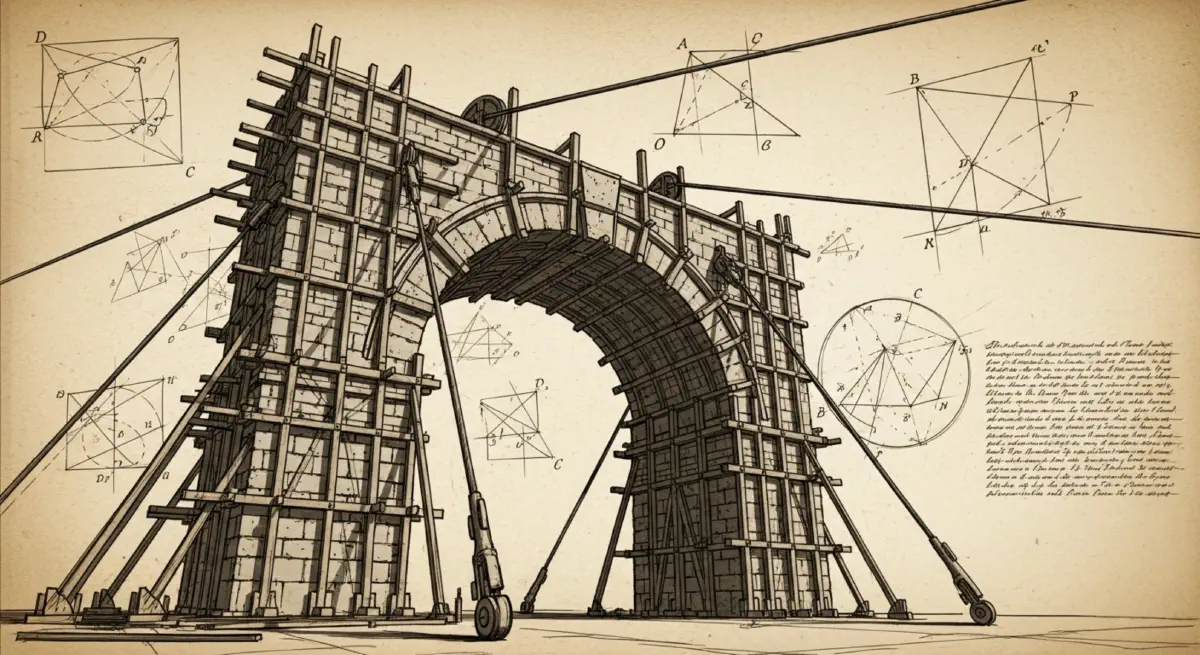
This is the central lesson of Anthony Weston and his work on the structure of arguments. We often treat arguing as a verbal battle, a contest of wills where the goal is to flatten an opponent. But a true argument is a process of inquiry. it is a way of finding out which views are better than others. It is the mechanism by which we test our own beliefs and, if we find them wanting, discard them for something more durable. To do this well, we need a set of rules. Not to constrain our thinking, but to give it teeth.
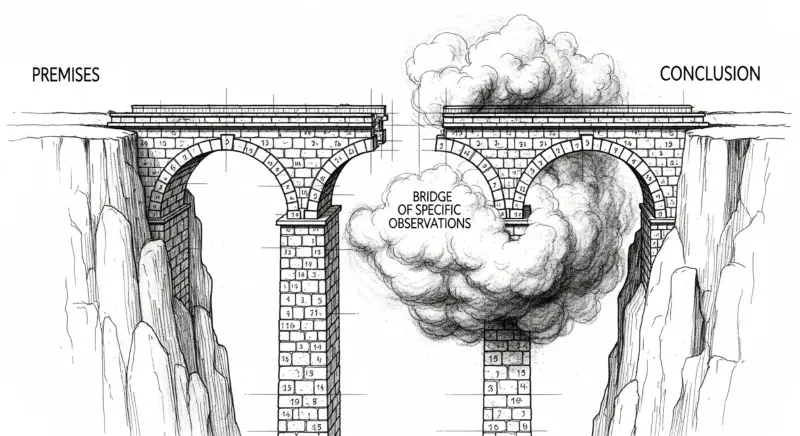
An argument begins with two distinct parts that must never be confused. the premise and the conclusion. The conclusion is the statement for which you are giving reasons. The premises are the statements that provide those reasons. This sounds elementary, but the failure to distinguish them is the primary cause of intellectual fog. If you say that the world is due to moral defects as much as a lack of intelligence, you have made a claim. But unless you follow it with the specific observation that progress only happens when we improve intelligence because we have no reliable method for teaching virtue, you have not made an argument. You have merely made an assertion.
To make an argument land, you must present your ideas in a natural order. You can put the conclusion first, followed by your reasons, or set out your premises first and draw the conclusion at the end. Either way, the listener must never have to guess where they are in the journey. If you jump from a premise about the cost of education to a conclusion about global trade without a bridge, you lose the listener. You are asking them to do the work that you, the speaker, should have done.
Every argument is only as strong as its starting point. This brings us to the rule of reliable premises. If your premises are weak, your conclusion will be weak, no matter how flawless your logic is. If you start with the premise that nobody in the world today is really happy, you have already lost. That claim is almost certainly false, and if your entire case rests on it, the case collapses before it begins. You must start with what is known, or at least with what is widely agreed upon.
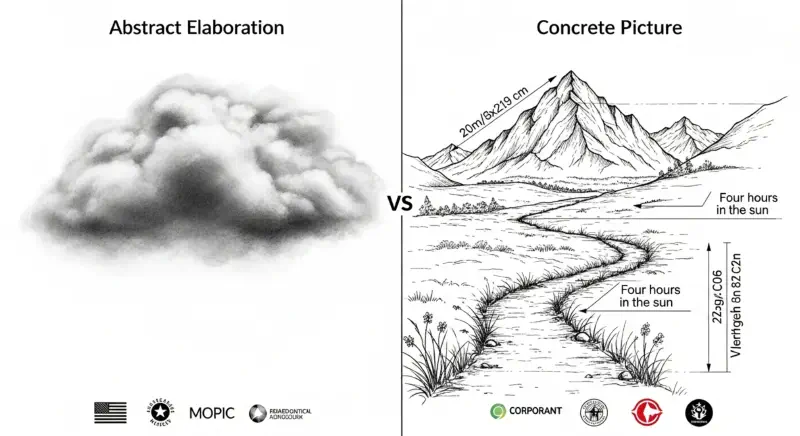
In this process, language is your greatest tool or your greatest obstacle. Precision is mandatory. We are often tempted to use abstract, vague terms to make ourselves sound more authoritative. We say an extended period of laborious exertion when we mean we hiked for four hours in the sun. The abstract phrasing is a fog. The concrete phrasing is a picture. You must be concrete and concise. Airy elaboration does not add depth; it only adds weight.
Similarly, you must build on substance, not overtone. It is easy to use loaded language to win a point. Calling an opponent a cold-blooded bureaucrat or a radical extremist does not prove they are wrong. It only proves you have a vocabulary of insults. Loaded language is a form of cheating. It tries to force a conclusion through emotion rather than earning it through evidence. If you cannot make your case using neutral, descriptive terms, you do not have a case. You have a grudge.
Once you have the structure, you must consider the evidence. Most of our arguments rely on examples, but a single example is rarely enough for a generalization. If you want to prove that the sun always rises in the east, one morning is not enough evidence. You need a series of mornings. For a large generalization, you need a representative sample. If you only look at the habits of your three closest friends, you cannot claim to know anything about the habits of twenty million people.
This is where background rates become crucial. This is the archery example again. To know if a success is significant, you have to know the rate of failure. If you hear that a specific vitamin helped two people recover from a cold, that sounds promising. But if you find out that those two people were part of a group of ten thousand, the vitamin looks like a statistical fluke. You must always ask: out of how many? Precision in numbers makes an argument credible. Saying only three thousand people survived is fundamentally different from saying thousands died. One is a data point; the other is a vague impression.
We also use analogies to bridge the gap between what we know and what we are trying to prove. An argument by analogy moves from one specific example to another. We might argue that because a team of doctors works together to save a patient, a team of architects should work together to design a hospital. The strength of the analogy depends on the relevance of the similarity. A doctor and an architect are both professionals, but the stakes of their work and the nature of their collaboration are different. If the similarity is superficial, the analogy fails. To succeed, the analogy requires a relevantly similar example.
When we cannot observe a phenomenon directly, we turn to authority. We cite experts. But not all experts are created equal. An informed source is not just someone with a degree; it is someone who has the specific data and the current standing to speak on the topic. A Nobel laureate in physics is not necessarily an authority on the best way to raise children. Furthermore, sources must be impartial. If a study on the health benefits of sugar is funded by a soda company, the source is compromised. You must cross-check sources. If every expert in the field agrees, you are on solid ground. If they disagree, the only honest position is to reserve judgment.
One of the most complex areas of reasoning involves causes. We see two things happening together and we assume one caused the other. This is the classic trap of correlation. For instance, ice cream sales and shark attacks both increase during the summer. If you were a purely correlational thinker, you might conclude that eating ice cream causes shark attacks, or that shark attacks make people crave ice cream. Both are absurd. The common cause is the heat. People buy ice cream when it is hot, and they go swimming when it is hot. Correlated events are not necessarily related. They may have a common cause, or it might be a case of the chicken and the egg, where either of two events could cause the other.
To prove causation, you must explain how the cause leads to the effect. You must propose the most likely cause and rule out the alternatives. If a student fails an exam, the cause could be a lack of study, a difficult test, or a distracting environment. To find the truth, you have to weigh these possibilities and see which one holds up under scrutiny. Causes are almost always complex. Rarely is there a single, isolated trigger for a major event.
This brings us to the formal heart of logic. deductive arguments. Unlike the arguments we have discussed so far, which deal with probabilities, deductive arguments aim for certainty. If the premises are true, the conclusion must be true. This is the realm of the syllogism. The most famous form is known as modus ponens. If p then q. P is true, therefore q is true. For example, if it is raining, the ground is wet. It is raining. Therefore, the ground is wet. This is simple, but it is the foundation of all rigorous thought.
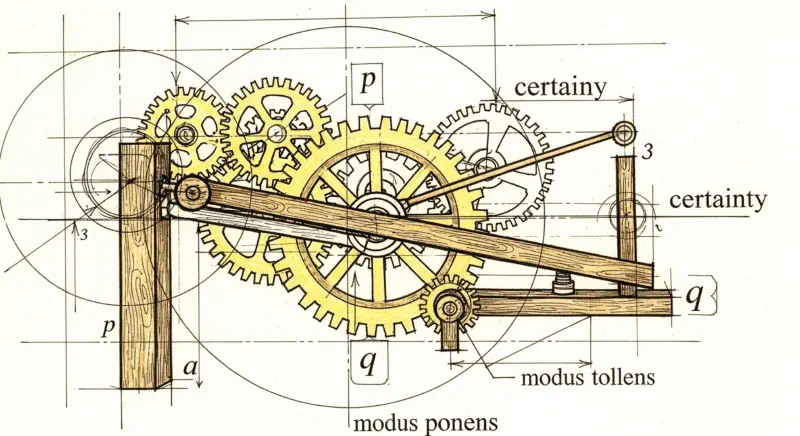
Then there is modus tollens. If p then q. Not q is true, therefore not p is true. If the ground is not wet, then it cannot be raining. This is the logic of the detective. It allows us to rule out possibilities with absolute precision. We also have the hypothetical syllogism, which chains ideas together. If p then q, and if q then r, then if p then r. This is how we build long-range predictions. If a trade war leads to higher tariffs, and higher tariffs lead to a recession, then a trade war leads to a recession.
But even with these tools, we often fall into traps known as fallacies. The most common is the ad hominem attack, where you attack the person rather than the argument. If a doctor tells you to stop smoking, and you respond by pointing out that the doctor also smokes, you have not proven that smoking is healthy. You have only pointed out a hypocrisy that has no bearing on the medical facts.
Another trap is the appeal to ignorance. This is the claim that because something has not been proven false, it must be true. We have no proof that there are no ghosts, therefore ghosts exist. This is a failure of logic. The absence of evidence is not evidence of absence. Similarly, we must avoid the false dilemma. This is the attempt to force a choice between two extremes when other options exist. You are either with us or you are against us. This ignores the vast middle ground of neutrality or partial agreement.

As you move from short arguments to extended ones, such as an essay or a public debate, the rules do not change, but the stakes do. You must explore the arguments on all sides of the issue. This is not just a matter of fairness; it is a matter of strength. If you do not understand your opponent’s best points, you cannot hope to answer them. You must question and defend every premise. You must be willing to revise and rethink your argument as new evidence emerges.
In a public setting, the goal is not to win, but to reach out to your audience. You must signpost your argument, telling the listener exactly where you are and where you are going. You must offer something positive. It is easy to tear down an idea, but much harder to build one up. At the very least, you must be civil. Manners are not just social niceties; they are the oil that allows the machinery of public discourse to function without grinding to a halt.
An argument is not a static object. It is a living process. It requires us to be fully present, to connect with our audience, and to respect the intelligence of those we are trying to persuade. We must end not with a summary, but with a diagnostic claim. A conclusion that has been earned through the hard work of reasoning.
Ultimately, the ability to argue well is the ability to think well. It is the refusal to be led by emotion or by the easy consensus of the crowd. It is the commitment to a standard of truth that is higher than our own convenience. When we master the rules of argument, we do more than just win debates. We develop the capacity to change our own minds, which is the only true mark of an educated person. The weight of an argument is not measured by the volume of the speaker, but by the density of the evidence. It is a quiet, persistent force that, over time, can move the world. In a culture of noise, the most revolutionary act is to be clear.
References#
Weston, A. (2009). A rulebook for arguments (4th edition). Hackett Pub.