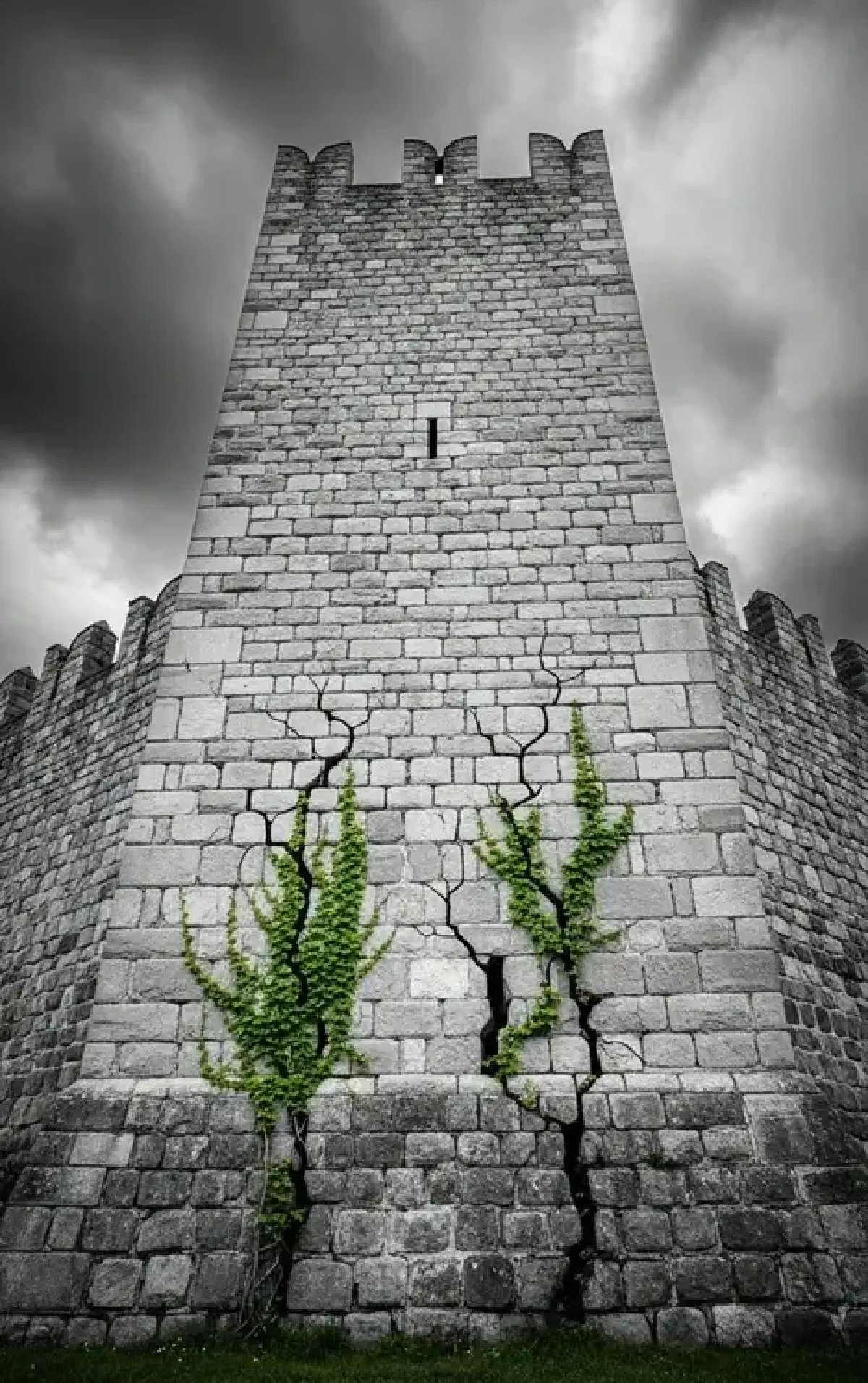
The Tower That Bankrupted a Kingdom#
In 1174, King William I of Scotland, known as “the Lion,” was captured by English forces at the Battle of Alnwick. To secure his release, he signed the Treaty of Falaise, which effectively made Scotland a feudal vassal of England. The English king, Henry II, then embarked on a monumental project to cement this new reality: the construction of a vast stone castle at Dumfries, a permanent garrison to dominate the Scottish lowlands. Contemporary chronicles note the castle’s construction consumed a staggering portion of the English treasury. The stone itself was an announcement: our power is unshakeable, permanent. Yet within 15 years, the financial and administrative strain of maintaining this network of coercive fortifications, coupled with Scottish resistance, led Henry’s successor to quash the treaty in return for a large, one-time payment. The stone had proven less durable than gold.
The rise and fall of Dumfries Castle encapsulates the third mechanism: coercion. This is the arithmetic of asymmetric strength, where one party can impose its will directly through the threat or application of force, bypassing negotiation and deception. It is the most primal and visually definitive form of power—the wall, the army, the law backed by a prison. Yet the story of the castle reveals its fundamental paradox: the very act of demonstrating and maintaining coercive power is exhaustingly expensive. Force is not just a tool; it is a continuous drain on resources, attention, and legitimacy.
The Thesis: Coercion as a High-Overhead, Diminishing-Returns Enterprise#
Coercion is the default when power asymmetry is vast and obvious. It provides the clearest, most immediate control. However, its efficiency is a mirage. Every application of force consumes capital—financial, human, and social—and generates resistance, requiring ever more investment in surveillance, suppression, and fortification. While it can seize territory or compel obedience, it is notoriously poor at generating willing cooperation, innovation, or loyalty. Thus, coercive power carries a hidden depreciation curve; its costs tend to escalate while its benefits diminish, often pushing the powerful to seek less expensive alternatives, like exchange or deception, to maintain their position.
The Machinery of Direct Control#
The Foundational Equation: Imposing Costs to Shape Behavior#
At its core, coercion works by credibly threatening to impose costs that outweigh the benefits of defiance. Sociologist Max Weber defined the state by its “monopoly on the legitimate use of physical force.” This definition contains the two critical components: capability (the monopoly of force) and legitimacy (the perceived right to use it). Pure coercion exists when capability is divorced from legitimacy—a mugging, a military occupation. Its mechanism is straightforward: alter the target’s cost-benefit analysis through fear. Political scientist Robert Dahl distilled power as the ability to get B to do something B would not otherwise do.
The infrastructure required to sustain this is immense. It includes standing armies, police forces, prisons, surveillance networks, and judicial systems. The financial burden is quantifiable. The United States, for instance, spends over $800 billion annually on its military and another $130+ billion on federal law enforcement and incarceration. For a coercive enterprise like a criminal syndicate, the overhead includes weapons, payments to enforcers, and losses from interdiction by state forces. This overhead must be continuously funded by extracting value from the controlled population, through taxes, tribute, or plunder, which itself can fuel resentment and increase the need for coercion—a vicious cycle.
The Complicating Sands of Resistance and Legitimacy#
Coercion’s efficiency is eroded by two relentless forces: the ingenuity of resistance and the necessity of legitimacy. History shows that dominated populations are not passive. They engage in everyday forms of resistance—foot-dragging, sabotage, cultural preservation—detailed by scholar James C. Scott. They can also spark full-blown rebellions where the cost of suppression can bankrupt the coercor, as the American Revolution did to Britain. The mathematics of insurgency are particularly punishing for the strong; a defender must be everywhere, always, while the insurgent need only succeed occasionally.
This is why even the most authoritarian regimes invest heavily in manufacturing legitimacy—the belief that their rule is right or inevitable. Propaganda, ritual, and the co-option of religion or ideology are attempts to lower the constant overhead of pure force by convincing at least a portion of the population to comply willingly. This is where coercion blends with deception. However, when the gap between propaganda and lived experience grows too wide, legitimacy evaporates, and the regime must fall back on increasingly naked and costly force, as seen in the collapse of the Eastern Bloc in 1989.
The Cascading Costs to Society and Innovation#
A society optimized for coercion pays a steep price in stunted development. Economist Mancur Olson contrasted “stationary bandits” (coercive rulers who plunder but have a long-term interest in keeping their “hostage” population productive) with “roving bandits” (who simply loot and move on). Even the more “enlightened” stationary bandit, however, stifles the conditions for growth. Coercion kills trust, the essential lubricant for complex market exchange and social cooperation. It diverts talent and capital from productive enterprise to security and suppression.
Case studies abound. The extractive institutions of colonial powers, designed to coercively pull resources from colonies, left behind economies ill-suited for independent growth. In the corporate world, a management culture rooted in fear and top-down diktat (coercion) reliably produces lower employee engagement, higher turnover, and less innovation compared to cultures fostering autonomy and exchange. Data from Gallup consistently shows that only 15% of employees globally are engaged at work; disengagement is often a silent form of resistance to perceived coercive control. The coercive system, in seeking to eliminate risk and dissent, systematically eliminates the very experimentation and voluntary cooperation that drive long-term resilience and prosperity.
The Iron Law of Enforcement#
The story of Dumfries Castle is universal. Coercion can build impressive edifices of control, but it mortgages the future to pay for the present. Its iron law is that enforcement costs are perpetual and tend to rise, while the returns are volatile and tend to fall. It is the mechanism of first resort for the uniquely strong, but it is also the most precarious and exhausting. This inherent instability is what drives the powerful, however reluctantly, to the negotiating table or the propaganda studio—to exchange and deception. In the end, pure force is unsustainable, a lesson written not only in abandoned castles but in the hollowed-out economies and broken social contracts of states that failed to learn it.