The Most Valuable Real Estate on Earth#
In the early 17th century, the Banda Islands—a small archipelago in what is now eastern Indonesia—were the center of the global economy. Not metaphorically. Literally.
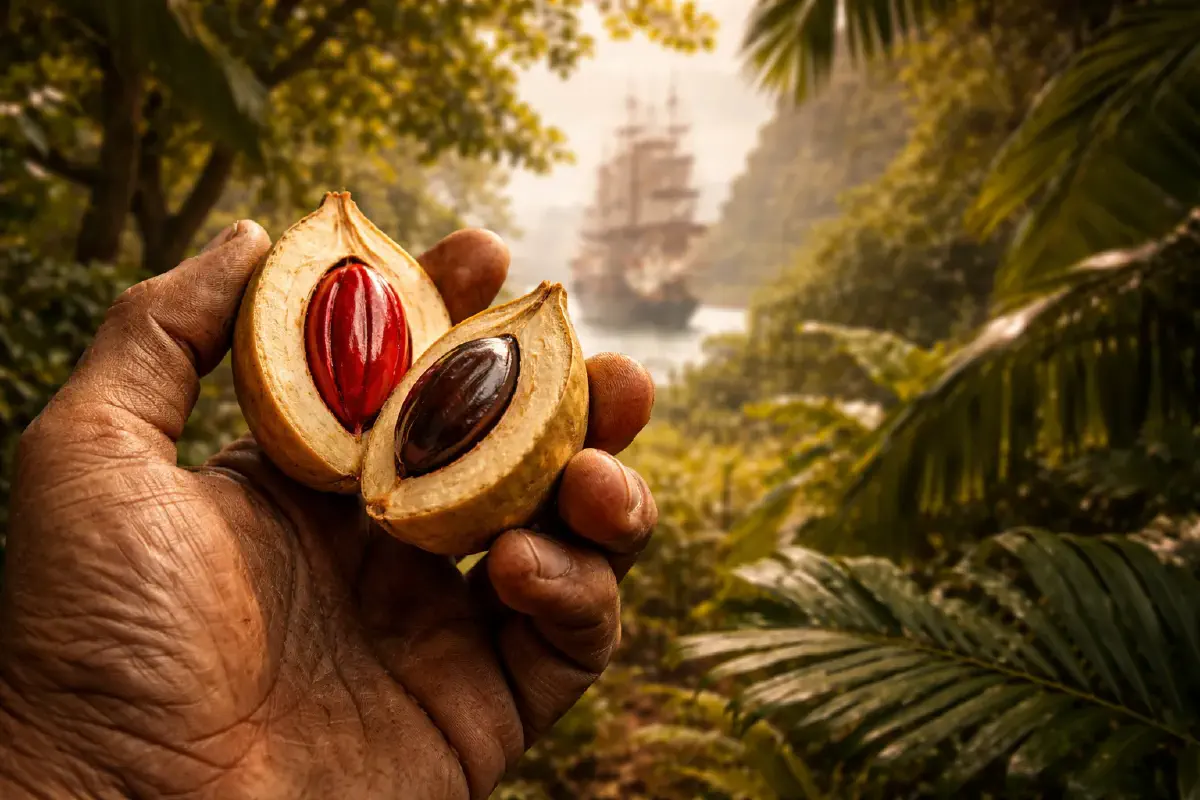
Nutmeg, native only to these volcanic specks in the Banda Sea, was worth more by weight than gold in European markets. A single pound of nutmeg could sell for 30 to 40 times its purchase price in the East Indies after transport to Amsterdam. The spice was not merely a luxury; it was a currency, a status symbol, and, in the medical understanding of the time, a prophylactic against plague.
The islands were remote. The journey from Europe took 12 to 18 months, circumnavigating Africa, crossing the Indian Ocean, threading through the Indonesian archipelago. The local Bandanese populations had controlled the nutmeg trade for centuries, maintaining intricate relationships with Javanese, Malay, and Chinese merchants while preserving their political independence through a decentralized structure of village orang kaya—literally “rich men”—who governed with consensus and managed the groves collectively.
When the Dutch East India Company—the Vereenigde Oostindische Compagnie, or VOC—arrived in the region in 1599, they encountered a system that had evolved over generations. The Bandanese were not naive or weak. They had negotiated with Portuguese, English, and local powers for decades. They understood the value of what they controlled. And they had no intention of surrendering it.
The Company That Was Not a Company#
The VOC was unlike any commercial entity that had existed before. Chartered by the Dutch States General in 1602, it was granted quasi-sovereign powers: the right to wage war, negotiate treaties, build fortifications, and administer territory. It was, in effect, a state in corporate form, with 76 million guilders in initial capitalization—more than the combined capitalization of all other European trading companies at the time.
Its mandate was monopoly. Not profit, in the conventional sense, but exclusive control over specific trade routes and commodities. The VOC’s business model was predicated on eliminating competition through force where negotiation failed. This was not mercantilism as theory; it was mercantilism as practiced.
The Bandanese understood the threat. When the VOC attempted to negotiate exclusive contracts in the early 1600s, the Bandanese refused, continuing to trade with English, Portuguese, and Asian merchants. The VOC’s response was not to improve terms but to escalate pressure. In 1609, they demanded that the Bandanese grant them a monopoly; when the Bandanese resisted, the Dutch murdered 40 village leaders in a surprise attack. The resistance that followed forced the VOC to withdraw temporarily.
But the Company did not abandon the objective. It changed its method.
The Turn Toward Internal Fracture#
Direct conquest of the Banda Islands was not feasible for the VOC in the early 17th century. The Company’s military resources were stretched across a vast geography, from the Moluccas to Java to the Coromandel Coast. The Bandanese, despite their decentralized governance, had demonstrated an ability to resist and coordinate across villages when threatened.
The Dutch solution was to work through intermediaries.
The English as an Entry Point#
The VOC’s primary European rival in the region was the English East India Company. In the Bandas, the English had established a presence on the island of Run, the only island not under VOC control after a series of campaigns. The competition between Dutch and English created a dynamic that the Bandanese attempted to exploit, playing one European power against the other to preserve their autonomy.
But the VOC recognized that the English presence also created vulnerabilities. The Bandanese who traded with the English were, from the Dutch perspective, breaking the monopoly that the VOC claimed. This conflict between local actors and external powers became a wedge.
The Role of Informants#
By 1620, the VOC had developed an intelligence network in the islands. The Company recruited Bandanese informants who provided details on village defenses, trade routes, and internal political divisions. These informants were not coerced; they were paid, often in goods or promises of protection.
The information they provided transformed Dutch operations. Landing points that had previously been defended could now be approached with precision. Resistance movements that might have coalesced were preempted through targeted strikes. The Bandanese leadership, which had relied on the complexity of the islands and the loyalty of their populations for security, found that complexity now worked against them.
The 1621 Catastrophe#
In 1621, Jan Pieterszoon Coen, the VOC’s Governor-General in the East Indies, launched a campaign to bring the Banda Islands under full control. Coen was not a man given to half measures. He had previously ordered the massacre of the Banda island of Lonthor’s inhabitants in 1621 after a campaign of brutal conquest, and he applied the same logic to the remaining islands.
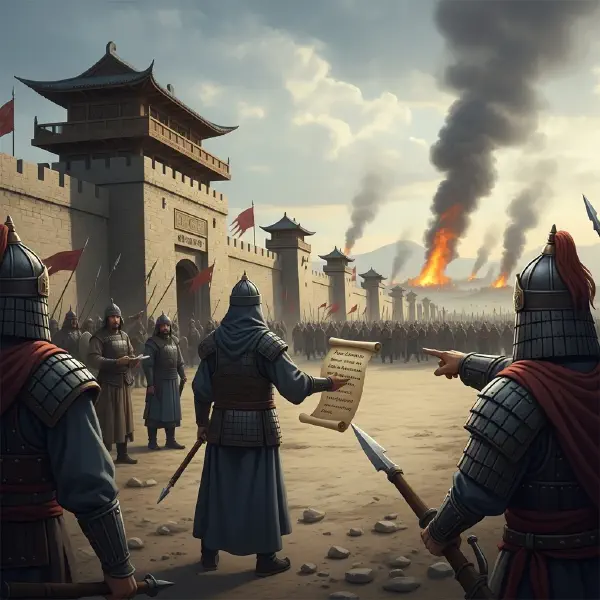
The campaign was methodical. The VOC assembled a force of 1,900 soldiers and sailors, supported by local auxiliaries from neighboring islands who had their own grievances against the Bandanese. With intelligence from informants, the Dutch moved systematically through the islands, destroying villages, seizing nutmeg groves, and capturing or killing the orang kaya.
The scale of the violence was staggering. Contemporary accounts suggest that approximately 90% of the Bandanese population—perhaps 15,000 people—were killed, enslaved, or fled the islands. The survivors, numbering perhaps 1,000, were resettled as forced laborers in the nutmeg groves, now owned by the VOC.
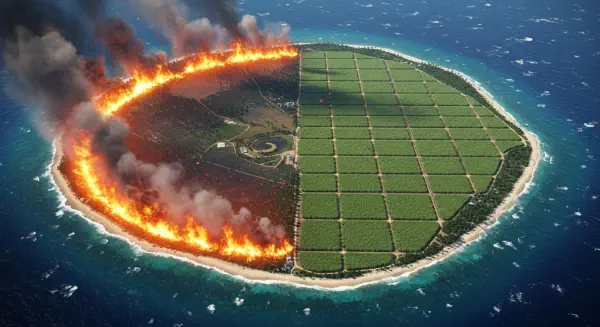
The islands were restructured as a perkenier system—plantations controlled by Dutch settlers who managed the labor of enslaved and indentured workers. The nutmeg trade, once controlled by a decentralized network of Bandanese villages, became a monopoly enforced by military occupation.
The Structural Anatomy of Conquest#
The fall of the Banda Islands is often narrated as an act of colonial brutality—which it was. But it is also a case study in how internal division enables external conquest.
The VOC did not defeat the Bandanese through superior force in open battle. The Company’s military advantage was real but not overwhelming; the Bandanese had demonstrated their capacity to resist in the previous decade. What changed was the informational environment.
With informants providing intelligence, the Dutch could target their violence with precision. They could strike when and where resistance was weakest. They could exploit preexisting tensions between villages—tensions that had existed for generations but had been managed through the consensus-based governance system. The orang kaya who collaborated with the Dutch were not traitors in the abstract; they were actors responding to a strategic environment in which collaboration offered survival and resistance offered annihilation.
The Economics of Defection#
The Bandanese case also reveals the economic calculus that underlies betrayal in many contexts. The informants who worked with the VOC were not ideologically aligned with Dutch colonialism. They were individuals—often from less powerful families or villages—who saw in the Company’s advance an opportunity to shift local power dynamics.
This is a recurring pattern: external actors do not create divisions out of nothing. They amplify and weaponize divisions that already exist. The Bandanese system, for all its sophistication, contained internal hierarchies and rivalries. The VOC’s intelligence network identified and exploited these fractures.
The Aftermath: A System Transformed#
The conquest of the Banda Islands did not merely transfer control of the nutmeg trade from one set of hands to another. It restructured the entire society. The decentralized governance, the communal control of land and groves, the complex trade relationships with Asian merchants—all of it was destroyed and replaced with a system of plantation labor, military enforcement, and monopoly pricing.
The VOC’s monopoly lasted for more than 150 years, generating enormous profits for the Company and its shareholders. The nutmeg that had been a source of wealth for the Bandanese became a source of wealth for Amsterdam. The islands themselves were transformed into a colonial possession, their original population reduced to a small remnant.
The English, who had maintained a presence on Run until forced out in 1621, did not forget. In 1667, the Treaty of Breda formally ceded Run to the Dutch in exchange for the Dutch surrendering their claim to a small, swampy island on the other side of the Atlantic: Manhattan.
Beyond Banda: A Pattern of External Exploitation#
The Banda catastrophe is not an isolated historical event. It reflects a broader structural dynamic that repeats across contexts and centuries.
External actors seeking control over a territory or resource rarely succeed through direct force alone. They require internal knowledge: of terrain, of social divisions, of economic flows, of political vulnerabilities. That knowledge is often provided by individuals within the target system who have their own reasons for cooperating.
The pattern is consistent:
- An external power identifies a target with resources worth controlling
- Direct confrontation proves costly or ineffective
- The external power cultivates internal informants or allies
- Intelligence enables precision targeting and asymmetric dominance
- The target system fragments, unable to coordinate resistance
- Conquest or control follows
At each step, the role of internal actors is not incidental. It is decisive.
What the Banda Case Reveals#
The Banda Islands did not fall because their people were weak or their defenses inadequate. They fell because external power gained internal visibility. Once the VOC understood the islands’ social geography as well as its physical geography, resistance became impossible to sustain.
This is the deeper lesson: geography and military capability provide only partial protection. The true line of defense is social coherence—the willingness of individuals within a system to resist rather than collaborate with external actors. Where that coherence is strong, external powers face a hostile environment in which every potential informant is a risk and every military operation is blind. Where coherence is weak, the external power navigates the system as easily as its own territory.
The Banda catastrophe demonstrates that conquest is often less about breaking walls than about walking through doors that someone else has opened.