

The previous three parts have traced a grim continuity: from colonial plantations to Mexico’s IMMEX program to the special economic zones of Vietnam, Bangladesh, Ethiopia, and beyond. In each case, foreign capital gains access to cheap labour, tax breaks, and unrestricted profit repatriation, while the host country receives low‑wage jobs but little industrial deepening. This is not development; it is extraction.
Yet the story is not inevitable. A handful of countries – most notably South Korea, Taiwan, and China – have successfully used FDI as a tool for technological catch‑up rather than as an end in itself. Their experience shows that the terms of engagement with foreign capital can be rewritten. This final part distills the lessons of the East Asian developmental state and offers a practical roadmap for countries that wish to reject the plantation model.
The East Asian Counter‑Example: Conditional FDI#
South Korea, Taiwan, and China each pursued different strategies, but they shared a common philosophy: FDI must serve national industrial goals, not the other way around.
🇰🇷 South Korea: The Anti‑FDI Model#
From 1962 to 1983, South Korea actively restricted inward FDI, preferring foreign loans and turnkey plants that could be paid off and then owned outright. When FDI was allowed, it came with strict performance requirements: local content, export targets, and technology transfer. The result was the rise of the chaebol (Samsung, Hyundai, LG) – nationally‑owned conglomerates that mastered imported technologies and then became global innovators. By 2000, South Korea’s R&D spending exceeded 3% of GDP, with 80% financed by the private sector.
🇹🇼 Taiwan: Selective Absorption with State Power#
Taiwan opened its economy more than South Korea, but always under state supervision. Foreign investment applications required mandatory prior approval, with a negative list of prohibited sectors. The government founded the Industrial Technology Research Institute (ITRI) and later spun off TSMC, creating the world’s dominant semiconductor foundry model. To this day, Taiwan enforces an “N‑1” rule – foreign fabs must keep their most advanced processes on the island, with overseas facilities lagging by at least one generation. Technology leakage is a criminal offence.
🇨🇳 China: Market for Technology#
China’s strategy was the most aggressive in leveraging market size. For decades, foreign companies were forced into joint ventures with local partners as the price of accessing the Chinese market. Technology transfer agreements were mandatory and had to be submitted for state approval. Local content requirements – particularly in autos, electronics, and telecoms – forced foreign firms to source components locally, building up domestic supply chains. While China has since softened explicit requirements, critics argue that “induced” technology transfer remains the de facto price of entry.
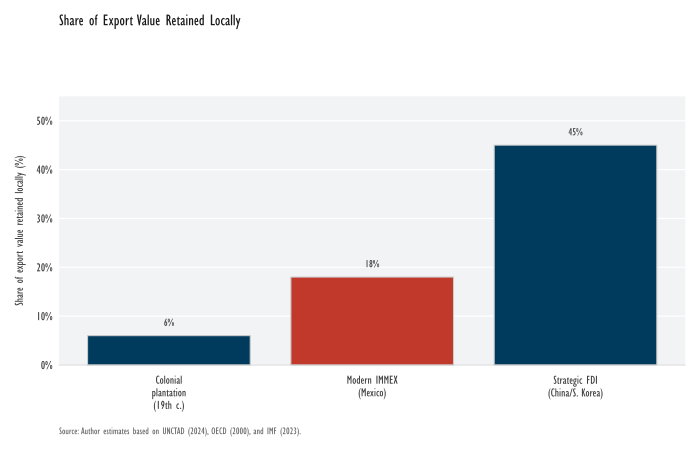
The payoff of these strategies is visible in Figure 1. While Mexico’s IMMEX retains only 18% of export value locally, China and South Korea have achieved retention rates of 45% or higher – because domestic firms capture more of the value chain, and profits are reinvested rather than repatriated.
The Enabling Factor: A Strong Developmental State#
Why have so few countries replicated the East Asian model? The answer lies not in culture or geography, but in state capacity and political will. A developmental state must be able to:
- Say no to footloose investors that offer only low‑wage assembly.
- Enforce contracts and performance requirements on powerful multinationals.
- Invest patient capital in education, R&D, and infrastructure without expecting immediate returns.
- Coordinate policy across trade, industry, finance, and labour – avoiding the fragmentation that allows investors to play one ministry against another.
Most developing countries today lack these capabilities. Their FDI policies are designed not by industrial ministries but by investment promotion agencies whose sole metric is the volume of inflows. Tax holidays and wage suppression are easier to implement than building a domestic supplier base or funding a national science foundation. The plantation model persists because it is politically convenient – at least in the short term.
A Policy Roadmap for Rejecting the Plantation#
Escaping the plantation model does not mean rejecting FDI entirely. It means changing the terms under which FDI is admitted. The following measures, drawn from the East Asian playbook and adapted to contemporary legal and political constraints, offer a starting point.
1. Mandatory Local Content Requirements#
Foreign investors should be required to source a rising share of components and services from domestic suppliers. This creates backward linkages, builds local industrial capacity, and raises the value retained in the country. The WTO’s Agreement on Trade‑Related Investment Measures (TRIMs) prohibits certain local content requirements, but exceptions exist for developing countries, and many measures can be designed as voluntary incentives rather than explicit mandates.
2. Technology Transfer Agreements#
No foreign firm should be allowed to operate in strategic sectors (autos, electronics, pharmaceuticals, renewables) without a legally binding technology transfer plan. This can take the form of joint R&D, training of local engineers, licensing of patents on fair terms, or the establishment of local design centres. China’s experience shows that technology transfer can be induced even without explicit legal compulsion.
3. Reinvestment Requirements#
A portion of profits – say, 30% – should be required to be reinvested locally for a minimum period. This prevents the immediate repatriation of earnings and aligns the foreign investor’s interest with the host country’s long‑term growth. Reinvestment can be directed toward R&D, worker training, or local supplier development.
4. Progressive Taxation, Not Blanket Holidays#
Tax holidays are a race to the bottom. Instead, offer a standard corporate income tax with accelerated depreciation for reinvestment, and tax credits for local sourcing, training, and R&D. This rewards behaviour that benefits the host economy rather than simply rewarding the act of locating there.
5. Strong Labour Protections and Collective Bargaining#
Low wages are not a comparative advantage; they are a policy choice. Countries should enforce minimum wages that rise with productivity, strengthen trade unions, and extend labour protections to all workers in export zones. Higher wages force firms to invest in automation and skills, which raises productivity – a virtuous cycle.
6. Strategic State Enterprise and R&D Investment#
No country has industrialised without active state investment in strategic industries. This means patient capital for national champions, public research institutes that collaborate with private firms, and mission‑oriented procurement (e.g., renewable energy, electric vehicles, semiconductors). The state must be willing to pick winners – and also to phase out support when industries mature.
7. Capital Account Management#
Unrestricted profit repatriation is a choice, not a law of nature. Countries can impose withholding taxes on dividends, require minimum retention periods, or use capital controls to manage outflows during balance‑of‑payments crises. Ethiopia’s 15% tax on repatriated profits (2025) is a small but significant step.
Conclusion: The Plantation Can Be Dismantled#
The colonial plantation was not abolished by the goodwill of plantation owners; it was abolished by slave revolts, anti‑colonial movements, and ultimately by political action that changed the rules of the game. The modern FDI plantation is no different. It persists because it is profitable for the few and politically convenient for the many. But the East Asian experience proves that an alternative exists.
The choice for developing countries today is stark: continue competing to offer the cheapest labour, the longest tax holidays, and the weakest regulations – or build the state capacity to impose conditions on foreign capital, reinvest profits at home, and gradually climb the value chain. The plantation model delivers jobs. The developmental state delivers prosperity.
The figures in this series have quantified the extraction. The policies outlined here show the way out. Now the question is political will.
End of series.