

The modern enthusiasm for Foreign Direct Investment (FDI) in developing countries often overlooks a troubling historical precedent. Before the era of global supply chains and special economic zones, there was the colonial plantation system. For centuries, European powers established enclave economies in Asia, Africa, and the Americas designed for one purpose: extraction.
This first part of our series reconstructs the economic logic of the colonial plantation and shows how its core features – foreign ownership, resource extraction, cheap labour, minimal local linkages, and profit repatriation – have been replicated in today’s FDI‑driven models.
The Anatomy of a Plantation Economy#
The classic colonial plantation was not a market transaction between equals. It was a legally and militarily enforced system where land, labour, and capital were mobilised to produce a single cash crop (sugar, rubber, cotton, or coffee) for export to the colonising power. Key characteristics included:
- Foreign ownership – Plantations were owned by absentee companies or settlers, with no local equity participation.
- Land appropriation – Indigenous land rights were extinguished, and the best land was reserved for export agriculture.
- Coerced or ultra‑cheap labour – Enslaved labour, indentured workers, or forced cultivation systems kept wages at subsistence.
- Minimal value addition – Crops were processed only as needed for transport; refining and manufacturing happened in the metropole.
- Profit repatriation – The vast majority of revenues flowed back to the colonial power, financing its industrialisation.
- Enclave infrastructure – Ports, railways, and roads were built to connect the plantation to the export harbour, not to integrate the local economy.
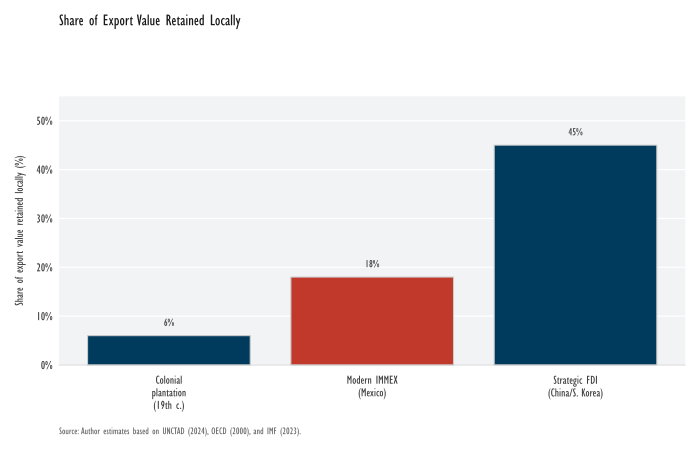
A quantitative estimate of how little value remained locally is telling. Historians of the Dutch Cultivation System in Indonesia (1830–1870) calculate that less than 6% of the export value stayed in the colony; the rest was transferred to the Netherlands. This is the baseline of the “extraction ratio.”
Labour: The Engine of Extraction#
Low labour costs were the plantation’s core competitive advantage. Then as now, wages were set not by productivity but by the need to undercut competing colonies. The British‑run sugar plantations in the Caribbean, after emancipation, relied on indentured labourers from India paid a fraction of what a British farmworker earned. This gap was not a temporary market outcome; it was a policy choice designed to maximise surplus extraction.
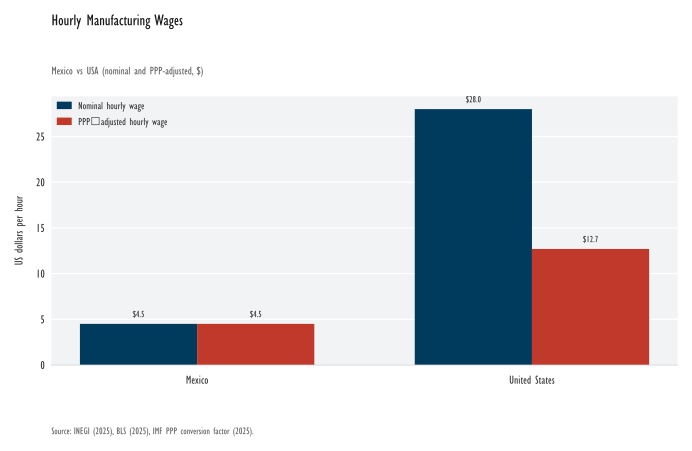
In the modern context, the wage gap between a host country and the investing country’s home market is often even wider. Figure 2 compares hourly manufacturing wages in Mexico (the largest IMMEX host) and the United States. The nominal gap is staggering: US$4.50 vs. US$28.00. Adjusting for purchasing power parity (PPP) – i.e., what that wage can actually buy in each country – the US advantage shrinks but does not disappear. A Mexican worker effectively earns the equivalent of a PPP‑adjusted US wage of US$12.70 per hour, still more than double the local wage. This residual gap is the modern “rent” extracted by the foreign investor.
Profit Repatriation: The Invisible Drain#
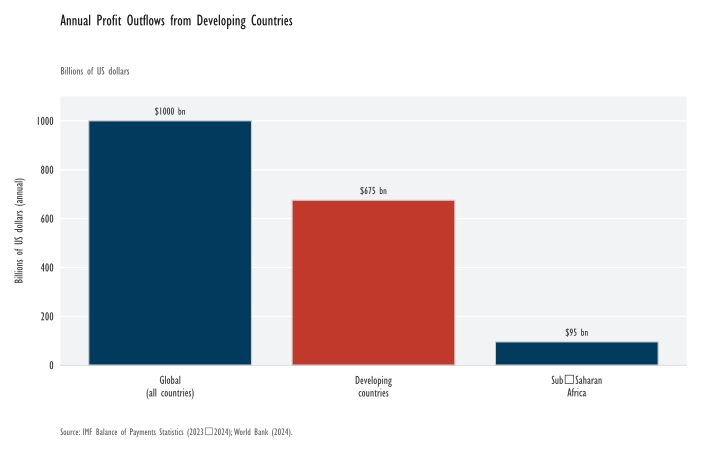
The ultimate measure of extraction is where the money ends up. Modern balance‑of‑payments statistics allow us to track the outflow of primary income – profits, dividends, and interest – from host to home countries. Globally, multinational corporations repatriate an estimated US$1 trillion annually** in dividends. For developing countries as a group, outflows amount to roughly **US$675 billion per year. Sub‑Saharan Africa, despite being a net recipient of FDI, loses about US$95 billion annually in profit repatriation and debt service.
These figures are not natural or inevitable. They are the direct result of policy choices: no restrictions on profit transfers, weak reinvestment requirements, and tax treaties that favour the home country.
Conclusion: The Blueprint Has Not Changed#
The colonial plantation was not a development strategy; it was an extraction strategy. Its modern descendants – the IMMEX maquiladoras, the special economic zones of Bangladesh and Vietnam, the industrial parks of Ethiopia – share the same DNA: foreign ownership, cheap labour, minimal local linkages, and unrestricted profit repatriation. The next part of this series will examine how the Mexican IMMEX program has perfected this model for the 21st century.
Next: Part II – The Modern IMMEX Model: The Plantation Reborn