
The FDI Plantation: How Foreign Investment Became the New Colonialism – and How to Escape It
The Argument in Brief#
Foreign Direct Investment (FDI) is often celebrated as a shortcut to development. But for many developing countries, the reality resembles an old colonial plantation: foreign‑owned enclaves extract cheap labor, land, and tax breaks, while profits flow back to wealthy home countries. Local economies receive low‑wage jobs but little industrial deepening.
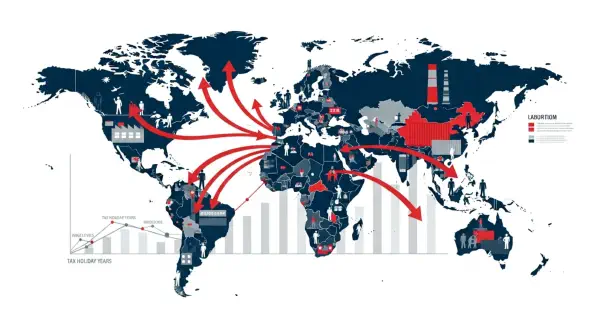
This article summarizes a four‑part investigation into the modern FDI plantation – from Mexico’s IMMEX program to the special economic zones of Vietnam, Bangladesh, and Ethiopia – and draws lessons from the few countries (South Korea, Taiwan, China) that successfully imposed conditions on foreign capital. The conclusion is clear: FDI is not a development strategy; it is a tool. Used passively, it replicates colonial extraction. Used strategically, it can build national prosperity.
1. The Colonial Blueprint – Extraction by Design#
The colonial plantation (19th‑century sugar, rubber, cotton) was an enclave economy designed to transfer value to the metropole. Its features:
- Foreign ownership, no local equity.
- Land appropriation and coerced or ultra‑cheap labor.
- Minimal local value addition – processing done abroad.
- Profit repatriation – less than 6% of export value remained in the colony.
- Infrastructure (ports, railways) built only to serve the enclave.
The takeaway: The plantation was never meant to develop the host economy. It was an extraction machine.
📖 For a deeper dive, see Part I: The Colonial Blueprint – with historical data on profit outflows and wage gaps.
2. The Modern Sequel – Mexico’s IMMEX Program#
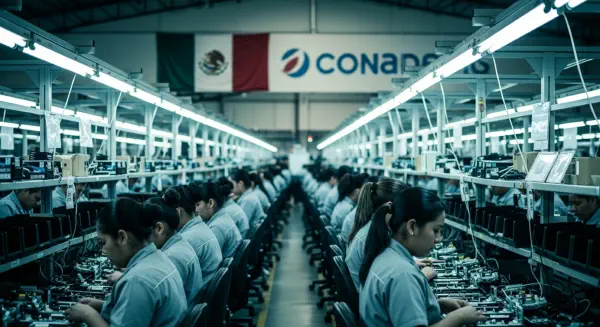
Mexico’s IMMEX (maquiladora) program, launched in 2006, is the plantation reborn. Over 3,000 plants employ 1 million workers, assembling goods for export to the US.
Key parallels:
- Foreign ownership – US, Japanese, German multinationals control IP, supply chains, and branding.
- Low wages – Mexican manufacturing wage: ~$4.50/hour vs. US $28.00/hour. Even after adjusting for living costs (PPP), US workers retain a large surplus.
- Low local retention – Only about 18% of export value stays in Mexico. The rest leaves as imported inputs, royalties, and profit repatriation.
- Tax holidays – Generous breaks reduce fiscal contribution.
- Profit repatriation – Estimated $15+ billion annually leaves Mexico – nearly half of total FDI inflows.
The takeaway: IMMEX delivers jobs but locks Mexico into low‑wage assembly, with minimal technology transfer or industrial upgrading.
📖 For a deeper dive, see Part II: The Modern IMMEX Model – with wage gap charts and profit outflow data.
3. The Global Plantation – Nine Countries, One Pattern#
The same model has spread across Asia, Africa, and Latin America. We examined nine countries:
| Country | Monthly Wage (USD) | Tax Holiday (years) | 2025 FDI Inflows (est.) |
|---|---|---|---|
| Ethiopia | $65 | 2‑7 | $3.5 bn |
| Bangladesh | $200 | up to 10 | $1.6 bn |
| Cambodia | $210 | up to 9 | $5.2 bn |
| Sri Lanka | $200 | 25 | ~$1.5 bn |
| Honduras | $399 | variable | maquila: $1.5 bn FX |
| Pakistan | $150‑200 | preferential | $100m (single SEZ) |
| Vietnam | $350 | 4‑9 | $27.5 bn |
| Indonesia | $300‑400 | 10‑20 | $4.2 bn |
| Philippines | $300‑400 | 4‑7 | $3.8 bn |
Common features:
- All allow unrestricted profit repatriation (Ethiopia’s 15% tax is a rare exception).
- Longer tax holidays correlate with lower wages (Figure 5 in the full series).
- Labour rights are weak; the ITUC ranks Bangladesh among the 10 worst countries for workers.
- Local linkages are minimal; most high‑value components are imported.
Globally, developing countries lose an estimated $675 billion annually to profit repatriation – a modern form of tribute.
📖 For a deeper dive, see Part III: The Global Reach – with country‑by‑country breakdowns and data on tax holidays vs. wages.
4. The Escape – Conditional FDI (South Korea, Taiwan, China)#
The plantation model is not inevitable. Three East Asian economies showed how to use FDI as a tool for catch‑up.
South Korea (1960s‑1980s)#
- Heavily restricted FDI, preferring foreign loans and turnkey plants.
- When FDI was allowed, required local content, export targets, and technology transfer.
- Nurtured chaebol (Samsung, Hyundai) that became global innovators.
- R&D spending rose to >3% of GDP, 80% private.
Taiwan#
- Mandatory prior approval for all foreign investment, with a negative list.
- Created ITRI and spun off TSMC, dominating semiconductors.
- Enforces an “N‑1” rule – most advanced processes stay on the island.
China#
- Forced joint ventures and mandatory technology transfer as price of market access.
- Local content requirements built domestic supply chains (autos, electronics).
- Result: local value retention estimated at 45% – more than double Mexico’s 18%.
The common factor: A strong, autonomous developmental state that could impose conditions on foreign capital and invest patient resources in R&D, education, and national champions.
📖 For a deeper dive, see Part IV: The Path Forward – with a detailed policy roadmap and the role of state capacity.
5. A Policy Roadmap for Rejecting the Plantation#
Developing countries do not have to accept the race to the bottom. The following measures, drawn from East Asian practice, can reorient FDI toward genuine development.
| Policy | What it does |
|---|---|
| Local content requirements | Forces foreign firms to source locally, building domestic supply chains. |
| Technology transfer agreements | Legally binding plans for joint R&D, training, patent licensing. |
| Reinvestment requirements | Mandates a portion of profits be reinvested locally for a minimum period. |
| Progressive taxation | Replace blanket tax holidays with accelerated depreciation and credits for local sourcing, R&D, training. |
| Strong labour protections | Enforce minimum wages that rise with productivity; strengthen collective bargaining. |
| Strategic state investment | Patient capital for national champions; public research institutes; mission procurement. |
| Capital account management | Withholding taxes on dividends, minimum retention periods, or controls during crises. |
The bottom line: These policies require political will and state capacity. They are not easy – but the alternative is permanent dependency.
Conclusion: From Plantation to Prosperity#
The modern FDI plantation is a choice, not a destiny. Countries that compete only on low wages and tax breaks will remain at the bottom of the global value chain. Those that build the institutional strength to impose conditions on foreign capital – as South Korea, Taiwan, and China did – can turn FDI into a ladder for industrial upgrading.
The evidence is clear. The tools are known. What is needed now is the political courage to use them.
Further Reading & Data Sources#
All figures, country‑level data, and full references are available in the detailed parts of this series:
- Part I: The Colonial Blueprint – Historical profit outflows, extraction ratios.
- Part II: The Modern IMMEX Model – Mexico wage gaps, PPP adjustments, profit repatriation.
- Part III: The Global Reach – Nine country case studies, tax holiday vs. wage scatter plot.
- Part IV: The Path Forward – East Asian conditional FDI, policy roadmap.
Primary data sources (APA format, working URLs in the full series appendix):
- IMF Balance of Payments Statistics (2023‑2024)
- UNCTAD World Investment Report 2025
- ILO Global Wage Report 2024‑2025
- INEGI (Mexico), BLS (US)
- Country investment agency reports (Vietnam, Cambodia, Ethiopia, etc.)
- ITUC Global Rights Index 2025
This single article is a summary of a longer investigation. For full methodology, data tables, and references, please consult the four detailed parts.
References#
Bosma, U. (2019). The Making of a Periphery: How Island Southeast Asia Became a Mass Exporter of Labor. New York: Columbia University Press. https://doi.org/10.1093/ahr/rhac270 (American Historical Review book review, September 2022)
Démurger, S. (2000). Economic Opening and Growth in China (OECD Development Centre Studies). Paris: OECD Publishing. https://ebooks.mpdl.mpg.de/ebooks/Record/EB000319654
Government of Pakistan. (2012). Special Economic Zones Act 2012. Islamabad: Government of Pakistan. https://documents1.worldbank.org/curated/en/585181583852150750/txt/Assessment-of-Special-Economic-Zones-in-Pakistan-Suggesting-Steps-Towards-Improved-Performance.txt
Government of the Philippines, Philippine Economic Zone Authority (PEZA). (2025). GET THE PEZA ADVANTAGE. http://www.peza.gov.ph/
Government of Sri Lanka. (2025, September 22). Sri Lanka overhauls Port City incentives. Daily Mirror. https://www.dailymirror.lk/
International Labour Organization (ILO). (2024). Global Wage Report 2024-25: Is wage inequality decreasing globally? Geneva: ILO. https://www.ilo.org/publications/flagship-reports/global-wage-report-2024-25-wage-inequality-decreasing-globally
International Labour Organization (ILO). (2025). Direct Request (CEACR) – Honduras. NORMLEX. https://normlex.ilo.org/dyn/normlex/en/f?p=NORMLEXPUB:13100:0::NO::P13100_COMMENT_ID:4413703
International Monetary Fund (IMF). (2024). Balance of Payments Statistics: Profit Repatriation Data. Washington, D.C.: IMF.
Organization for Economic Co-operation and Development (OECD). (2000). Main Determinants and Impacts of Foreign Direct Investment on China’s Economy. Paris: OECD Publishing. https://ebooks.mpdl.mpg.de/ebooks/Record/EB000319654
Parnreiter, C., Steinwärder, L., & Kolhoff, K. (2024). Uneven Development through Profit Repatriation: How Capitalism’s Class and Geographical Antagonisms Intertwine. Antipode, 56(6), 2343-2367. https://doi.org/10.1111/anti.13089 (Q1 journal)
United Nations Conference on Trade and Development (UNCTAD). (2025). World Investment Report 2025. Geneva: UNCTAD. https://unctad.org/news/global-foreign-investment-drops-again-dire-consequences-development-unctad-chief
United Nations Conference on Trade and Development (UNCTAD). (2025). Global Investment Trends Monitor (No. 48, January 2025). Geneva: UNCTAD. https://unctad.org/publications/global-investment-trends-monitor-no-48
World Bank. (2024). Changing Foreign Direct Investment Dynamics and Policy Responses: White Paper for Japan’s G7 Presidency. Washington, D.C.: World Bank Group. https://katalog.slub-dresden.de/id/0-1906679148
World Bank. (2019). The Rise of Special Economic Zones in Bangladesh: Key issues and challenges. Washington, D.C.: World Bank Group. https://openknowledge.worldbank.org/server/api/core/bitstreams/3bf695e9-9003-5a31-9f7b-0d0e09fa96fd/content
Zebregs, H. (2001). Foreign Direct Investment and Output Growth in China. IMF Working Paper (forthcoming). Washington, D.C.: International Monetary Fund.
World Bank. (2024, March 29). Egypt: Extended Fund Facility Arrangement. U.S. Department of State. https://2021-2025.state.gov/
UNCTAD. (2025, June 19). Morocco FDI Jumps 55% in 2024, Reaching $1.6 Billion. https://en.hespress.com/98588-fdi-in-morocco-jumps-by-55-in-2024-reaching-1-6-billion-unctad.html
INEGI (National Institute of Statistics and Geography, Mexico). (2025). IMMEX Program Statistics (via Mexico Daily Post). https://mexicodailypost.com/2025/08/26/tariffs-drive-job-losses-at-mexicos-border-factories/
Bank of Namibia. (2025, May 18). Namibia Bleed FDI Profits in Excess of N$9 Billion. https://nambusinessexpress.com/
The American University in Cairo. (2025, November 10). The FDI Illusion: How Egypt’s Investment Zones Fall Short of Real Growth. https://aps.aucegypt.edu/
Bosma, U. (2022). The Making of a Periphery: How Island Southeast Asia Became a Mass Exporter of Labor. https://academic.oup.com/
EurekAlert. (2019, May 14). Colonial policies can result in economic growth (Dutch Cultivation System). https://www.eurekalert.org/news-releases/732684
Fasseur, C. (n.d.). The Development of the Cultivation System from 1840 to 1860. (No URL provided)
Vietnam News. (2025, December 11). NA allows HCMC to establish free trade zone. https://english.thesaigontimes.vn/na-allows-hcmc-to-establish-free-trade-zone/
ASEAN Briefing. (2025, September 8). Profit Repatriation in Vietnam: Strategies for Investors. https://www.aseanbriefing.com/news/profit-repatriation-in-vietnam-strategies-for-investors/
ILO. (2025, September 18). First beneficiaries of Bangladesh’s pilot employment injury scheme from export processing zones notified. https://www.ilo.org/resource/news/first-beneficiaries-bangladeshs-pilot-employment-injury-scheme-export
Bangladesh Textile Journal. (2025, June 22). Bangladesh prepares to attract increased Chinese FDI. https://bangladeshtextilejournal.com/bangladesh-prepares-to-attract-increased-chinese-fdi/
Business & Human Rights Resource Centre. (2025, June 4). Bangladesh: Among 10 worst countries for 9th consecutive year, ITUC finds no guarantee for workers’ rights. https://www.business-humanrights.org/en/latest-news/bangladesh-among-10-worst-countries-for-9th-consecutive-year-ituc-finds-no-guarantee-for-workers-rights/
Cambodia Investment Review. (2026, February 2). Cambodia Attracts $5.2 Billion in FDI in 2025, China Accounts for Over 70% of Inflows. https://cambodiainvestmentreview.com/2026/02/02/cambodia-attracts-5-2-billion-in-fdi-in-2025-china-accounts-for-over-70-of-inflows/
Aquarii BD. (2025, November 28). Cambodia Investment Climate 2025: Growth and Policy Framework. https://aquariibd.com/cambodia-investment-climate-2025/
Manhattan SEZ. (2025, October 23). Cambodia Raises Minimum Wage to USD 210 — Steady Policy Strengthens Investor Confidence. https://www.manhattansez.com/news/cambodia-raises-minimum-wage-to-usd-210-steady-policy-strengthens-investor-confidence/
Hulunem. (2026, March 13). Capital Repatriation and Profit Remittance for Foreign Investors in Ethiopia. https://hulunem.com/capital-repatriation-and-profit-remittance-for-foreign-investors-in-ethiopia/
Friedrich-Ebert-Stiftung Ethiopia. (2025, May 14). Linking Global Frameworks to On-the-Ground Realities. https://ethiopia.fes.de/news-list/e/linking-global-frameworks-to-on-the-ground-realities
Hondurasensusmanos. (2026, January 12). Maquila generó $ 1,500 millones en divisas en 2025. https://www.hondurasensusmanos.info/maquila-genero-1-500-millones-en-divisas-en-2025
Guozun Law. (2025, December 4). 跨境投资企业在斯里兰卡经营的策略与实践. https://www.guozunlaw.com/article/sri-lanka-investment-strategies-2025
Daily Times. (2025, August 15). PM launches Chinese-led SEZ, welcomes $100m investment. https://dailytimes.com.pk/2025/08/15/pm-launches-chinese-led-sez-welcomes-100m-investment/
ASEAN Briefing. (2025, December 23). Indonesia’s Special Economic Zones and a Structural Shift. https://www.aseanbriefing.com/news/indonesias-special-economic-zones-and-a-structural-shift/
Triple i Consulting. (2025, March 27). PEZA Incentives. https://www.tripleiconsulting.com/peza-incentives/