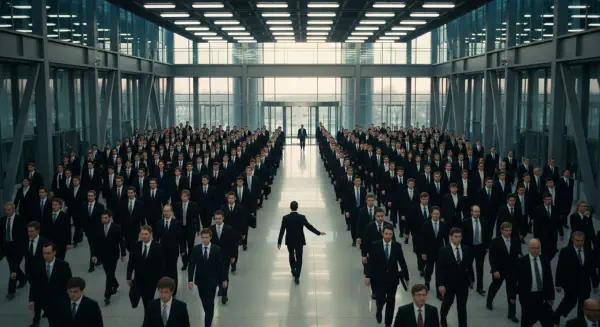
The Delusion Engine – Part 2: The Social Shortcut
·1578 words·8 mins
Investigates how group dynamics and environmental cues override individual logic and morality, from the Good Samaritan experiment to the replication crisis in priming research.

Asch, S. E. (1951). Effects of group pressure upon the modification and distortion of judgments. In H. Guetzkow (Ed.), Groups, leadership and men (pp. 177–190). Carnegie Press.
Darley, J. M., & Batson, C. D. (1973). “From Jerusalem to Jericho”: A study of situational and dispositional variables in helping behavior. Journal of Personality and Social Psychology, 27(1), 100–108.
Johansson, P., Hall, L., Sikström, S., & Olsson, A. (2005). Failure to detect mismatches between intention and outcome in a simple decision task. Science, 310(5745), 116–119.
Kahneman, D. (2011). Thinking, fast and slow. Farrar, Straus and Giroux.
Loftus, E. F., & Palmer, J. C. (1974). Reconstruction of automobile destruction: An example of the interaction between language and memory. Journal of Verbal Learning and Verbal Behavior, 13(5), 585–589.
Milgram, S. (1963). Behavioral study of obedience. Journal of Abnormal and Social Psychology, 67(4), 371–378.
Open Science Collaboration. (2015). Estimating the reproducibility of psychological science. Science, 349(6251), aac4716.
Tversky, A., & Kahneman, D. (1974). Judgment under uncertainty: Heuristics and biases. Science, 185(4157), 1124–1131.