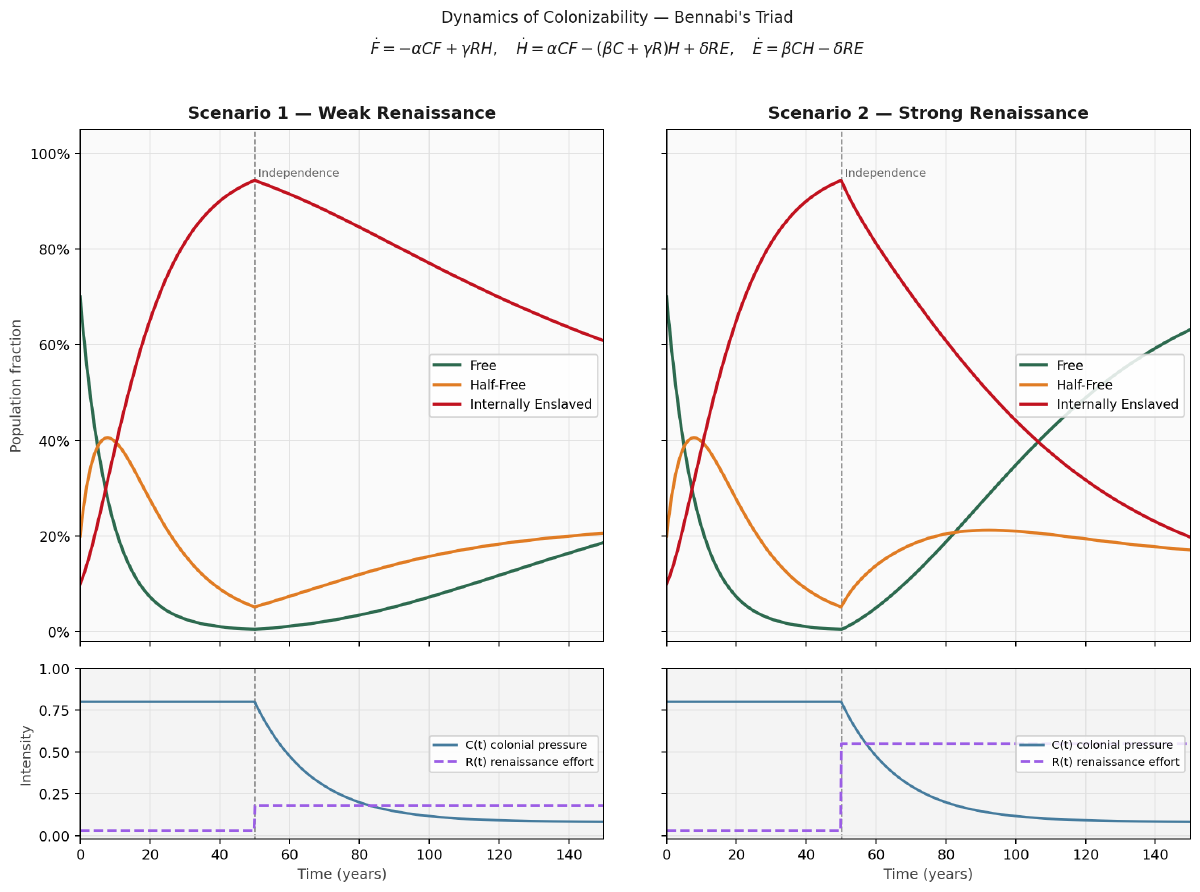
This article translates Malik Bennabi's concept of colonizability into a simple dynamical picture. It tracks how three psychological types — Free, Half‑Free, and Internally Enslaved — shift in proportion across a society over time, driven by two competing forces: the weight of colonial pressure and the depth of the inner work needed to escape it.
The three types#
Free souls (F)
People who have shed their colonizability. They are psychologically independent; they do not measure themselves by the coloniser's standards. They may be materially poor, but they are spiritually and culturally whole. They are not susceptible to the coloniser's value system.Half‑Free souls (H)
People caught in between. They recognise the injustice of colonialism but have also partly absorbed the coloniser's worldview. They imitate, they waver, they seek recognition from both worlds without fully belonging to either. They are vulnerable to both further assimilation and genuine renaissance, depending on which force is stronger around them. In the model they are a transient state — a crossroads, not a destination.Internally Enslaved souls (E)
People who have fully internalised the coloniser's worldview. They despise their own people, language, religion, and history. They need to believe in the coloniser's superiority because their entire self‑worth is built on borrowed values. They are the most colonisable and the hardest to reclaim. In the model they are the terminal sink of colonial pressure.
How people move between types#
Two external forces govern all transitions:
- Colonial pressure \(C(t) \in [0,1]\): the direct and indirect influence of the dominant power — laws, forced schooling in the coloniser's language, economic dependence, cultural prestige, media.
- Renaissance effort \(R(t) \in [0,1]\): the inner work of decolonisation — revival of faith, culture, language, authentic education, community organising; anything that rebuilds psychological independence from within.
The model allows four transitions, each proportional to the force driving it:
Free → Half‑Free at rate \(\alpha \cdot C\)
Colonial pressure slowly erodes even a free soul's wholeness through economic dependence and constant cultural bombardment.Half‑Free → Internally Enslaved at rate \(\beta \cdot C\)
If pressure continues and the half‑free person finds no authentic alternative, he slides further — adopting the coloniser's values as his own and beginning to despise his origins. This is the model's only one-way fall without any countervailing force.Half‑Free → Free at rate \(\gamma \cdot R\)
This is the path of healing. A strong renaissance effort — genuine education, spiritual revival, community solidarity — can pull the wavering person back toward psychological independence.Internally Enslaved → Half‑Free at rate \(\delta \cdot R\)
Even the internally enslaved can begin to recover, but it is the slowest and hardest transition. A sustained renaissance effort may bring them to a stage of initial questioning and ambiguity — the half‑free state — from which they might eventually progress further.
The core logic is directional: colonial pressure pushes people along the chain F → H → E; renaissance effort pulls them back along E → H → F. The net direction of change at any moment depends entirely on which force is stronger.
The formal model#
This logic translates into a system of three coupled differential equations. Let \(F\), \(H\), and \(E\) denote the fraction of the population in each type, with \(F + H + E = 1\).
\[ \begin{aligned} \dot{F} &= -\alpha\, C(t)\, F + \gamma\, R(t)\, H \\ \dot{H} &= \alpha\, C(t)\, F - \beta\, C(t)\, H - \gamma\, R(t)\, H + \delta\, R(t)\, E \\ \dot{E} &= \beta\, C(t)\, H - \delta\, R(t)\, E \end{aligned} \]The three right‑hand sides sum to zero, so the constraint \(F + H + E = 1\) is automatically preserved at every moment: no one enters or leaves the population, they only move between states.
Interpreting the model#
During colonisation (high \(C\), low \(R\)), the Free erode steadily. The Half‑Free grow initially — they accumulate as Free souls are displaced — but because \(C\) simultaneously drives them toward enslavement, they peak and then decline. The Internally Enslaved are the terminal sink: they grow throughout the colonial period and become the dominant type.
After formal independence, \(C\) drops but does not reach zero. Structural remnants of colonial pressure — economic dependency, inherited curricula, cultural prestige — persist at a lower level. What happens next depends entirely on \(R\):
- If renaissance effort is weak, the accumulated mass of Internally Enslaved barely moves. The Half‑Free recover slowly and the Free remain a small minority. The society is politically independent but psychologically colonised.
- If renaissance effort is strong, the Half‑Free begin migrating back toward Freedom in significant numbers. Even the Internally Enslaved start to thin, though their recovery takes decades longer than anyone else's. The direction of travel reverses.
Simulating two possible futures#
Scenario 1 — independence without serious inner work.
Colonial rule ends and direct pressure drops sharply, but the society invests little in cultural, spiritual, and educational renewal. The Internally Enslaved do shrink — but slowly, over generations. The Free recover only modestly. After a century of formal independence the Enslaved still constitute a large plurality. The society has changed its flag; it has not changed its psyche.
Scenario 2 — independence accompanied by a sustained renaissance.
The same end of formal colonisation, but now accompanied by a deliberate, sustained renaissance effort. The contrast is dramatic: the Free recover to a majority within living memory of independence, while the Internally Enslaved fall from dominance to a persistent minority. The Half‑Free serve as the active transit layer — rising briefly as the Enslaved begin to question themselves, then thinning as those same people continue the journey back toward freedom.
The crucial difference between the two scenarios is not the level of colonial pressure — that is identical — but the depth and duration of the inner work.
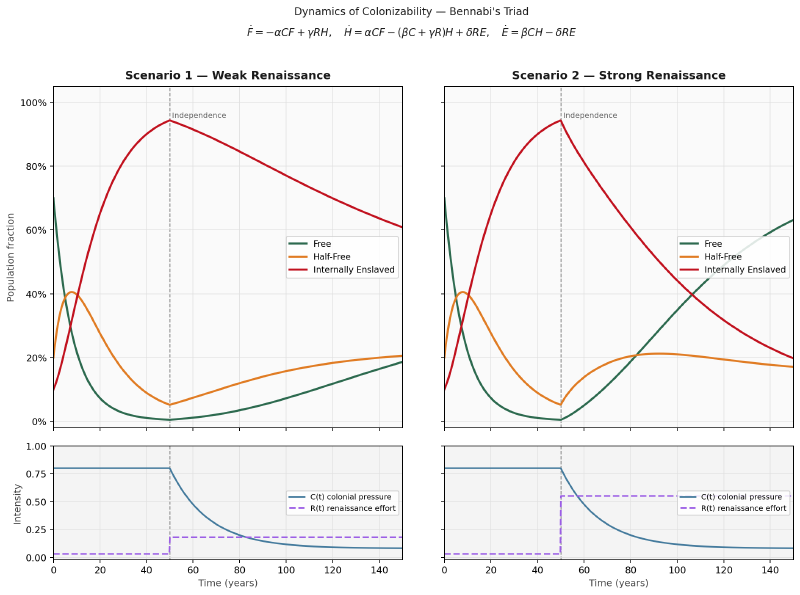
Political independence alone is not enough. The model makes this visible: without a sustained \(R(t)\), the distribution of psychological types changes very little even after many decades of formal freedom. The colonisability Bennabi diagnosed remains intact — now administered by natives, which makes it harder to see and harder to resist.
What the model deliberately leaves out#
The model is a toy, not a prediction machine. It omits countless real‑world complexities — class differences, generational transmission, economic forces, migration, post‑colonial neo‑imperialism — and reduces the entire civilisational project of decolonisation to a single "renaissance effort" variable. But its value is precisely this simplification: it isolates Bennabi's central thesis into a form that can be seen immediately.
Removing the coloniser is a necessary first step, but the real battle is fought inside the human being. That battle has its own logic, its own timescales, and its own conditions of victory — none of which follow automatically from the moment a flag is lowered.