I. Introduction#
In 1936, a colonial policeman in Moulmein, Lower Burma—an Englishman who hated his job and despised the Empire that paid his wages—found himself trapped in the most absurd dilemma of his career. A tame elephant had gone must and was rampaging through the bazaar. The locals expected him, the representative of imperial authority, to shoot it. He did not want to. But he was being watched. “The crowd would laugh at me,” he wrote later. “And my whole life, every white man’s life in the East, was one long struggle not to be laughed at.” So he raised his rifle. The elephant died slowly, in agony, and the policeman walked away not as a victor but as a hollow man who had just demonstrated, to himself above all, that the colonial apparatus owns the coloniser every bit as much as it owns the colonised.
That policeman was George Orwell, and the essay is “Shooting an Elephant.” It is a miniature masterwork on the psychology of domination, and it exposes a truth that most political writing about colonialism prefers to avoid: that colonialism is not merely a system of external control—it is an internal deformation. It remakes the soul before it redraws the map.
About two decades after Orwell’s Burmese episode, an Algerian engineer and social philosopher named Malek Bennabi sat down to write Les Conditions de la Renaissance (The Conditions of Renaissance), a book that has never received the audience it deserves outside the Muslim world. Bennabi was no Marxist, no nationalist firebrand, no apologist for tradition. He was something rarer: a diagnostician of the spirit. And his key insight was so simple, so brutal, that it is easy to understand why it has been quietly ignored by those who prefer their anti-colonialism to be a morality play with clean villains and spotless victims.
Bennabi coined the term colonisabilité—colonizability.
He meant something quite precise. Colonization, he argued, is not a political caprice; it is a historical fatality. “On ne cesse d’être colonisé qu’en cessant d’être colonisable,” he wrote: One does not stop being colonised except by ceasing to be colonisable. That is an immutable law. And the grave problem cannot be resolved by simple aphorisms, nor by more or less crude tirades, but by profound transformations of our being: each person must be readapted, little by little, to his social functions and to his spiritual dignity.
This is not victim-blaming dressed up as philosophy. Bennabi was perfectly clear that the coloniser bears moral responsibility for the violence, the theft, the humiliation. But he was also clear that a people who locate the entire source of their misery in the coloniser’s bayonet will never liberate themselves, even if every foreign soldier boards a ship and sails away. The wound is deeper. The wound is in the psyche. And the psyche, once colonised, does not heal merely because the flag changes.
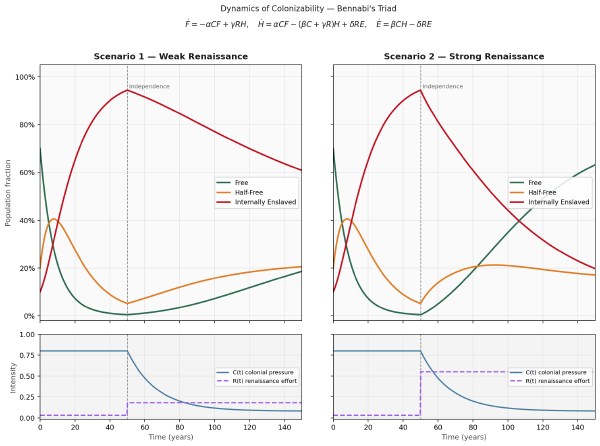
Reading Bennabi alongside Orwell, and alongside the great anti-colonial psychiatrists of the mid-twentieth century—Frantz Fanon, Albert Memmi, Aimé Césaire—a pattern begins to emerge. Colonialism does not produce one type of subject. It produces three. You can see them in every colonial photograph, in every memoir of the raj or the protectorate, in the faces that stare back from the old newsreels. And you can see them still, long after the formal empires have crumbled, in the parliaments, the universities, the markets, and the slums of the post-colonial world.
They are the Free, the Half‑Free, and the Internally Enslaved.
II. The Free#
Let us begin with the least understood, because the least theatrical.
The Free soul is the one who, in Bennabi’s language, has shed his colonisabilité. He is not necessarily the one who takes up arms. He may be a peasant who has never read a newspaper, or a woman who has never left her village. What distinguishes him is this: he does not measure himself by the coloniser’s yardstick. His sense of his own worth, his language, his faith, his way of being in the world—these remain his own, unapologetically, without the corrosive interior monologue that asks, Is this good enough? Is this modern? Is this what the French would do?
Bennabi called this figure “the man of nature” (l’homme de la nature). He is the raw material of civilisation, the one who still possesses what Bennabi described as the three primal resources of any infant society: the human being himself, the soil beneath his feet, and time—real, productive, purposeful time. The Free soul may be materially impoverished. He may be illiterate. He may be ignorant of the wider world in ways that the Western observer finds pathetic. But he has not surrendered the core of his being. He is not colonisable.
This is a hard idea for the modern mind to swallow, because we have been trained to equate freedom with loud, visible acts of rebellion. But the deepest resistance is often silent and almost invisible. Consider the Indian peasant who, during the Raj, continued to speak his own language at home, continued to observe his own religious rites, continued to organise his family life according to his own customs, and refused—simply refused—to adopt the manners, the dress, the tastes of the sahibs. He paid his taxes because he had to. He bowed when a white man passed because the alternative was a beating. But in the interior of his mind, the coloniser had no dominion.
Orwell, for all his sensitivity to colonial brutality, had difficulty seeing this type, because Orwell’s gaze was fixed unwaveringly on the visible—the suffering body, the filthy street, the starved donkey. In “Marrakech,” he wrote with undisguised horror about the poverty of the Moroccans, the way they seemed to him almost sub‑human in their degradation. What he could not see, because he was an Englishman peering in from the outside, was the inner life that persisted despite the degradation. He could see only that they lived like animals; he could not see that they did not think of themselves as animals. That is the difference that makes the Free soul free.
Fanon put his finger on something similar when he wrote in Black Skin, White Masks that the colonised person who has not internalised the coloniser’s values retains a kind of psychological wholeness. The tragedy, Fanon argued, begins with the first act of comparison—the moment when the colonised person begins to see himself through the eyes of the coloniser and finds himself wanting. The Free soul has not yet reached that moment. Or, having glimpsed it, he has turned away.
The enormous practical importance of this type is that he is the seedbed of genuine renaissance. When Bennabi dreamed of a reborn Islamic civilisation, he did not dream of it being built by the westernised urban elite, the lawyers and journalists who had learned to parrot the language of the Sorbonne. He dreamed of it being built by the peasant and the shepherd, once they had been given, not European things, but a living idea—a religious idea capable of organising their instincts, giving meaning to their time, and directing their labour toward a transcendent goal. That is what the Prophet of Islam achieved with the Bedouin of the Arabian Peninsula in the seventh century. That is what Bennabi believed could be achieved again.
III. The Half‑Free#
Bennabi’s second type is the most tragic, because he is caught exactly midway between liberation and surrender. Bennabi called him “the man of the half” or “the man of the little” (l’homme du peu).
He is the product of the colonial city. He has had some schooling, enough to read French but not enough to read profoundly. He has picked up the external manners of the coloniser—the hat, the cigarettes, the taste for certain kinds of music—without absorbing the intellectual discipline that underlies European achievement. His French is good enough to get him a job as a clerk or a minor functionary, but not good enough to write poetry. His Arabic has grown rusty. He is at home in neither culture.
The Half‑Free soul is a walking contradiction. He knows, at some level, that the colonial system is unjust and that he is its victim. But he also half‑believes the coloniser’s propaganda about the backwardness of his own people. He wants to be modern, but he does not know how to be modern without merely imitating the West. He wants to honour his tradition, but he has lost the key to understanding it. So he oscillates between a shallow, aggressive nationalism and a slavish admiration for Europe, never achieving the synthesis that would allow him to stand on his own feet.
This is the psychological type that Bennabi saw proliferating across the Islamic world in the mid‑twentieth century, and it has multiplied since. He is the reader of half‑digested political slogans. He is the consumer of bad films imported from Cairo or Hollywood. He is the student who can recite the names of French philosophers but cannot explain what any of them actually argued. He is the politician who speaks of “authenticity” while arranging for his children to be educated in Switzerland.
Fanon described him with clinical precision. The colonised intellectual, Fanon wrote, is the man who has internalised the coloniser’s values so thoroughly that he no longer knows who he is. He speaks the coloniser’s language, he wears the coloniser’s clothes, he adopts the coloniser’s tastes, and he looks upon his own people with a mixture of pity and contempt. Yet he cannot become the coloniser either, because the coloniser will never fully accept him. He is suspended in a void between two worlds.
Memmi, in The Colonizer and the Colonized, analysed this figure under the heading of the colonised who attempts to assimilate. The coloniser, Memmi argued, holds out the promise of assimilation as a permanent temptation—become like us and you will be accepted—but the promise is a lie. No matter how well the colonised person learns French, no matter how many diplomas he earns, no matter how many European habits he adopts, he will always be, in the eyes of the coloniser, an indigène playing dress‑up. And the tragedy is that, in trying to become what he cannot become, he has lost what he was.
The Half‑Free soul is politically dangerous precisely because of his inner confusion. He is the natural recruit for what Bennabi called “the half‑solution,” the political compromise that changes the names of things without changing their substance. He is the one who fills the committee rooms after independence, who writes the new constitution in the language of the old coloniser, who runs the ministries in the manner he learned as a junior clerk under the French. The flag is new, but the habits of mind are unchanged. The coloniser has left, but the colonisability remains.
IV. The Internally Enslaved#
And then we come to the type that most infuriated Bennabi and that must preoccupy anyone who takes the problem of mental decolonisation seriously: the person who is not merely colonised from without but has become a colony from within.
This is the collaborator in the fullest sense—not merely the one who works for the colonial police or provides intelligence to the security services (though he often does that), but the one who has so thoroughly absorbed the coloniser’s worldview that he has become the coloniser’s echo, his proxy, his second self, even in the coloniser’s absence. He not only speaks the coloniser’s language; he has begun to think in it. He not only admires the coloniser; he has learned to despise his own people, his own faith, his own history, his own skin.
Bennabi saw this type emerging from the same colonial education system that produced the Half‑Free. But whereas the Half‑Free is confused and ambivalent, the Internally Enslaved has resolved his confusion by choosing the coloniser’s side completely. He is the évolué in the worst sense—the “evolved” native who has been emptied of his own civilisation and refilled with a caricature of the West. He represents, in Bennabi’s framework, the terminal stage of colonisability.
There is a chilling passage in Orwell’s Burmese writings where he describes the Indian clerks who worked for the British administration. They wore European clothes, spoke clipped English, and treated the Burmese peasants with a contempt that exceeded anything the British themselves displayed. Orwell did not moralise about them; he simply observed. But the observation contains an entire sociology. The worst racial contempt, he noted, was often expressed not by the white sahibs but by the brown functionaries who had partially climbed the ladder of colonial prestige and needed to keep everyone else firmly at the bottom, to prove to themselves—and to their white masters—that they belonged near the top.
This is the psychological mechanism that Bennabi understood so well. The Internally Enslaved person must despise his own origins because his entire self‑worth depends on his identification with the coloniser. If the coloniser’s values are false, then his own life is a lie. If his mother tongue is a real language, then why has he spent decades learning to speak French without an accent? If his ancestors produced a great civilisation, then why have his masters spent centuries telling him that only Europe is civilised? The cognitive dissonance is unbearable. The solution he finds is to become more royalist than the king—to adopt the coloniser’s racism and direct it against his own people.
Fanon devoted some of his most lacerating pages to this figure. The colonised intellectual, he wrote, is a man who has borrowed the personality of the coloniser and now wears it like a mask. He speaks of “universal values” and “civilisation” and “progress,” but what he really means is European values, European civilisation, European progress. He has interiorised the colonial gaze so completely that he sees his own people as backward, lazy, superstitious, in need of tutelage. He is, in Fanon’s unforgettable phrase, a Black skin wearing a White mask.
And here is the crux of the matter, the part that even the most radical anti‑colonial thinkers often flinch from confronting: the Internally Enslaved person does not cease to exist when the coloniser withdraws. On the contrary, he often inherits power. The new president, the new minister, the new ambassador—how many of them are simply the old colonial évolués with new titles? They speak the language of national liberation, but their mental furniture was manufactured in Paris or London. They run their countries with the same authoritarian habits they learned from the colonial administration. They send their own children to the same schools they themselves attended, where the curriculum has barely changed. The coloniser is gone, but the colonisability remains—indeed, it is now administered by natives, which makes it harder to see and harder to resist.
This is what Bennabi meant when he warned that the gravest danger to the decolonised world was not the return of the foreign soldier but the persistence of the colonisable personality—the man who, having been emptied of his own civilisation by the colonial experience, is now a kind of eternal dependent, always waiting for someone else to tell him what to be, always looking outward for validation, incapable of the inner transformation that alone can break the cycle. Bennabi’s theory of colonisabilité distinguishes colonization—a political and external phenomenon—from colonizability, which he defines as a sociological and internal condition. According to Bennabi, a society becomes colonizable when it enters a stage of civilizational decline marked by interrelated pathologies: the crisis of ideas, the accumulation of things, and the loss of creative vitality.
V. The Lingering Children of Colonizability#
More than half a century has passed since Bennabi wrote, and the formal empires he described have dissolved. Yet his triad has not vanished. It has migrated. It has adapted. It has found new homes in the very structures that were supposed to replace colonialism—the independent state, the national university, the patriotic press, the ruling party.
The Free soul is still there, of course, and in some places he is more numerous than before. The peasant who works his own land, the artisan who practices his inherited craft, the teacher who insists on teaching in the vernacular, the mother who refuses to let her children be ashamed of their own language—these are the silent bearers of Bennabi’s vision. They are the ones who keep a civilisation alive from below while the elites above them perform their endless pantomime of modernity. But they are also perpetually under siege—by economic pressure, by cultural imperialism, by the contempt of their own westernised compatriots, who see their way of life as embarrassing and their values as obsolete.
The Half‑Free soul is the dominant type of the post‑colonial ruling class. He is the man in the suit in the capital city, the one who attended a European university and came home with a degree and a permanent sense of inferiority. He speaks two languages, but neither of them fluently. He has two cultures, but he is at ease in neither. His ideas are a patchwork of borrowed slogans: a little Marxism here, a little nationalism there, a little neo‑liberalism when the international financial institutions insist. He is not evil. He is not even incompetent in the narrow sense. But he has no inner compass. He cannot think for himself. He is, in Bennabi’s phrase, a man of the half‑solution, and when he is called upon to provide a full solution, he panics and reaches for the old colonial toolkit.
The Internally Enslaved soul is the most disturbing to describe, because he is often the most difficult to recognise as a type rather than as a collection of individuals who simply happen to admire the West. He is the newspaper columnist who writes in the former coloniser’s language about the hopeless backwardness of his own society. He is the politician who argues that his country needs a “benevolent dictatorship” because its people are not yet ready for democracy. He is the academic who has internalised the Western canon so completely that he cannot cite a single thinker from his own civilisation without adding a qualifying footnote. He is, in the most subtle and therefore most dangerous cases, the reformer who genuinely wants to help his people but cannot imagine helping them in any way other than making them more like Europeans.
Bennabi’s great contribution was to insist, against the whole current of his age and ours, that the struggle against colonialism is primarily a struggle within the soul. The coloniser can be expelled by political action, and that is necessary and just. But the colonisability—the internal condition that made colonisation possible in the first place—cannot be expelled by political action. It can only be dissolved by a spiritual and intellectual transformation, one that proceeds person by person, community by community, generation by generation.
This is a hard teaching. It offers no shortcut. It promises no quick victory. It requires of the colonised something far more difficult than marching in the street or voting in an election: it requires a complete revaluation of values, a turning inward before a turning outward, a long and painful process of self‑recovery. And it requires, above all, the rejection of the false consolation that the coloniser is the sole cause of one’s misfortune and that his departure will automatically restore what was lost.
Bennabi’s triad allows us to see the post‑colonial predicament with an unblinking eye. The Free remind us that psychological independence is possible, that it exists, that it has always existed among the people who were never fully conquered because they never consented, in the depths of their being, to be conquered. The Half‑Free remind us of the ambiguity of the colonial legacy, the way it leaves decent people stranded between two worlds, unable to go forward and unwilling to go back. And the Internally Enslaved remind us—and the reminder is bitter—that colonialism’s most lasting victory was the creation of a class of native people who could be relied upon to perpetuate the colonial system even after the colonial flag had been lowered.
VI.#
Near the end of “Shooting an Elephant,” Orwell makes a curious admission. He had shot the beast not because it was dangerous, not because it was necessary, but “solely to avoid looking a fool.” The crowd had watched him, and he had performed for them the role expected of him. The imperial policeman, the armed representative of the greatest empire the world had ever seen, was a puppet whose strings were pulled by the naked gaze of the colonised.
This is the final irony that Bennabi and Orwell, in their different idioms, both grasped: the coloniser and the colonised are bound together in a single, symbiotic pathology. The coloniser cannot stop being a coloniser without ceasing to believe in his own superiority. The colonised cannot stop being a colonised without ceasing to believe in his own inferiority. Both must change, and both must change from within.
But Bennabi’s triad reminds us that the burden falls heaviest on the colonised—not because the coloniser is innocent, but because the colonised is the one who must live with the consequences of his own colonisability long after the coloniser has gone home. The coloniser can retreat into his own society, change his government, rewrite his textbooks, and forget. The colonised cannot forget, because the damage is inside him, and it reproduces itself in his children, in his institutions, in his language, in his dreams.
To cease being colonisable: that is the task Bennabi laid down. It is not a task that can be accomplished by legislation. It cannot be accomplished by revolution, at least not by revolution understood as a merely political event. It can only be accomplished by the slow, patient, invisible labour of rebuilding a civilisation from the ground up—beginning with the human being himself, with his soul, his values, his sense of time, his relationship to the soil beneath his feet and to the transcendent reality above his head.
The Free, the Half‑Free, and the Internally Enslaved: they are the children of colonisability. They will remain among us, in various proportions, for as long as the work of inner decolonisation remains undone. The great question of our age is not who will win the next election, or which great power will dominate the coming century, but whether the Half‑Free and the Internally Enslaved can rediscover the path that the Free never entirely lost—the path that leads, not back to some imagined golden age, but forward to a genuine renaissance in which the human being, remade from within, takes possession once again of his soil and his time and dares to construct a civilisation that is truly, authentically his own.
Not a copy. Not an imitation. Not a half‑solution. But something born in the soul and built with the hands: the only kind of liberation that has ever been, or ever will be, real.