Children of Colonizability: Essay
·3815 words·18 mins
How pressure from colonial dominant force causes three human behavioral patterns
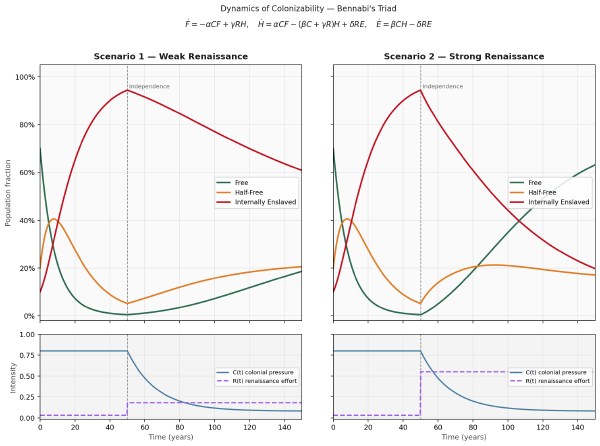
Inspired by Malik Bennabi's concept of colonisabilité, the article "Children of Colonizability" traces how colonial domination sculpts three psychological types—the Free, the Half‑Free, and the Internally Enslaved—each defined by its degree of inner surrender to the colonizer's values, while the companion mathematical model distills this typology into a dynamical system in which colonial pressure pushes individuals rightward along the chain (Free → Half‑Free → Internally Enslaved) and a sustained renaissance effort pulls them leftward toward psychological wholeness, together illuminating Bennabi's central, sobering thesis: removing the colonizer is only the beginning; without a deep, patient rebuilding of culture and spirit, the colonizable psyche persists, and political independence becomes merely a transfer of power among the internally colonized.
This infographic gives an overview of the series
Orwell, G. (1968). Shooting an elephant. In S. Orwell & I. Angus (Eds.), The collected essays, journalism and letters of George Orwell: Vol. 1. An age like this, 1920–1940 (pp. 235–242). Secker & Warburg. (Original work published 1936)
Orwell, G. (1968). Marrakech. In S. Orwell & I. Angus (Eds.), The collected essays, journalism and letters of George Orwell: Vol. 1. An age like this, 1920–1940 (pp. 243–247). Secker & Warburg. (Original work published 1939)
Bennabi, M. (2003). The conditions of renaissance (A. El-Mesawi, Trans.). Islamic Book Trust. (Original work published 1949)
Fanon, F. (1967). Black skin, white masks (C. L. Markmann, Trans.). Grove Press. (Original work published 1952)
Memmi, A. (1965). The colonizer and the colonized (H. Greenfeld, Trans.). Orion Press. (Original work published 1957)
Césaire, A. (1972). Discourse on colonialism (J. Pinkham, Trans.). Monthly Review Press. (Original work published 1950)