The Nakba and Its Aftermath#
On April 9, 1948, Zionist paramilitaries from the Irgun and Lehi factions attacked the Arab village of Deir Yassin, near Jerusalem. By the time the fighting ended, between 100 and 120 Palestinian villagers were dead—many of them killed after surrendering, some mutilated, some paraded through the streets of West Jerusalem in a deliberate effort to terrify the broader Palestinian population.
Deir Yassin was not an isolated atrocity. It was one event in a coordinated campaign of expulsion that the historian Ilan Pappe has called the “ethnic cleansing of Palestine.” Between December 1947 and mid-1948, Zionist forces systematically depopulated hundreds of Palestinian villages. An estimated 750,000 Palestinians—more than half the Arab population of what became Israel—were expelled or fled. Over 500 villages were destroyed. Palestinian urban centers—Jaffa, Haifa, Acre, Safed, and the western half of Jerusalem—were emptied of their Arab inhabitants.
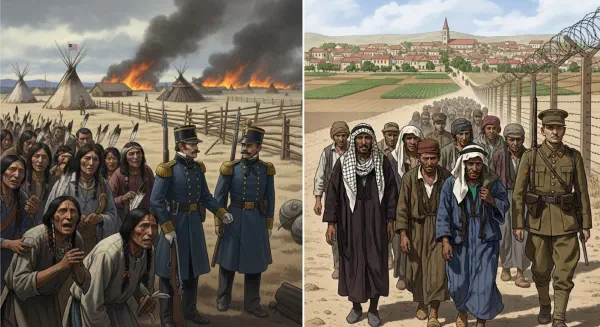
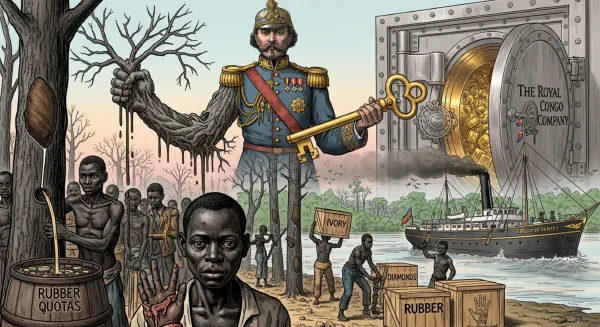
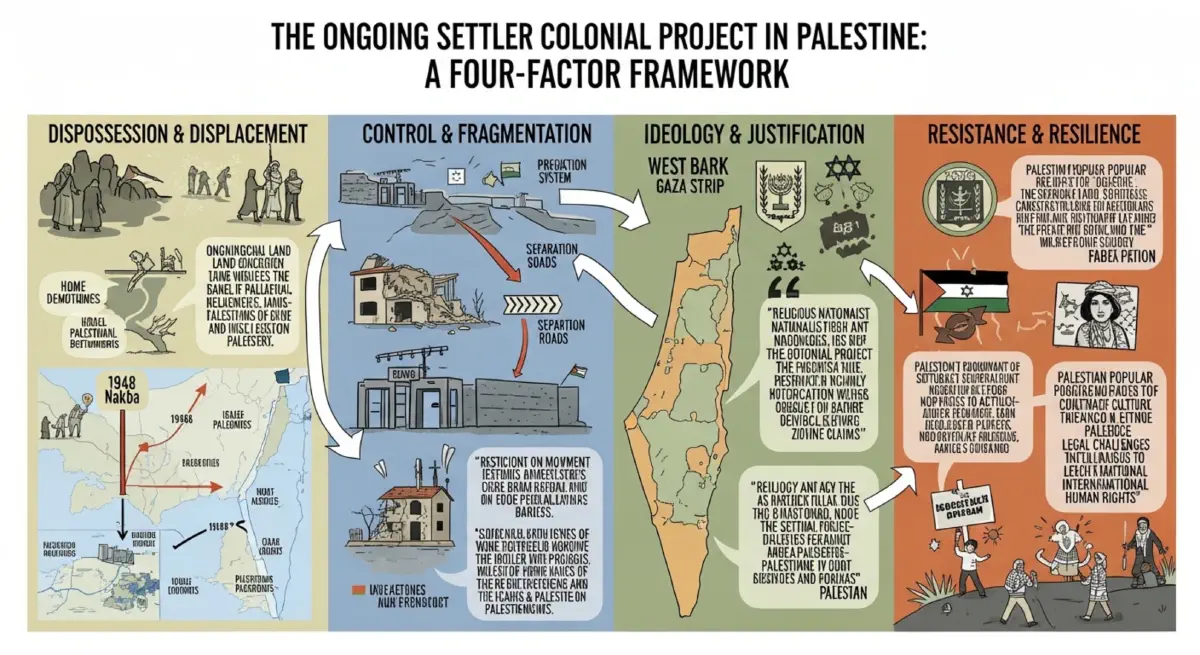
The Nakba (Arabic for “catastrophe”) was the foundational event of the Israeli-Palestinian conflict. But it was also something else: the latest iteration of a colonial logic that had been developing for more than three centuries. The four factors that drove colonial violence in Banda, North America, Algeria, and the Congo—unaccountable power, racial dehumanization, settler colonial logic, and economic imperatives—all converged in Palestine.
This final post in the series applies the four-factor framework to the Zionist project in Palestine, from its origins in the late 19th century through the Nakba and the decades of occupation that followed. It argues that the violence of settler colonialism did not end with decolonization. It continued, in new forms, in the last remaining settler colonial project of the 20th and 21st centuries.
Zionism as Settler Colonialism#
Zionism emerged in the late 19th century as a nationalist movement among European Jews seeking a solution to antisemitism. Its founder, Theodor Herzl, proposed the establishment of a Jewish state—not necessarily in Palestine, but in whatever territory could be secured. Palestine was not the only candidate; for a time, the British offered territory in East Africa. But Palestine, as the ancestral homeland of the Jewish people, became the focus of the movement.
From its earliest days, the Zionist project faced a problem that it never fully resolved: Palestine was already inhabited. In 1882, when the first wave of Zionist immigration began, Palestine had an Arab population of approximately 450,000, comprising 95 percent of the inhabitants. The Zionist settlers who arrived over the next six decades did not seek to coexist with this population. They sought to replace it.
The settler colonial logic was explicit in the writings of the movement’s founders. Ze’ev Jabotinsky, the founder of Revisionist Zionism and the ideological father of the Israeli right, wrote in 1923: “Zionist colonization, even the most restricted, must either be terminated or carried out in defiance of the will of the native population. This colonization can, therefore, continue and develop only under the protection of a force independent of the local population—an iron wall which the native population cannot break through.”
This was not extractive colonialism. The Zionist movement did not seek to exploit Palestinian labor or resources. It sought to create a Jewish state in which Jews would be the majority, the land would be owned by Jews, and the national character would be Jewish. The Palestinian population, in this vision, was not a labor force to be exploited but an obstacle to be removed.
The Four Factors in Palestine#
Settler colonial logic operated in Palestine as it had in North America and Algeria. The goal was replacement, not exploitation. This logic did not necessarily require the physical extermination of the Palestinian population—expulsion would suffice. But the eliminationist imperative was structural: the land could not become a Jewish state while its Arab inhabitants remained in place.
Racial dehumanization was present from the beginning. Zionist discourse often described Palestine as “a land without a people for a people without a land”—a phrase that rendered the Arab population invisible. When Palestinians were acknowledged, they were often described in terms that echoed earlier colonial dehumanization: “primitive,” “backward,” “incapable of modern self-government.” The Palestinian resistance to Zionist colonization was framed as evidence of Arab “fanaticism” rather than as a legitimate response to dispossession.
Economic imperatives operated differently in Palestine than in extractive colonies, but they were no less powerful. The Zionist movement required land. Between 1900 and 1947, the Jewish National Fund purchased land from absentee Arab landlords and then prohibited its sale or lease to Arabs. This created a structure of land ownership that made coexistence structurally impossible. The economic logic of Zionist colonization required the separation of the two populations, which in turn required the expulsion of Palestinians from land designated for Jewish settlement.
Unaccountable power characterized the Zionist project from its origins. During the British Mandate period (1922–1948), Zionist institutions operated with a degree of autonomy that the Palestinian Arab population was denied. After 1948, the new state of Israel created legal structures—the Absentees’ Property Law, the Law of Return, the military government that ruled over Palestinian citizens of Israel until 1966—that gave Jewish Israelis rights and powers that were denied to Palestinians, whether inside Israel or in the occupied territories.
The Nakba: Elimination in Practice#
The 1948 war provided the opportunity to implement the eliminationist logic that had been implicit in the Zionist project for decades. The war began after the United Nations voted in November 1947 to partition Palestine into Jewish and Arab states. Zionist leaders accepted the partition; Arab leaders rejected it. When British forces withdrew in May 1948, Zionist forces declared the establishment of the State of Israel. Arab armies intervened, and the war became a regional conflict.
But the expulsion of Palestinians had begun months earlier. Between December 1947 and May 1948, Zionist forces carried out a systematic campaign to depopulate areas designated for the Jewish state. Plan Dalet, adopted by the Zionist leadership in March 1948, authorized the conquest and expulsion of Palestinian populations from strategic areas. Deir Yassin was one implementation of this plan.
By the time the war ended in 1949, Israel controlled 78 percent of mandatory Palestine—far more than the UN partition plan had allocated. Of the 750,000 Palestinians who had lived in that territory, only about 150,000 remained. The rest had become refugees, barred from returning to their homes by Israeli laws that declared their property “absentee” and transferred it to the state.
The Nakba was not a spontaneous event. It was a planned, systematic, and deliberate campaign of expulsion. The historian Benny Morris, who was among the first Israeli scholars to document the Nakba in the 1980s, concluded that “the idea of transfer was inherent in Zionism from the start.” The violence of 1948 was not an unfortunate side effect of war. It was the implementation of a settler colonial logic that had been present from the beginning.
The Occupation and Its Continuities#
The 1948 war did not end the conflict. The remaining 22 percent of mandatory Palestine—the West Bank, including East Jerusalem, and the Gaza Strip—came under Jordanian and Egyptian control. In the 1967 Six-Day War, Israel conquered these territories, placing approximately 1.3 million Palestinians under military occupation.
The occupation that began in 1967 has lasted more than 50 years, making it one of the longest military occupations in modern history. It has evolved from a temporary military administration into a permanent system of control that the Israeli human rights organization B’Tselem, in 2021, declared a system of “apartheid.” The four factors continue to operate in the occupied territories, though in forms adapted to the constraints of the post-colonial era.
Settler colonial logic persists in the settlement enterprise. Since 1967, Israel has established more than 200 settlements in the West Bank and East Jerusalem, housing approximately 700,000 Jewish settlers. These settlements are illegal under international law, as the Fourth Geneva Convention prohibits an occupying power from transferring its own population into occupied territory. But the settlement enterprise has continued, with the support of successive Israeli governments, because it serves the same function that settler colonization has always served: it takes land and makes it unavailable for Palestinian sovereignty.
Racial dehumanization operates in the discourse of the occupation. Palestinians in the West Bank and Gaza are subject to a military legal system that is separate from the civil legal system that applies to Jewish settlers. Palestinians can be detained indefinitely without trial, held in administrative detention, and tried in military courts with conviction rates exceeding 99 percent. Settlers accused of similar offenses are tried in Israeli civilian courts. The dual legal system is not merely discriminatory—it reflects a racial hierarchy in which Palestinians are deemed inherently suspect and settlers inherently entitled.
Economic imperatives drive the occupation’s structure. The Palestinian economy in the West Bank is constrained by Israeli control over land, water, borders, and trade. Palestinian access to agricultural land is restricted by settlement expansion and the separation barrier. Palestinian construction in Area C (the 60 percent of the West Bank under full Israeli control) is effectively prohibited, while settlement construction continues. Gaza, since Israel’s 2005 disengagement, has been subjected to a blockade that has devastated its economy and created what the United Nations has described as “de-development.”
Unaccountable power characterizes the entire system. The occupation operates with minimal oversight from the international community. Israeli military courts, which try Palestinian civilians, have a conviction rate of approximately 99.5 percent. The Israeli government has consistently ignored UN resolutions calling for an end to settlement construction. The United States has used its veto power in the UN Security Council to block resolutions critical of Israel more than 40 times since 1972, insulating the occupation from international accountability.
Gaza: The Recurrent Catastrophe#
The Gaza Strip, home to 2.3 million Palestinians in an area of 365 square kilometers (approximately the size of Detroit), has become the site of the most intense violence in the conflict’s recent history. Israel withdrew its settlements from Gaza in 2005 but retained control over its borders, airspace, and coastline, creating what the UN has called “the world’s largest open-air prison.”
Since 2008, Israel has conducted five major military campaigns in Gaza—in 2008–2009, 2012, 2014, 2021, and 2023–present. Each campaign has been characterized by the same pattern: massive aerial bombardment, the destruction of civilian infrastructure, and a death toll that overwhelmingly consists of civilians. The 2023–2024 war, which began after Hamas’s October 7 attack killed approximately 1,200 Israelis, has been the deadliest by far. By early 2025, Palestinian health authorities reported more than 45,000 dead, with women and children comprising a majority of the identified casualties.
The military doctrine Israel has employed in Gaza, known as the “Dahiya Doctrine” (named after a district in Beirut destroyed during the 2006 Lebanon war), explicitly targets civilian infrastructure as a means of pressuring militant groups. The doctrine holds that disproportionate force against civilian populations is not a violation of international law but a legitimate military strategy.
The pattern in Gaza—a population trapped, subjected to periodic military campaigns that kill civilians in large numbers, denied the right to flee, and prevented from rebuilding—represents the logical extreme of the four-factor architecture in the 21st century. Unaccountable power allows the violence to continue despite international condemnation. Racial dehumanization frames Palestinians in Gaza as an existential threat rather than a population under occupation. Settler colonial logic drives the expansion of settlements in the West Bank while Gaza is kept under siege. Economic imperatives make the normalization of the occupation profitable for regional powers and for the international arms industry that supplies the weapons used in each campaign.
The Architecture Stands#
The four factors that converged in Banda in 1621—unaccountable power, racial dehumanization, settler colonial logic, and economic imperatives—continue to operate in Palestine in the 21st century. The technologies have changed. The justifications have been updated. The structure remains.
This persistence is not coincidental. The architecture of colonial violence was built to last. It is embedded in legal systems that distinguish between populations, in economic structures that make extraction profitable, in ideologies that divide the world into those who are fully human and those who are not. The specific projects come and go. The structure adapts.
Understanding this architecture does not explain everything about any particular case. Each colonial project has its own history, its own contingencies, its own specific actors and decisions. The Banda massacre was not the same as the Trail of Tears. The French conquest of Algeria was not the same as the Belgian Congo. The Nakba was not the same as the occupation of Gaza. But they share a structure. They are variations on a theme.
The value of the four-factor framework is that it allows us to see the pattern beneath the surface. When we look at Palestine and see the same factors operating that drove the violence in Banda, North America, Algeria, and the Congo, we are not making a moral equivalence claim. We are making a structural argument. The architecture of atrocity is not a relic of a more brutal past. It is a system that continues to operate, in new forms, in the present.