A King’s Private Empire#
In 1885, King Leopold II of Belgium acquired a territory seventy-six times larger than his own country. The Congo Free State was not a Belgian colony—it was Leopold’s personal property, an empire of 2.3 million square kilometers in central Africa that he ruled as a private corporation. He had never visited it.
For the next 23 years, Leopold’s private domain became the site of one of the worst atrocities in modern history. The population of the Congo—estimated at between 20 and 30 million at the start of Leopold’s rule—declined by an estimated 10 million people. Through murder, starvation, disease, and plummeting birth rates, nearly half the population perished. The violence was systematic, bureaucratic, and profit-driven.
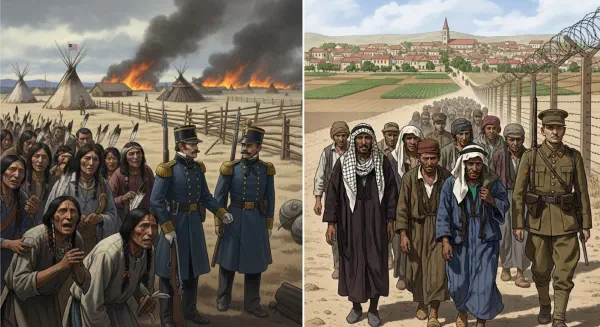
The Congo Free State represents a distinct but related configuration of the four-factor architecture. Unlike the settler colonial projects examined in Part 2, the Congo was an extractive enterprise. Leopold did not want to replace the Congolese with Belgian settlers. He wanted their labor, and he wanted the resources they could extract. But the eliminationist logic that drove settler colonialism reappeared in a different form: when economic imperatives demanded total control, and unaccountable power provided the means, the existing population became as expendable as it had been in North America or Algeria.
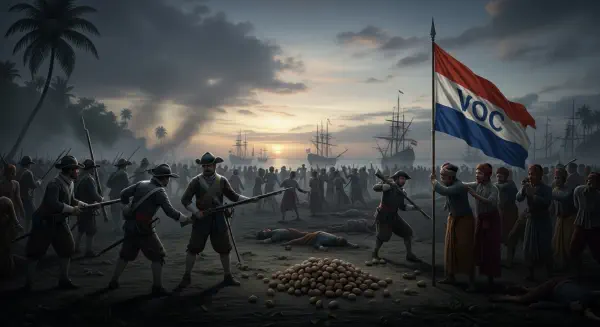
The Congo case also demonstrates how the four factors can converge in a single institution—a corporation with sovereign powers, answerable to no one, driven by the profit motive, and operating on the assumption that its workers were not fully human. The VOC in Banda had pioneered this model in the 17th century. Leopold perfected it in the 19th.
The Architecture of Corporate Sovereignty#
Leopold’s acquisition of the Congo was a masterpiece of deception. At the Berlin Conference of 1884–1885, where European powers partitioned Africa without African representation, Leopold presented himself as a humanitarian seeking to suppress the Arab slave trade and bring civilization to the interior. The European powers, relieved that someone else would bear the cost of administering central Africa, granted him sovereignty.
The Congo Free State’s governing structure was designed from the start to maximize unaccountability. As a personal possession of the king, it was not subject to Belgian parliamentary oversight. Leopold appointed his own administrators, who answered only to him. The Congo’s revenues flowed directly to Leopold’s personal accounts. The state was, in effect, a shell corporation whose sole shareholder could do as he pleased.
This structure created the perfect conditions for the other factors to operate without constraint. There was no legislature to question the budget. No courts to hear complaints. No free press to report on conditions. The few journalists and missionaries who tried to document what was happening were expelled or silenced. The Congo Free State was a zone of absolute unaccountability—a laboratory for atrocity.
The Economic Imperative: Rubber and Ivory#
The Congo’s initial years were financially disappointing. Leopold had spent heavily on infrastructure and administration, and the ivory trade alone could not cover the costs. Then, in the 1890s, the bicycle boom in Europe and America created a sudden, massive demand for rubber. The invention of the pneumatic tire transformed rubber from a minor commodity into one of the world’s most valuable resources.
The Congo was rich in wild rubber vines (Landolphia and Cauda species) that grew throughout the equatorial forest. But harvesting rubber was labor-intensive. Workers had to venture into the forest, slash the vines, collect the latex, and carry it back to trading posts—often over long distances. The system Leopold devised to supply this labor combined economic imperatives with violence in a way that proved catastrophic.
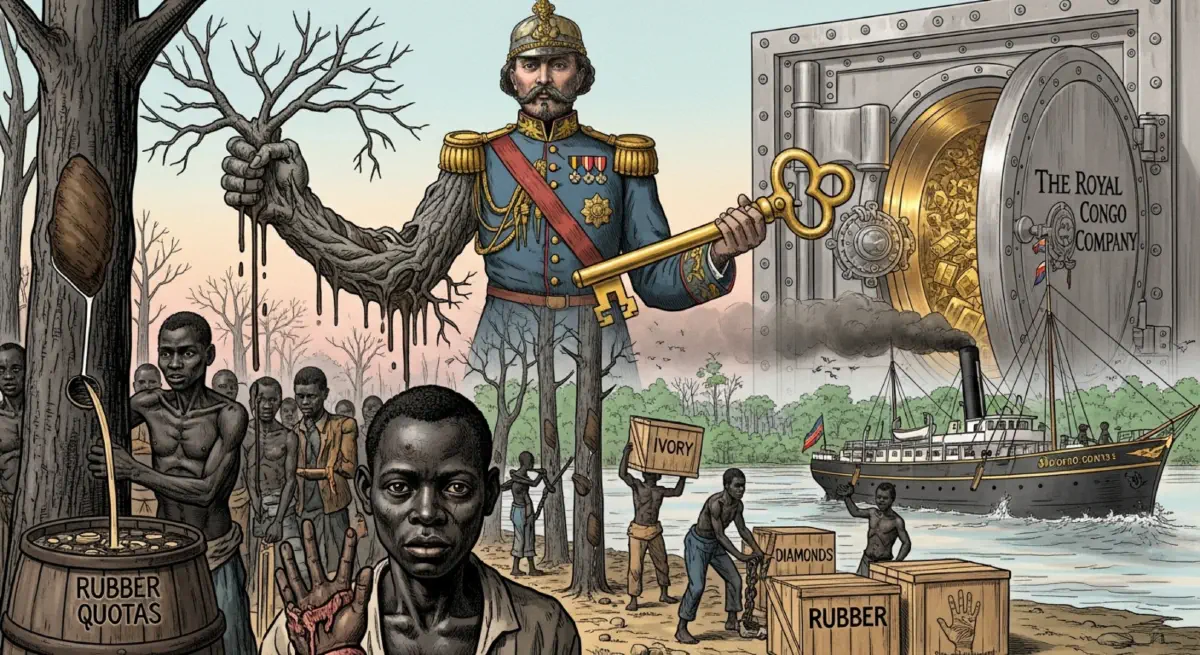
The Force Publique—the Congo Free State’s military force, composed of African soldiers led by European officers—was deployed to enforce rubber quotas. Villages were assigned production targets they could not meet without neglecting their own food cultivation. When quotas were not met, the Force Publique carried out reprisals: hostages taken, villages burned, and, most notoriously, hands cut off.
The mutilation campaign was not random. Force Publique officers were required to account for every cartridge they used. They were expected to bring back the hand of each person they killed as proof. The system created a perverse incentive: the more hands collected, the more ammunition the officer would receive. The severed hands—of men, women, and children—became a currency of atrocity.
By 1900, the Congo was producing more than half the world’s rubber. Leopold’s fortune grew accordingly. In 1901 alone, the Congo Free State exported 6,000 metric tons of rubber, generating revenues of 36 million Belgian francs (approximately $180 million in today’s value). The cost was counted not in francs but in human lives.
Racial Dehumanization: The Logic of the “Childlike” African#
The violence in the Congo was enabled by a racial ideology as systematic as anything produced in North America or Algeria. Leopold and his agents described Congolese people as “lazy,” “childlike,” and in need of discipline. The brutality was framed as a form of pedagogy—a harsh but necessary training for people incapable of civilization.
This dehumanization took explicit form in the language of the Congo Free State’s administrators. Edmund Morel, a shipping clerk who became the Congo’s most effective critic, documented how European agents referred to Congolese workers as “human machines” and “rubber-gatherers” rather than people. One Belgian officer described the Force Publique’s tactics as necessary because “the native is a child—he understands only force.”
The racial hierarchy did more than excuse violence. It structured it. The Congo Free State’s legal system, such as it was, applied one set of rules to Europeans and another to Africans. European officers who committed atrocities against Congolese faced no consequences. Congolese who resisted were executed, often without trial. The indigénat system that France would later refine in Algeria had its prototype in Leopold’s Congo.
The Unaccountability Machine#
What made the Congo Free State unique was not the violence itself—colonial violence was widespread in Africa in the late 19th century—but the systematic, bureaucratic, and corporate nature of the killing. This was not a settler militia carrying out a massacre in the heat of war. It was a state-owned corporation operating on business principles, with quotas, supply chains, and accounting systems.
The Force Publique was not a rogue military unit. It was a professional force with a chain of command, standardized procedures, and a budget. Its officers were trained in Belgium. Its soldiers were recruited from across Africa. The system of hostage-taking, mutilation, and massacre was not a series of isolated atrocities but a management strategy.
When the Congo Reform Movement—an international campaign led by Morel, the British diplomat Roger Casement, and African American activists like Booker T. Washington—began exposing the atrocities, Leopold’s response was not to deny the violence but to argue that it was necessary. In a 1904 circular to his administrators, he wrote: “The natives must be made to work. If they refuse, they must be constrained by the most energetic means.” He then ordered the destruction of documents that might incriminate him.
The unaccountability was absolute until it was not. The international campaign, fueled by missionary reports and photographs of severed hands, eventually forced the Belgian parliament to act. In 1908, under intense pressure, Leopold sold the Congo to the Belgian state. He died the following year, one of the richest men in Europe.
But the transfer of sovereignty from king to parliament did not end the violence. The Belgian Congo continued to operate as a brutal extractive colony for another 52 years, though without the systematic mutilation campaigns that had marked Leopold’s rule. The architecture of unaccountable power had been modified, but the underlying structure—racial dehumanization, economic imperatives, and a political system that gave colonizers unchecked authority—remained intact.
The Industrialization of Atrocity#
The Congo Free State represents a critical evolution in the architecture of colonial violence. The Banda massacre had demonstrated how unaccountable power, economic imperatives, and racial dehumanization could combine to eliminate a population. North America and Algeria had shown how settler logic could drive eliminationist violence across centuries. The Congo showed something new: the industrialization of atrocity.
The Congo’s violence was not carried out by individual settlers or local militias. It was organized by a centralized administration, managed by professional officers, and scaled to cover a territory the size of Western Europe. The rubber quotas were not informal demands but formal targets, backed by a system of rewards and punishments. The Force Publique was not a mob but a military force with standardized procedures. The mutilation campaign was not a spontaneous outburst of cruelty but a system for accounting for ammunition and documenting kills.
This industrialization of violence would have echoes in the 20th century. The methods developed in the Congo—forced labor, hostage-taking, collective punishment, the use of military force against civilian populations—would be refined and expanded in other contexts. The German colonial war in Southwest Africa (1904–1908), which produced the first genocide of the 20th century against the Herero and Nama peoples, drew directly on Congo precedents. The Nazis, in turn, studied German colonial practices.
The Corporation as State#
The Congo Free State was not an anomaly. It was the logical extreme of a pattern that had been developing since the VOC was chartered in 1602. The corporation with sovereign powers—answerable to shareholders but not to the people it governed—created a structure of unaccountability perfectly suited to extreme exploitation.
The VOC had pioneered this model in Banda. The British East India Company had refined it in India, where it governed millions of people with minimal oversight until the 1857 rebellion led the British crown to take direct control. Leopold’s Congo Free State was the model’s apotheosis: a single individual, acting through a corporate structure, governing a territory the size of Western Europe with no accountability whatsoever.
The lessons of the Congo were not lost on later corporate actors. When oil companies operated in the Niger Delta in the late 20th century, they employed private security forces, operated in zones of weak state control, and faced accusations of human rights abuses that echoed Leopold’s Congo. When multinational corporations today operate in conflict zones or in countries with weak governance, they often create structures of unaccountability that enable abuses their home countries would never permit.
The Congo Free State shows that the four-factor architecture does not require a state. It requires only unaccountable power, economic imperatives, racial dehumanization, and a logic that treats populations as obstacles to be managed. The corporate form, with its single-minded focus on profit and its structural insulation from democratic accountability, is particularly well suited to producing this combination.