A Question of Replacement#
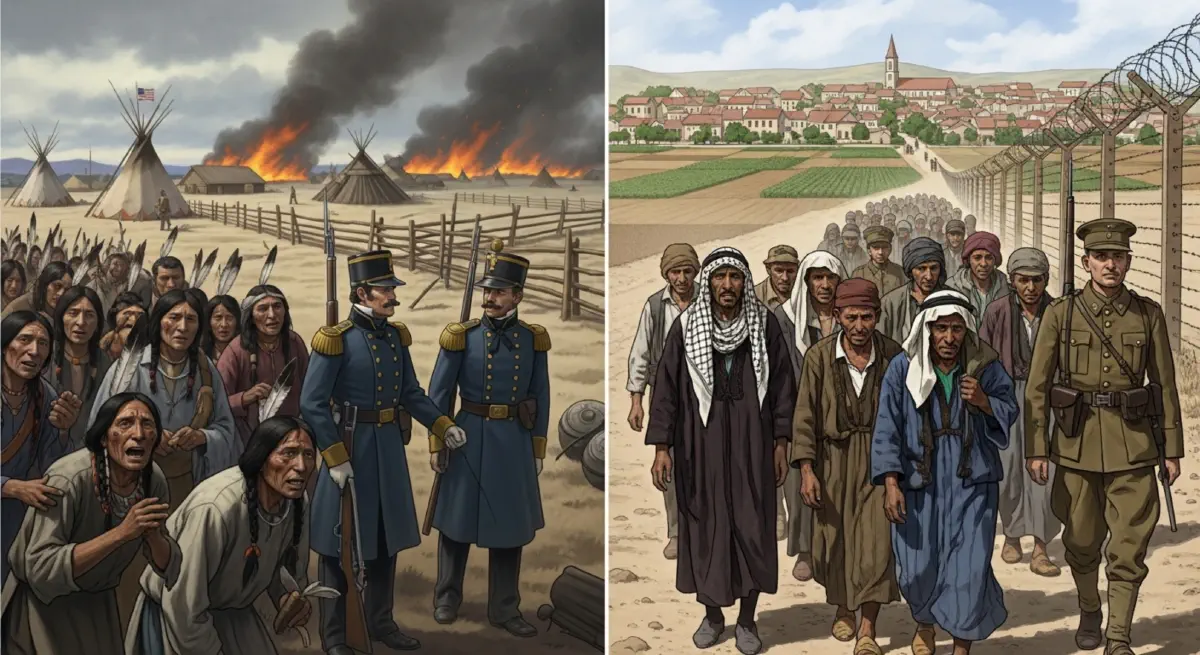
In 1637, English Puritan colonists in Connecticut surrounded a fortified Pequot village on the Mystic River. Under cover of darkness, they set it ablaze. Those who fled the flames were shot or hacked down with swords. Within an hour, between 400 and 700 Pequot men, women, and children were dead. The English commander, John Mason, later wrote with satisfaction: “God laughed his enemies and the enemies of his people to scorn.”
The Mystic massacre was not an isolated act of wartime brutality. It was a deliberate policy of elimination. The English had declared the Pequot a “nation” that could no longer be permitted to exist. Survivors were hunted down, sold into slavery in the West Indies, or given as servants to English families. The word “Pequot” was to be erased from memory.
Two centuries later and half a world away, French forces in Algeria pursued a similar logic with different methods but identical intent. Between 1830 and 1872, the French military systematically destroyed Algerian society. Entire villages were buried alive in caves. The countryside was subjected to razzias—scorched-earth raids designed to kill combatants and non-combatants alike. The Algerian population declined by an estimated one-third, from approximately 3 million to 2 million.
The connection between Mystic and Algeria is not merely that both were violent. The connection is structural. Both were manifestations of settler colonial logic—the project of replacing one population with another—combined with racial dehumanization that made elimination seem not only permissible but necessary. In both cases, unaccountable power allowed violence to proceed without constraint, and economic imperatives (land, in both instances) supplied the motive.
This post examines how these four factors operated in the settler colonial contexts of North America and French Algeria, showing how eliminationist violence became not a tragic excess but the central mechanism of the colonial project.
The Settler Colonial Imperative#
The scholar Patrick Wolfe famously described settler colonialism as a “structure, not an event.” Unlike extractive colonialism—which seeks resources and labor from an existing population—settler colonialism seeks the land itself. The indigenous population is not a labor force to be exploited but an obstacle to be removed.
This structural logic has profound consequences. In extractive colonies, there is a perverse incentive to preserve the population that provides labor. In settler colonies, the incentive is toward elimination. The land cannot be fully possessed while its original inhabitants remain. Their continued presence—with their own sovereignties, economies, and attachments to place—represents a rival claim that must be extinguished.
Wolfe’s most cited formulation captures the dynamic: “Settler colonialism destroys to replace.” The destruction is not incidental. It is the work.
North America: A Continent of Erasure#
The European colonization of North America was not a single event but a 300-year process of elimination that employed every tool in the colonial arsenal: war, massacre, forced removal, treaty-breaking, disease (sometimes deliberate), destruction of food sources, and cultural assimilation designed to extinguish indigenous identity.
The pattern was established early. In Virginia after the 1622 uprising, English settlers declared a “perpetual war” against all Native people. In New England, the 1637 Pequot War established the precedent that indigenous nations could be declared extinct. In King Philip’s War (1675–1676), New England colonists killed or displaced perhaps 40 percent of the region’s Native population and sold survivors into slavery.
By the time the United States became an independent nation, the settler logic was already deeply embedded. Thomas Jefferson, who wrote that “all men are created equal,” also advocated for the removal of Native Americans beyond the Mississippi, arguing that indigenous peoples could not be assimilated and must make way for white settlement.
The Indian Removal Act of 1830, signed by Andrew Jackson, transformed this logic into federal policy. The Trail of Tears—the forced removal of 16,000 Cherokee from the Southeast to Oklahoma in 1838–1839—killed an estimated 4,000 people. But the Cherokee were lucky compared to other nations. The Creek, Chickasaw, Choctaw, and Seminole endured similar removals with comparable death tolls.
The logic of elimination did not end with removal. Throughout the 19th century, the U.S. government pursued a policy of extermination against Native peoples who resisted. The California genocide of the 1850s and 1860s, carried out by state militias with federal support, reduced the Native population of California from perhaps 150,000 to 30,000. Bounties were paid for Native scalps. Villages were destroyed. Survivors were enslaved under state laws that allowed Native children to be “apprenticed” without parental consent.
The slaughter of the buffalo—from an estimated 30 million in 1800 to fewer than 1,000 by 1890—was not merely a commercial enterprise. It was a deliberate military strategy to destroy the food supply of Plains nations. General Philip Sheridan, who oversaw much of this campaign, testified before the Texas legislature: “Let them kill, skin, and sell until the buffalo is exterminated, as it is the only way to bring lasting peace.”
Wounded Knee in 1890 was the final act of the Indian Wars. The massacre of perhaps 300 Lakota men, women, and children by the 7th Cavalry—the same unit that had been destroyed at Little Bighorn—marked the end of armed resistance. But the eliminationist project continued in new forms: boarding schools designed to “kill the Indian, save the man,” allotment policies that broke up communal land holdings, and sterilization programs that targeted Native women well into the 20th century.
French Algeria: The Civilizing Mission as Extermination#
France’s conquest of Algeria began in 1830 as a diplomatic gambit by the last Bourbon king, Charles X, seeking to rally nationalist sentiment. It became a 132-year occupation that killed perhaps one-third of the Algerian population in its first four decades and established patterns of settler colonialism that would define French imperial identity until the brutal war of decolonization in the 1950s and 1960s.
The conquest was extraordinarily violent by any measure. The French military employed a doctrine of total war that made no distinction between combatants and civilians. Entire populations were displaced. Fields were burned. Water sources were poisoned. Villages were sealed in caves and suffocated or burned alive.
Alexis de Tocqueville, the French political theorist celebrated for his writings on American democracy, served in the National Assembly during the conquest and became one of its most articulate defenders. In an 1841 report, he argued that total war was necessary in Algeria because the “racial” difference meant European rules of war did not apply. He wrote: “I believe that the laws of war entitle us to ravage the country and that we must do so, either by destroying crops at harvest time or by making rapid incursions.”
Tocqueville was not a marginal figure. He represented a mainstream French liberal opinion that believed colonialism was compatible with democracy precisely because the colonized were not considered fully human. This racial dehumanization—the second factor in our framework—was foundational to French policy. Algerians were described in official documents as “fanatical,” “primitive,” and “incapable of civilization.” Their resistance was framed as evidence of their backwardness, which in turn justified further violence.
The settler logic in Algeria was explicit. The French government encouraged European immigration through land confiscation policies. By 1872, Algeria had 240,000 European settlers (pieds-noirs) who controlled the most fertile land and dominated the colonial economy. The indigenous population, meanwhile, was subjected to the code de l’indigénat—a set of laws that applied only to Algerians and criminalized behaviors (including political organizing, traveling without permission, and “insolence” toward Europeans) that were legal for settlers.
The indigénat was not merely discriminatory. It created a structure of unaccountable power in which French administrators could imprison Algerians without trial, confiscate property without compensation, and use lethal force without oversight. Between 1881 and 1918, an estimated 1.8 million summary penalties were imposed under the indigénat. The system persisted until 1944, surviving multiple French republics and a world war ostensibly fought against fascist racial ideology.
The Four Factors in Settler Context#
The cases of North America and French Algeria demonstrate how the four-factor architecture operates in settler colonial contexts. The differences between them—one largely English Protestant, one French Catholic; one continental, one Mediterranean—are less significant than the structural similarities.
Unaccountable power was built into both systems. In North America, settler militias operated with minimal oversight from distant colonial authorities. After independence, the U.S. government delegated authority to state militias that carried out massacres and removals with federal approval but without federal constraint. In Algeria, the indigénat gave administrators the power of life and death over millions of people, with no meaningful legal recourse.
Racial dehumanization provided the ideological framework. In North America, Native peoples were “savages” who stood in the way of “civilization.” In Algeria, Algerians were “fanatics” who could not be governed by normal laws. In both cases, dehumanization did not merely excuse violence—it made violence seem necessary. If the colonized were incapable of civilization, then their elimination was not murder but progress.
Settler colonial logic drove the scale of violence. In extractive colonies, there was an economic interest in preserving the labor force. In settler colonies, the opposite was true. The land could not be fully possessed while indigenous people remained. Removal, expulsion, and elimination were not tragic side effects—they were the central work of the colonial project.
Economic imperatives supplied the motive. Land was the prize. In North America, the dispossession of Native peoples enabled the expansion of cotton cultivation, mining, railroads, and eventually oil extraction. In Algeria, settler agriculture produced wine, citrus, and grains for export to France. The violence was not separate from these economic transformations. It was the mechanism that made them possible.
The Persistent Structure#
The settler colonial projects in North America and French Algeria did not end with the violence of the 19th century. They continued in modified forms into the 20th and beyond. In the United States, the logic of elimination persists in the reservation system—which confined Native peoples to small, often economically devastated enclaves—and in policies from forced sterilization to the removal of Native children into foster care, which continues at rates far higher than for any other population.
In Algeria, the settler colonial project ended in 1962 after one of the most brutal wars of decolonization in modern history. The National Liberation Front (FLN) fought a seven-year guerrilla war against French forces that employed torture, collective punishment, and systematic destruction of rural villages. The war killed perhaps 300,000 Algerians and 25,000 French soldiers, and ended with the expulsion of the pieds-noirs—the settler population that had been the project’s intended beneficiaries.
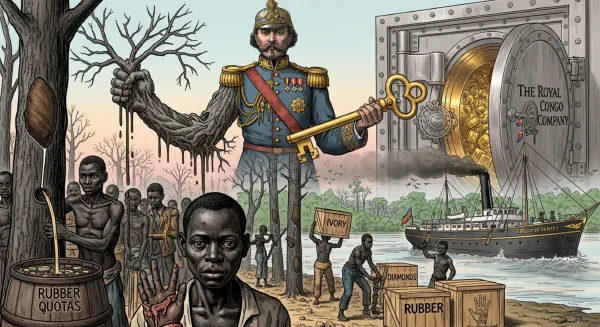
But the pattern did not disappear. It migrated. As the next post in this series will examine, the four factors that drove colonial violence in North America and Algeria found new expression in the Congo Free State—where a private corporation, granted sovereign powers, combined economic imperatives with racial dehumanization to create an industrial-scale killing machine that claimed an estimated 10 million lives.