The Nutmeg That Cost 15,000 Lives#
In 1621, the Dutch East India Company—the VOC, the most powerful corporation the world had yet seen—faced a problem. The Banda Islands, a tiny volcanic archipelago in what is now eastern Indonesia, produced the world’s entire supply of nutmeg. For centuries, Bandanese merchants had traded this spice freely with Javanese, Malay, Portuguese, and English buyers. The VOC wanted that trade for itself. Exclusively.
The Bandanese, a people numbering perhaps 15,000, said no. They had traded with outsiders for generations and saw no reason to surrender their sovereignty to a European company whose representatives arrived with demands dressed as contracts.
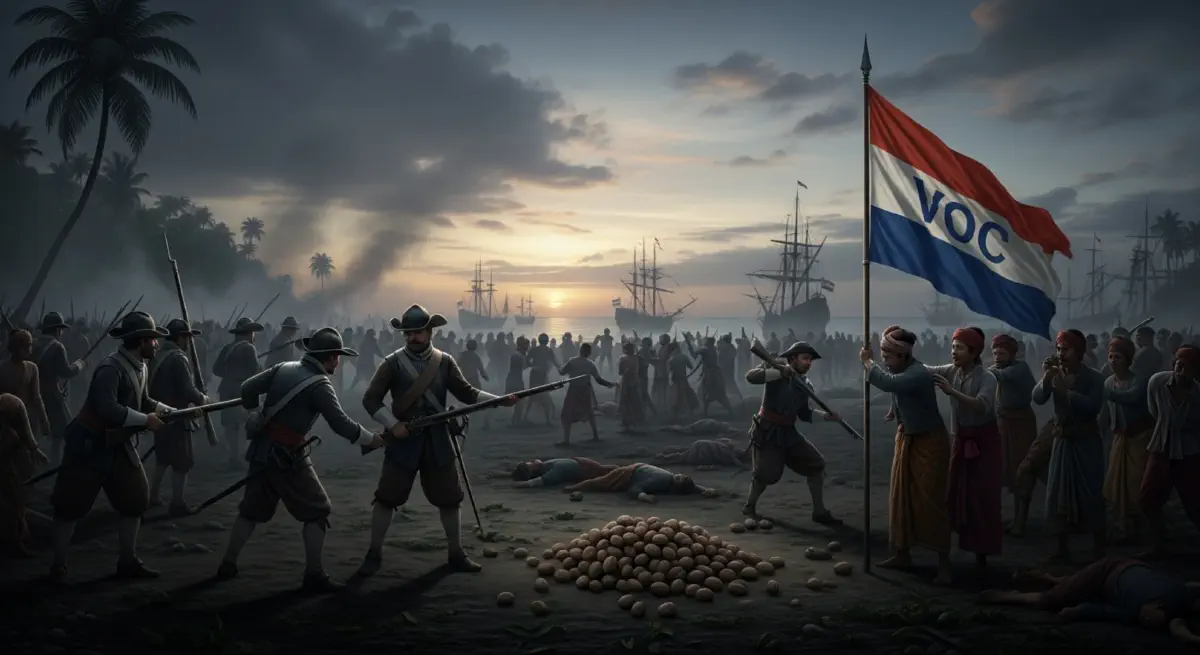
What followed was not a war in any conventional sense. It was a systematic extermination. The VOC assembled a fleet, landed 2,000 soldiers, and proceeded to kill, enslave, or drive into the sea every Bandanese they could find. The islands’ population collapsed by approximately 90 percent. Survivors were enslaved or fled to nearby islands. The VOC then repopulated Banda with enslaved laborers imported from elsewhere, creating a plantation system that would produce nutmeg for Dutch shareholders for the next two centuries.
The Banda massacre was not the first atrocity committed by Europeans overseas. But it was the first time all four factors that would define colonial violence for the next 400 years converged in a single event. Understanding how they came together—and why they worked so effectively—is the key to understanding the architecture of atrocity that followed.
The Four-Factor Framework#
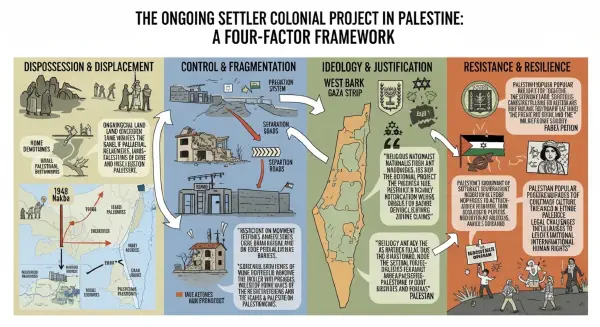
Colonial violence was never random. It was systematic, and systems have structures. Across five centuries of colonial history, four factors consistently appear, not as separate phenomena but as mutually reinforcing components of a single destructive machine.
Unaccountable power meant that colonial actors—whether states, corporations, or settlers—operated in zones where the legal and moral constraints that applied in Europe did not apply. Colonial spaces were designed as exemption zones from the start.
Racial dehumanization provided the ideological justification. Colonizers constructed elaborate hierarchies placing themselves at the top and their victims at the bottom—often not even fully human. This made violence not only permissible but necessary.
Settler colonial logic drove the most extreme forms of violence. When the goal was not just extraction but replacement—taking land permanently—the existing population became an obstacle to be removed by any means.
Economic imperatives supplied the motive and the machinery. Whether spices, sugar, silver, rubber, or land itself, the pursuit of profit without constraint created incentives for violence that no moral scruple could counter.
These factors did not operate in sequence. They reinforced each other. Economic imperatives demanded cheap labor and exclusive access to resources. Unaccountable power provided the means. Racial dehumanization removed the moral brakes. Settler logic determined the scale.
The Banda Islands in 1621 was the laboratory where this combination was first perfected.
The VOC: A Corporation With Sovereign Powers#
To understand what happened in Banda, one must first understand the VOC. Chartered by the Dutch States-General in 1602, the company was granted powers that no modern corporation possesses. It could wage war, negotiate treaties, build fortresses, coin money, and administer justice. It was, in effect, a state disguised as a business, accountable to shareholders but not to any meaningful oversight in the territories it controlled.
The VOC’s charter contained a clause that would prove decisive: it could act in the name of the States-General in Asia, meaning its violence was technically state violence, but without parliamentary oversight. This created a structure of unaccountability that was structural, not accidental. The company’s primary duty was to its shareholders. Human costs were externalities.
Jan Pieterszoon Coen, the VOC governor-general who orchestrated the Banda massacre, articulated this logic with brutal clarity. In a 1618 letter to his superiors, he wrote: “Your Excellencies know that the trade in Asia must be driven and maintained under the protection and favor of Your Excellencies’ own weapons, and that the weapons must be paid for from the profits of the trade.” Violence was not a cost of doing business. It was the business.
The Economic Imperative: A Monopoly Worth Killing For#
Nutmeg in the 17th century was worth more by weight than gold. The spice had medicinal uses, preserved food, and signaled status. The entire global supply came from Banda—a few volcanic islands less than 200 square miles in total area.
Before the Dutch arrived, Bandanese society was sophisticated and prosperous. The islands had a population organized into autonomous villages (orang kaya), each governed by local leaders who managed complex trade relationships across the region. Bandanese had been trading with Europeans for decades, playing the Portuguese, English, and Dutch against each other to maintain their independence.
The VOC’s demand was simple: exclusive rights to purchase all nutmeg at a price set by the company. The Bandanese refusal was equally simple: they would continue trading with whomever they chose.
To the VOC, this refusal was not a diplomatic problem but a logistical one. The company had spent enormous sums to establish its presence in the East Indies. Shareholders expected returns. The Bandanese stood between the VOC and those returns. The economic imperative, combined with unaccountable power, dictated a solution.
Racial Dehumanization: Constructing the Enemy#
Before the massacre, the VOC waged a propaganda campaign. Coen and other company officials described the Bandanese in letters as “treacherous,” “ungrateful,” and “untrustworthy.” These were not casual insults. They were part of a deliberate construction of the Bandanese as people to whom normal obligations did not apply.
The language mattered because it enabled the violence that followed. If the Bandanese were treacherous by nature, then preemptive violence against them was not murder but prudence. If they were ungrateful, then the VOC’s destruction of their society was just punishment.
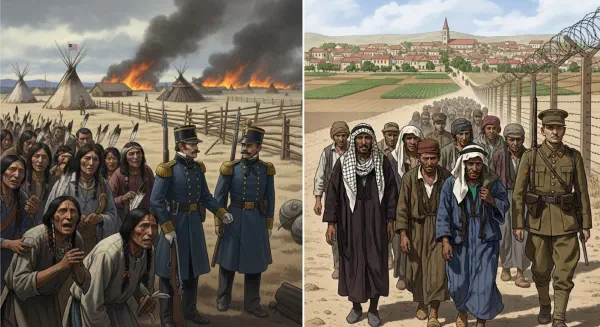
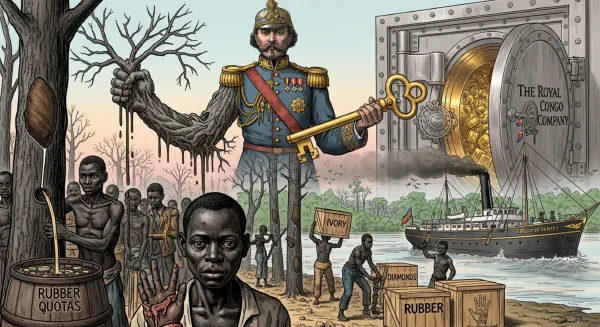
This pattern—first dehumanize, then destroy—would repeat across centuries. In Algeria, the French would call Algerians “fanatical” and “primitive.” In the Congo, Leopold’s agents would describe Congolese as “lazy” and “childlike.” In North America, Native Americans were “savages” who stood in the way of “civilization.” In each case, the dehumanization preceded the atrocity and made it possible.
Settler Logic in a Non-Settler Context#
Banda was not a settler colony in the classic sense. The VOC did not intend to populate the islands with Dutch farmers. Its goal was to create a plantation system producing nutmeg for export, worked by enslaved laborers brought from elsewhere.
But the Bandanese themselves had to go. Their presence was incompatible with the VOC’s economic model because they would not accept the company’s monopoly. The logic was eliminationist even if the mechanism was not settlement. The VOC needed the land and the productive capacity. The people who lived on that land were expendable.
This is a crucial distinction that helps explain later colonial violence. Settler colonialism—the project of replacing one population with another—produces eliminationist violence as a structural necessity. But extractive colonialism, when pursued with total monopoly ambitions, can produce the same outcome. The Bandanese were not killed because the Dutch wanted their houses. They were killed because they refused to accept a monopoly they had never agreed to.
The Massacre: Systematic Destruction#
The VOC’s campaign against Banda unfolded in stages. In 1609, the company built a fort on the island of Neira, establishing a permanent military presence. Over the next decade, a series of broken agreements and skirmishes deepened the hostility. By 1621, Coen had decided on a final solution.
His fleet carried 2,000 soldiers, more than enough to overwhelm the Bandanese, who had no central government and no standing army. Coen summoned the leaders of each village to the fort under safe conduct, then arrested them. Some were executed immediately. Others were tortured to reveal where they had hidden nutmeg trees—as if the trees themselves were contraband.
With the leadership eliminated, Coen sent soldiers across the islands. Villages were burned. People who did not flee were killed or captured. The VOC’s own records estimate that 15,000 Bandanese died or were enslaved. The islands’ population, once perhaps 15,000, fell to a few hundred survivors who managed to escape to other islands.
Coen then repopulated Banda. He divided the land into 68 plantations, each controlled by a VOC employee or collaborator. Labor was provided by enslaved people brought from other parts of Indonesia, India, and Africa. The plantations operated for nearly two centuries, producing nutmeg for Dutch shareholders while the descendants of the original Bandanese—those few who had escaped—lived in exile on neighboring islands.
The Blueprint#
The Banda massacre was not a secret. The VOC’s own records document it in detail. But there was no accountability. The States-General, which had granted the company its charter, received reports and did nothing. Shareholders collected dividends. The officers who orchestrated the massacre were promoted. Coen died in 1629, still serving as governor-general, celebrated in Dutch history as a national hero.
The pattern established in Banda would repeat across the colonial world. Unaccountable power meant that no one could stop the violence. Economic imperatives meant that there was always a profit motive to continue it. Racial dehumanization meant that perpetrators could commit atrocities without moral crisis. And settler logic—whether in its pure form or in its extractive variant—meant that the existing population was an obstacle to be removed.
From Banda to the Congo, from North America to Algeria, from the Caribbean to Palestine, the architecture remained the same. The materials changed. The justifications shifted. But the structure—four factors reinforcing each other to enable systematic violence—persisted.
What the Blueprint Built#
The Banda massacre was the first time this architecture was fully assembled. It would not be the last. In the centuries that followed, European powers would refine and expand the methods first tested in these small islands. The logic that drove the VOC to exterminate the Bandanese—total monopoly, racial hierarchy, unaccountable power, eliminationist thinking—would drive the Spanish in the Americas, the British in North America and Australia, the French in Algeria, the Belgians in the Congo, and the Zionist movement in Palestine.
The four factors did not operate independently. They formed a system. Unaccountable power enabled economic exploitation. Economic exploitation required racial dehumanization. Racial dehumanization made settler logic seem reasonable. Settler logic demanded the elimination of existing populations. And each atrocity reinforced the structures that made the next atrocity possible.
Understanding this architecture is not an academic exercise. The patterns established in the 17th century did not disappear with decolonization. They persist in the structures of global inequality, in the legal frameworks that protect some populations while rendering others vulnerable, and in ongoing colonial projects that continue to deploy the same logic with updated justifications.
The next post in this series will examine how these four factors operated in the settler colonial contexts of North America and French Algeria—where eliminationist violence was not a means to an economic end but the central purpose of the colonial project itself.