What is the CFA franc, and why haven't I heard of it?#
You know how some things are so strange that if they didn't already exist, nobody would dare invent them? The CFA franc is one of those things.
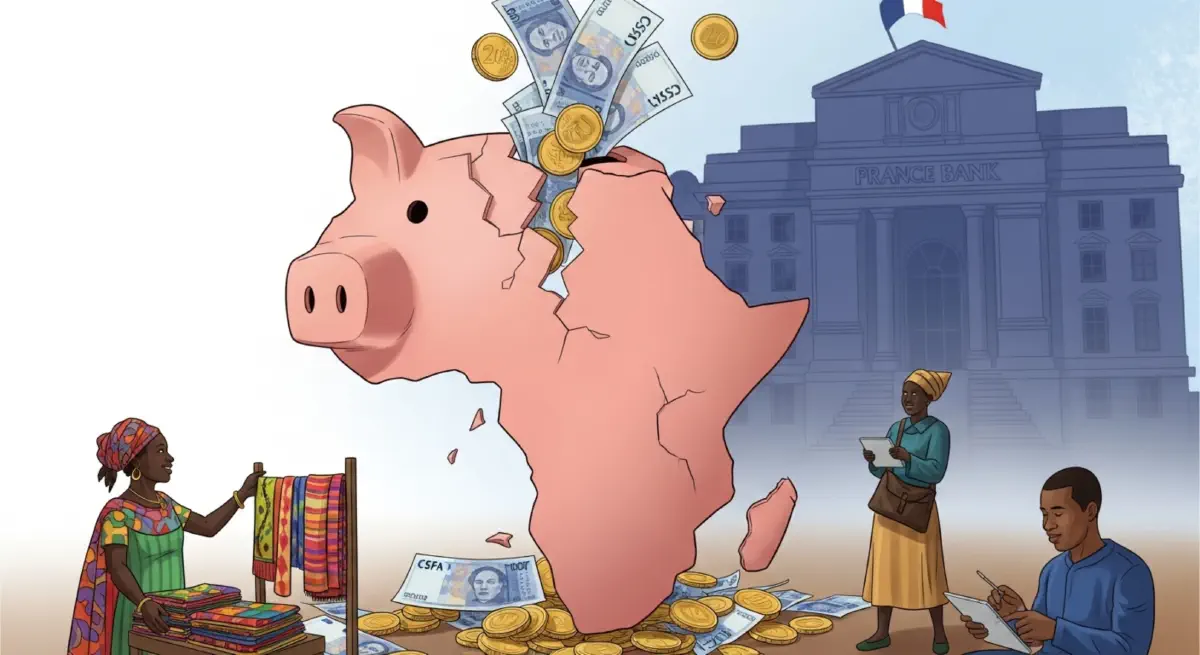
Imagine waking up tomorrow and learning that 14 countries on your continent deposit 50% of their national savings into a former colonial power's bank account. Not voluntarily—by rule. That's the CFA franc system in a nutshell.
Created in 1945, the CFA franc (which originally stood for Colonies Françaises d'Afrique) is still alive and well. Today, 14 African nations use it across two monetary unions:
| West Africa (WAEMU) | Central Africa (CEMAC) |
|---|---|
| 🇧🇯 Benin | 🇨🇲 Cameroon |
| 🇧🇫 Burkina Faso | 🇨🇫 Central African Republic |
| 🇨🇮 Côte d'Ivoire | 🇹🇩 Chad |
| 🇬🇼 Guinea-Bissau | 🇨🇬 Republic of Congo |
| 🇲🇱 Mali | 🇬🇶 Equatorial Guinea |
| 🇳🇪 Niger | 🇬🇦 Gabon |
| 🇸🇳 Senegal | |
| 🇹🇬 Togo | |
| 8 countries in West Africa | 6 countries in Central Africa |
Plus, France's Pacific territories use the CFP franc—a cousin with the same DNA.
Wait, France had that many colonies?#
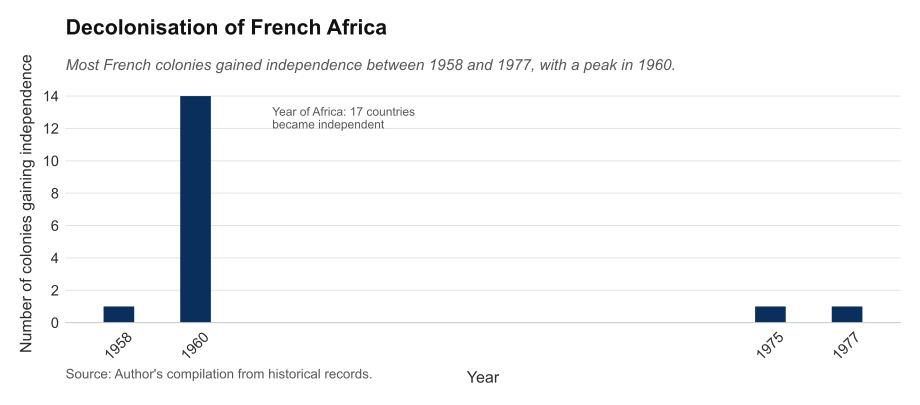
Before World War II, France controlled roughly 11 million square kilometers of colonies—that's about 21 present-day countries. The empire stretched from West Africa (French West Africa) through Central Africa (French Equatorial Africa) to Madagascar, Indochina, and beyond.
Most gained independence in the late 1950s and early 1960s. But France didn't exactly leave. It signed "cooperation agreements" that kept its financial fingerprints all over the new nations' economies.
How does the CFA franc actually work? (Explain it like I'm 10)#
Let me break this down with three kitchen-table analogies.
1. The Shared Savings Jar#
Imagine your former employer requires you to deposit 50% of every paycheck into their bank account. Not yours. Theirs.
You can't touch that money. You don't know how they invest it. The interest they pay you is lower than what they're actually earning. And sometimes, they use your savings to pay off their own debts.
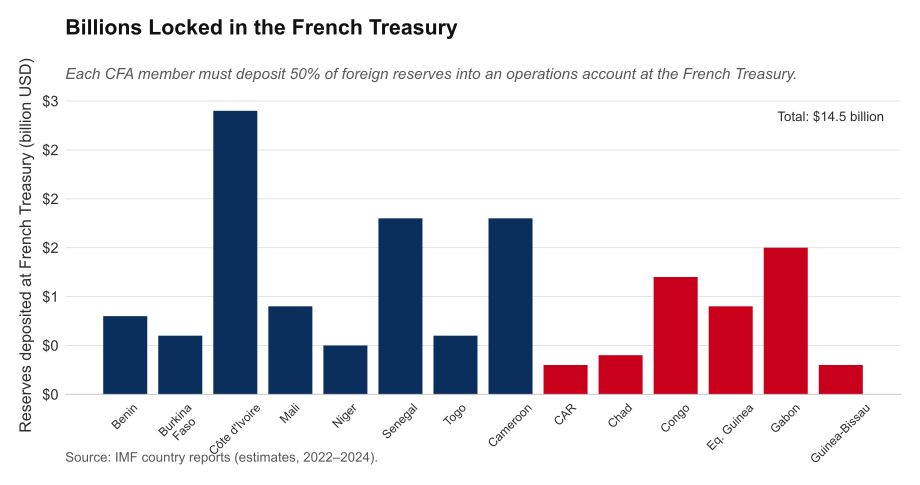
That's exactly what the CFA rule says: each member state must deposit 50% of its foreign exchange reserves into an "Operations Account" at the French Treasury.
2. The One-Way Gate#
France guarantees that you can always swap CFA francs for Euros at a fixed rate. Sounds great, right?
Here's the catch: because money moves so easily, wealthy elites and foreign corporations park their profits in Europe instead of reinvesting them in Africa. Economists estimate that over $80 billion has flowed out of CFA countries and into French bank accounts since 1970.
That's not a safety net. That's a siphon.
3. The Lending Squeeze#
To keep the currency stable and prevent inflation, the regional central banks are extremely stingy with loans. If you're a local shopkeeper or farmer, getting a bank loan is nearly impossible. When you do find one, interest rates can hit 15%.
The system prioritizes "sound money" over local businesses. Every. Single. Time.
So is the CFA franc good or bad?#
Let me show you both sides of the ledger.
The Case FOR the CFA Franc#
| Benefit | What it means |
|---|---|
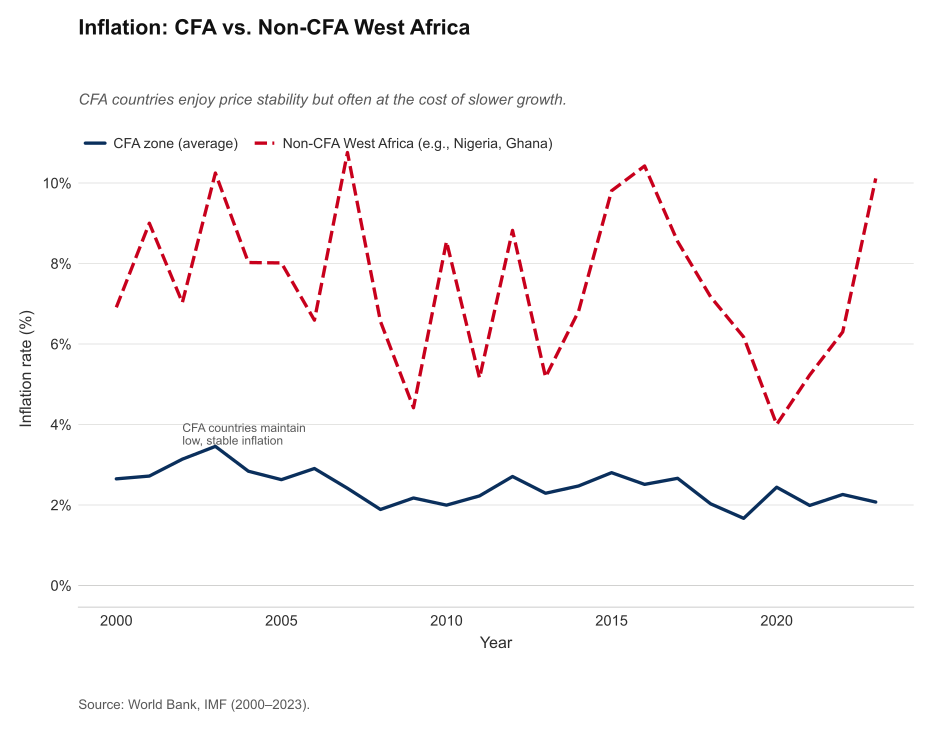
| Low inflation | CFA countries average 2-3% inflation while non-CFA neighbors often see 8-12% |
| Price stability | You can plan for next year without guessing what your money will be worth |
| Guaranteed convertibility | The French Treasury backs every CFA franc—no currency crises like Nigeria or Ghana have experienced |
| Easier trade | Within each union, money moves freely across borders |
The Case AGAINST the CFA Franc#
| Cost | What it means |
|---|---|
| No monetary sovereignty | You can't print more money when your economy needs stimulus |
| Overvalued currency | Exports become expensive; imports become cheap (killing local industry) |
| Capital flight | $80 billion+ has left the region for French banks |
| No exchange-rate lever | When cocoa or oil prices crash, you can't devalue—you just suffer |
| French veto power | Until recently, French officials sat on central bank boards |
What's the "stability-development tradeoff" everyone mentions?#
This is the heart of the debate. Let me walk you through it.
In a normal country, when the price of your main export crashes (say, oil drops from $100 to $40), you have options. You can let your currency lose value—devaluation. That makes your goods cheaper for foreigners to buy, softening the blow.
With the CFA franc, that lever is locked.
The currency is fixed to the Euro. President Macron doesn't call you one morning and say, "Go ahead, devalue by 20%." The rule is the rule.
So what happens instead? You have to do internal devaluation—slashing wages, cutting government spending on schools and hospitals, raising taxes. The pain doesn't hit the currency. It hits people.
Diagram showing how flexible currency absorbs price shocks vs. CFA fixed currency passing shock directly to domestic economy, With your own currency, the money takes the hit. With the CFA, the people take the hit#
flowchart LR
    subgraph Flex [💰 Flexible Currency]
        direction TB
        A[Oil price drops 40%] --> B[Currency devalues 40%]
        B --> C[Foreign buyers see same local price]
        C --> D[✅ Currency absorbs the shock]
    end

    subgraph Fix [🔗 CFA fixed to Euro]
        direction TB
        E[Oil price drops 40%] --> F[Exchange rate CANNOT change]
        F --> G[Local producers get 40% less revenue]
        G --> H[❌ People absorb the shock]
    end

    Flex ~~~ Fix

    style Flex fill:#1a2a3a,stroke:#4a9eff,stroke-width:2px,color:#eee
    style Fix fill:#1a2a3a,stroke:#ff6b6b,stroke-width:2px,color:#eee
    style D fill:#1a3a2a,stroke:#4caf50,stroke-width:1px
    style H fill:#3a1a1a,stroke:#ff4444,stroke-width:1px
#
Does the CFA help or hurt farmers and local businesses?#
Imagine you run a small bakery in Senegal. You grow local millet, you grind it yourself, you bake fresh bread every morning.
But because the CFA is tied to the Euro, imported European bread appears in your town's supermarket for half the price you need to charge. European wheat is subsidized. European logistics are efficient. And the "strong currency" makes their goods look even cheaper.
What happens to your bakery? You close. Your workers lose jobs. And Senegal imports more bread than ever.
This is called the Import Trap:
Local producers struggle
Strong currency makes imports artificially cheap. Local farmers can't compete with subsidized foreign prices.Industry never develops
Why build a textile factory when cheap imported clothes flood the market? Manufacturing stays dormant.Focus on raw materials
To pay for all those imports, countries export only raw materials—cocoa, cotton, oil—never processing them locally.
Flow diagram showing strong currency → cheap imports → local producers fail → economy trapped in raw material exports. The CFA's fixed exchange rate creates a self-reinforcing cycle that keeps economies dependent on raw material exports.#
flowchart TB
    S[💶 Strong CFA franc
pegged to Euro]
    S --> A[📦 Imports become artificially cheap]
    A --> B[🏭 Local producers cannot compete
→ factories close, farms fail]
    B --> C[🔄 Economy trapped in raw material exports
cocoa, oil, cotton]
    C -.->|Reinforces the trap| S

    B -.-> D[🚫 No industrialisation
🚫 No middle class growth]

    style S fill:#1e3a5f,stroke:#5a9eff,stroke-width:2px,color:#fff
    style A fill:#5f3a1e,stroke:#ffaa44,stroke-width:2px,color:#fff
    style B fill:#5f1e1e,stroke:#ff6666,stroke-width:2px,color:#fff
    style C fill:#2a2a2a,stroke:#aaaaaa,stroke-width:2px,color:#ddd
    style D fill:#1a1a1a,stroke:#888888,stroke-width:1px,stroke-dasharray:5 5,color:#bbb
What about oil-rich vs. agricultural countries? Different experience?#
Absolutely. The CFA hits different nations differently.
Agricultural Countries (mostly West Africa)#
- The competitiveness crush: Cotton and cocoa are priced in US dollars. When the Euro (and thus CFA) is strong, your goods become expensive to the world. Local farmers get less money.
- The import flood: Cheap imported rice puts local farmers out of business—they literally cannot compete with subsidized foreign prices.
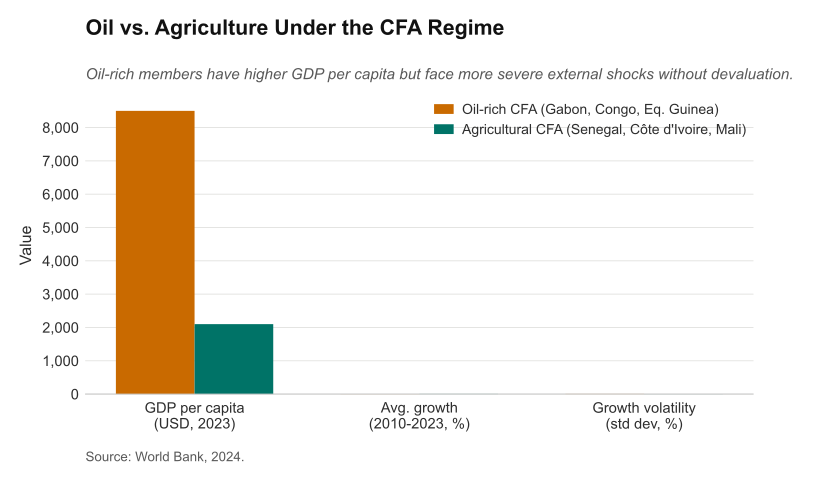
Oil-Rich Countries (mostly Central Africa: Gabon, Congo, Equatorial Guinea)#
- Dutch Disease: Oil windfalls create "excess liquidity" in banks, but farming and manufacturing wither away. The country becomes a one-trick pony.
- The boom-bust trap: When oil prices crash (which they always do), you can't devalue. You just bleed. French military presence is strongest here—coincidence? Probably not.
Which countries left the CFA? How are they doing now?#
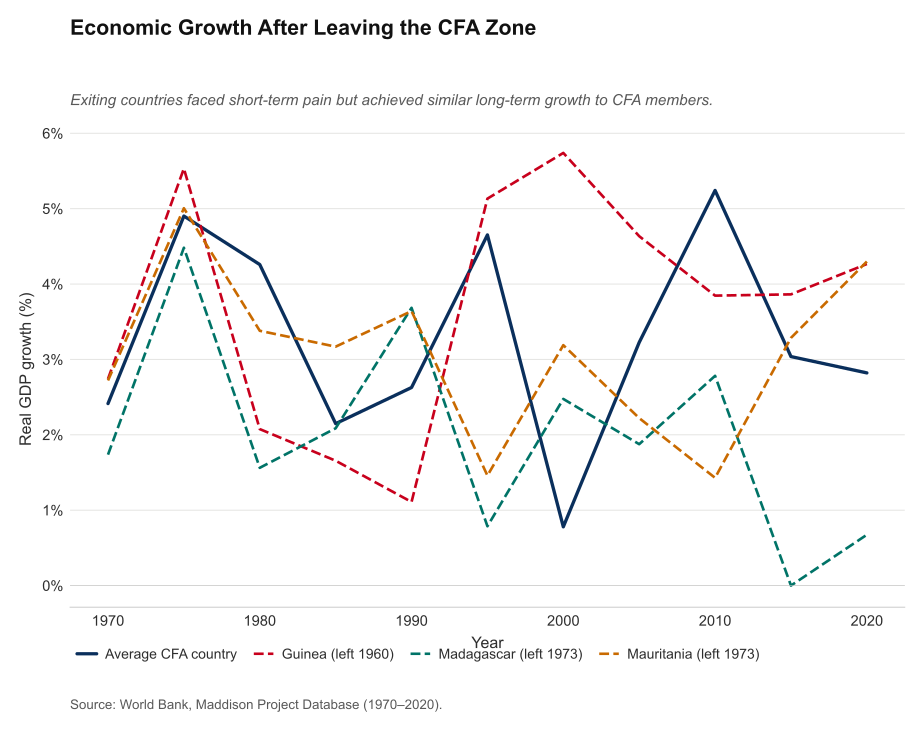
🇬🇳 Guinea (1960) 🇲🇱 Mali (1962 — rejoined 1984) 🇲🇬 Madagascar (1973) 🇲🇷 Mauritania (1973)
Let me tell you about each one.
Guinea (1960) — The First to Jump#
When Guinea voted "No" to Charles de Gaulle's new constitution in 1958, de Gaulle reportedly said: "Well, let Guinea have its independence then. And let's see how it manages without France."
Then France sabotaged them. Operation Persil—yes, that's the real name—involved French intelligence flooding Guinea with counterfeit currency to destabilize the economy. Guinea's first decade was brutal. But today? It has its own currency (the Guinean franc), full monetary sovereignty, and no French official sitting on its central bank board.
Verdict: Painful exit. Sovereign now. Still poor, but that's true of many CFA nations too.
Mali (1962-1984) — The Cautionary Tale#
Mali left, created the Malian franc, then suffered hyperinflation and economic collapse. It rejoined in 1984. Critics of CFA exit always point to Mali: "See! You can't survive alone!"
But here's the counterargument: Mali left during the worst possible time—no preparation, no technical assistance, and active French hostility. A planned exit today would look very different.
Madagascar (1973) — The Quiet Success#
Madagascar replaced the CFA with the Malagasy franc (now the ariary). Did it face turbulence? Yes. Severe turbulence. But it survived. Today, Madagascar has its own central bank, its own monetary policy, and no deposit requirement in Paris.
Growth has been inconsistent—but again, so has growth in CFA nations. The difference is that when Madagascar's economy struggles, it can devalue. When CFA nations struggle, they cut hospital budgets.
Mauritania (1973) — The Diplomatic Pivot#
Mauritania left as part of a broader reorientation away from France and toward the Arab world. It introduced the ouguiya and hasn't looked back. Was it easy? No. Did it work? Yes.
What's the political impact? Isn't this just about money?#
Oh, this is never just about money.
The CFA system is the financial anchor of Françafrique—the informal network of political, military, and business relationships that keeps French influence alive in Africa.
Here's how it works:
- Privileged access: "Friendly" leaders ensure French companies get exclusive deals on oil, uranium, and manganese.
- The penalty for rebellion: If a leader tries to break the rules, France has historically used its intelligence services or military to replace them. (Ask Thomas Sankara. Oh wait, you can't—he was assassinated in 1987 after threatening to break with Françafrique.)
- The debt hook: Much of France's "aid" comes with contracts that must go to French companies. Your tax dollars, paid to African governments, flow right back to Paris.
Until very recently, French officials sat on the boards of African central banks with de facto veto power over monetary decisions. Think about that: a former colonial power had veto power over another country's interest rates.
Is the CFA finally changing?#
Yes—slowly, grudgingly, under pressure.
In 2019, France and the West African CFA nations announced reforms:
- The currency was renamed from franc CFA to Eco (though it's still pegged to the Euro)
- France would withdraw its representatives from West African central bank boards
- The 50% reserve deposit requirement would end
The Central African CFA zone (CEMAC) hasn't followed suit. And the "Eco" still requires French guarantee. And the 50% deposit is being phased out, not eliminated tomorrow.
Change is happening. But it's happening at the speed France allows, not at the speed Africa demands.
So what's the bottom line?#
Here's my honest take after reading the research:
The CFA franc delivers exactly what it was designed to deliver: price stability for France's trading partners and guaranteed convertibility for French corporations. It was never designed to maximize African growth or industrialization.
For 80 years, 14 nations have traded monetary sovereignty for low inflation. Some economists say that's worth it. Others point to the $80 billion in capital flight, the destroyed local industries, and the political strings attached and say: Absolutely not.
The countries that left survived. Some thrived. None collapsed.
The question isn't "Can African nations survive without the CFA?" The question is: After 80 years, why are they still being asked to prove it?
The following infographic summarizes the key trade-offs of the CFA franc system:
References#
Devarajan, S., Jakobeit, C., & de Melo, J. (1986). Growth and adjustment in an African monetary union: The CFA Franc Zone (CPD Discussion Paper No. 1986-30). The World Bank.
Doyle, P. (2024, April 13). Leaving Africa's colonial-era currency will be hard, but wise. The Monitor.
International Monetary Fund. (2007). The CFA arrangements: More than just an aid substitute? (IMF Working Paper No. 07/19).
International Monetary Fund. (2020). Do monetary policy frameworks matter in low income countries? (IMF Working Paper No. 2020/139).
Pigeaud, F., & Sylla, N. S. (2021). Africa's last colonial currency: The CFA Franc story. Pluto Press.
Reuters. (2019, December 21). West Africa renames CFA franc but keeps it pegged to euro. Reuters.
Silva, K. de S. (2025). Françafrique, neocolonialism and the political economy of the CFA Franc. Revista Brasileira de Estudos Africanos, 10(19).
Tadesse, M. (2018). The CFA Franc Zones: Neocolonialism and dependency. Exploring Economics.
Tsangarides, C. G., & Abdih, Y. (2006). FEER for the CFA franc (IMF Working Paper No. 06/236). International Monetary Fund.
Une monnaie commune au Sahel : derrière la logique politique, un risque économique. (2024, June 26). Revue Conflits.