Who Paid, Who Benefited#
In the tournament model's simple formulation, rulers captured glory while subjects paid taxes. This asymmetry was not a bug; it was the mechanism that made war so frequent. A ruler who lost a war rarely lost his throne in early modern Europe (table 2.2). His subjects, however, suffered devastation: armies foraged off the land, spread disease, and disrupted agriculture for a generation or more.
The costs were enormous. In the Thirty Years War (1618-1648), some German regions lost half their population. French agricultural productivity fell 25 percent in war zones and took a generation to recover (Gutmann 1980). Taxes in England and France absorbed 12-20 percent of GDP by the 1780s — a crushing burden for pre-industrial economies.
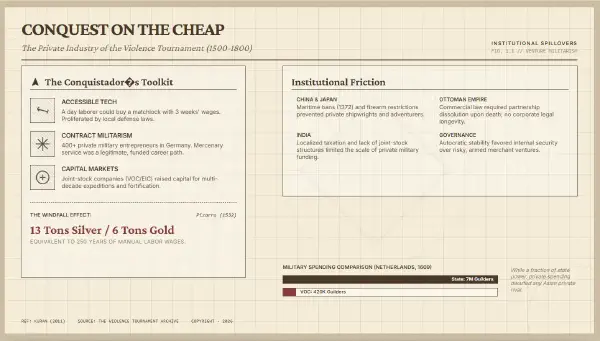
Who benefited? Rulers gained glory and sometimes territory. Merchant elites in maritime powers gained access to colonial trade monopolies. Soldiers and sailors could win plunder — Pizarro's ransom was 250 years' wages for a Spanish labourer. But these were tiny fractions of the population. The average European was poorer because of the tournament, not richer.
European war mortality
Military deaths per year: 41,000 (1650-1815); civilian deaths often higher.Atlantic slave trade
~11 million Africans transported to Americas; 1-2 million died in passage.Native American population collapse
Population fell by 90% in some regions; conquest and forced labour exacerbated disease.Colonial extraction
British Empire generated no net profit for British taxpayers, 1880-1912.Industrial Revolution
Welfare benefits ambiguous; real wages stagnated until 1820s, then rose.
The Colonial Balance Sheet#
The costs outside Europe were far greater. The Atlantic slave trade transported some 11 million Africans to the Americas; 1-2 million died during the crossing. In the Americas, native populations fell by 90 percent in some regions; disease was the primary killer, but conquest and forced labour prevented recovery.
What did Europeans gain? The silver from Latin America funded Spain's wars — but those wars were part of the tournament, not a net addition to European welfare. Sugar, tobacco, and cotton from slave plantations enriched British and French merchants, but the profits were concentrated.
By the nineteenth century, the colonial balance sheet was ambiguous. The British Empire generated no net profit for British taxpayers between 1880 and 1912; it required a subsidy and redistributed income from middle-class taxpayers to the upper classes (Davis & Huttenback 1986). French West Africa cost the French budget 0.29 percent annually — a trivial sum, but still a cost, not a profit (Huillery 2014).
The economic benefits of empire, where they existed, were captured by small elites. The costs — including the moral cost — were borne by everyone else.
The Industrial Revolution Question#
The strongest argument for the tournament's long-term benefit is that it triggered the Industrial Revolution. Robert Allen, Ronald Findlay, Kevin O'Rourke, and Patrick O'Brien have argued that Britain's victory in the wars of the seventeenth and eighteenth centuries won it a large share of intercontinental trade. That trade raised wages, creating incentives to substitute machines for labour — and thus the Industrial Revolution.
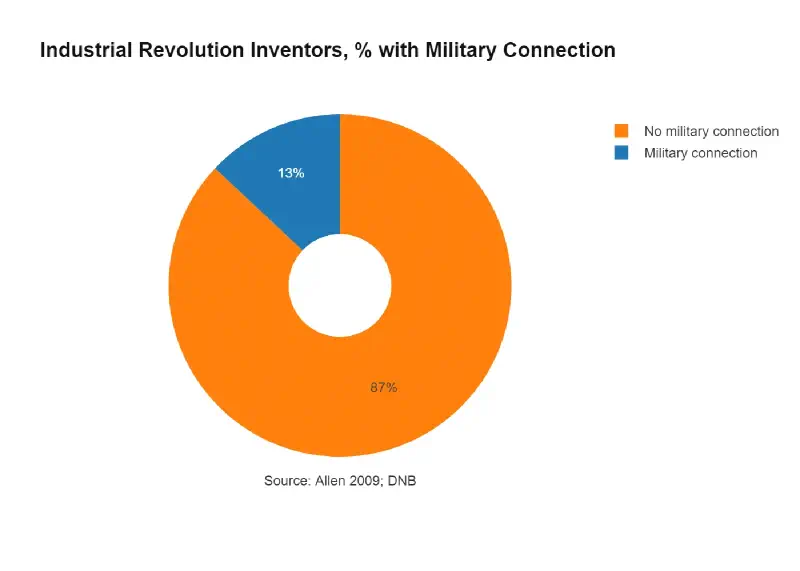
The evidence is mixed. Only 13 percent of Industrial Revolution inventors had any connection to the military — about what one would expect given military spending's share of GDP (Allen 2009; Dictionary of National Biography). Cotton textiles, the leading sector, had no military connections. Iron, where military demand was important, contributed less than 4 percent of total factor productivity growth between 1780 and 1860 (Mokyr 2003).
The counterfactual models are also fragile. Allen's empirical framework suggests that if Britain had lost its wars and its intercontinental trade, wages would have fallen to 1700 levels and industrialisation would have been delayed for decades. But it also suggests that if France had won Britain's trade, French wages would have risen only 2 percent — not enough to trigger industrialisation. The causal chain from naval victory to industrial breakthrough is plausible but far from proven.
Better evidence supports human capital explanations. Skilled mechanics migrated from France to England, not the reverse. British artisans had higher literacy and numeracy than their continental counterparts (Kelly, Mokyr & Ó Gráda 2012). The knowledge economy of the Enlightenment — which was European-wide, not uniquely British — may have mattered more than any single war's outcome.
The Shadow of 1914#
The tournament's final cost was the most catastrophic of all. By 1914, Europe's armed peace had produced an interlocking alliance system, massive standing armies, and military technology far deadlier than anything that had come before. The assassination of Archduke Franz Ferdinand triggered a war that killed 10 million soldiers and 7 million civilians.
World War I ended European global dominance. The United States and the Soviet Union emerged as superpowers; European states, exhausted and indebted, could no longer sustain their empires. Decolonisation followed World War II. By the 1970s, the European empires that had taken five centuries to build were gone.
In the Cold War that followed, Europe's former great powers became bit players. Britain and France acquired nuclear weapons but could not match American or Soviet spending. NATO provided security; European states free- rode on the American defence budget. The tournament that had made Europe the master of the world had ended.
The Persistent Shadow of Conquest#
The legacy of the tournament persists. The slave trade still keeps Africa poor, according to econometric evidence (Nunn 2008). The Spanish conquest's extraction institutions — the mita system in Peru, the encomienda in Mexico — correlate with poverty today (Dell 2010). Bad institutions, unequal wealth distribution, and blocked mass education all trace back to colonial rule.
Could the tournament have produced the Industrial Revolution without the conquest? Possibly. The scientific and engineering advances of the Industrial Revolution were European-wide; they did not depend on slavery or colonial extraction. But they did depend on the tournament's pressure to innovate — and that tournament was inseparable from the violence that accompanied it.
The Ultimate Contingency#
The series has argued that Europe conquered the world because a tournament of military innovation produced sustained technological superiority. The tournament required four conditions: frequent war, massive spending, focus on gunpowder, and open diffusion. Only Europe met all four continuously.
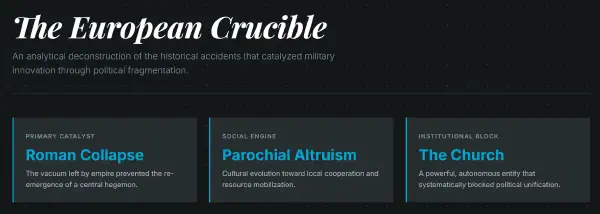
But those conditions were not preordained. They emerged from a specific political history: the Roman collapse, centuries without strong states, cultural evolution toward parochial altruism, an autonomous Church blocking unification, and political learning that lowered the cost of mobilising resources.
At several points — Charlemagne's succession, the Mongol conquest, the collapse of the Mughal Empire — plausible alternatives existed. A different turn could have produced a hegemon in Europe, a fragmented China, a powerful Indian state, or an Ottoman empire with low political costs. Any of these might have produced a different global order, perhaps with China as the conqueror, or with no global conqueror at all.
The series argument in one paragraph Europe conquered the world not because of cultural superiority, geography, or disease immunity, but because its rulers engaged in a tournament of military innovation that produced sustained technological superiority. The tournament required four conditions — frequent war, low political costs, focus on gunpowder, and open diffusion — that held continuously only in Europe. These conditions were not inevitable; they emerged from a specific chain of political history that included centuries without strong states, cultural evolution toward parochial altruism, and an autonomous Church. At several points, the chain could have broken, producing a different world. The cost of conquest was enormous: colonial peoples endured slavery and extraction; average Europeans saw ambiguous welfare effects; and the tournament eventually turned on itself in 1914.
The answer to "Why did Europe conquer the world?" is not that Europeans were smarter, braver, or more virtuous. It is that their political history produced a tournament that no other civilisation happened to experience. That history was contingent. It could have been otherwise. And in the long shadow of conquest, that is perhaps the most unsettling conclusion of all.