The Great Deceleration Surprise#
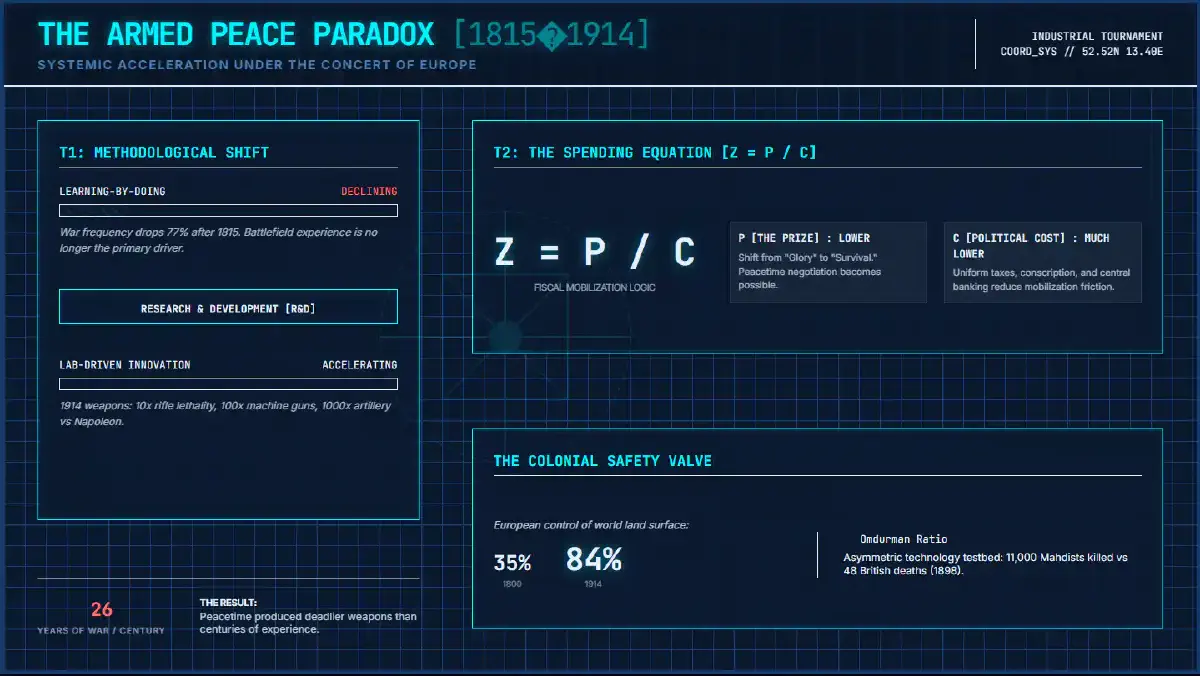
After the Napoleonic Wars, Europe's rulers attempted something unprecedented: they tried to stop fighting each other. The Congress of Vienna (1814-1815) created a coalition that discouraged great power war for nearly a century. Between 1816 and 1913, western Europeans spent only 26 years at war per century — a 77 percent decline from the 1650-1815 period (Dincecco 2009). Military deaths per year dropped from 41,000 to 9,000.
If learning-by-doing required battlefield experience, this deceleration should have halted military innovation. It did not. By 1914, infantry rifles were over ten times deadlier than eighteenth-century flintlocks; machine guns nearly a hundred times more lethal; artillery more than a thousand times more destructive than Napoleon's best cannons. Steam-powered ironclads replaced sailing ships. Railroads and telegraphs transformed supply and command.
Congress of Vienna
European powers create coalition that discourages great power war for a century.Paixhans shell
French officer introduces explosive shells for naval guns — wooden ships become obsolete.Austro-Prussian War
Prussian breech-loading rifles slaughter Austrians with muzzle-loaders.Matabeleland
700 Europeans with machine guns defeat 5,000 Ndebele warriors; casualties 30:1.First Opium War
British steam gunboats ascend Yangtze, force China to concede Hong Kong and trade rights.
How could innovation accelerate when warfare declined? The answer lies in three transformations.
Transformation 1: Research Replaces Experience#
In the early modern period, military innovation was primarily learning-by-doing. Rulers fought wars, saw what worked, and copied their enemies' successes. In the nineteenth century, research and development (R&D) became the primary engine.
The British navy's adoption of copper sheathing in the 1780s foreshadowed the shift. The impetus came from shipworm damage in tropical waters, not battle experience. Systematic experiments identified copper as an effective anti-fouling agent; further work solved the galvanic corrosion problem. The result was a 20 percent speed increase and a one-third increase in effective fleet size.
After 1815, R&D accelerated dramatically. The French officer Paixhans developed explosive shells in the 1820s; trials proved their devastating effect on wooden ships. By the Crimean War (1853-1856), both sides used shell-firing guns. The Ottoman fleet at Sinope was obliterated. By 1858, France was building ironclad warships; Britain responded with its own — and an arms race in naval armour began.
R&D had a decisive advantage: it did not require war. Rulers could fund research in peacetime, confident that any advance would give them an edge in the next conflict — or in the negotiations that, increasingly, replaced conflict.
Transformation 2: Political Costs Keep Falling#
The nineteenth century saw dramatic reductions in the political cost of mobilising resources. The Napoleonic Wars eliminated most of the Old Regime's fiscal particularism; uniform tax systems replaced provincial exemptions. Representative assemblies gained control of taxation, which — as in England after 1689 — lowered borrowing costs and made tax increases politically feasible.
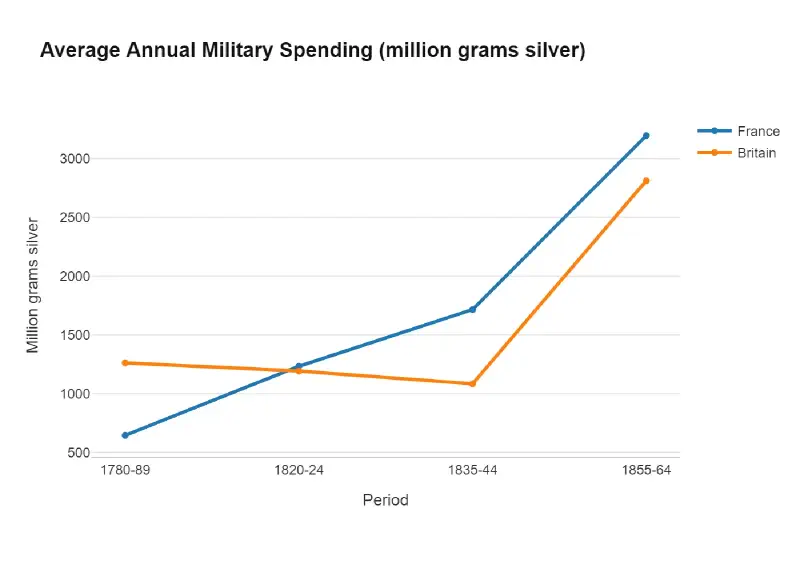
The result was rising military spending even in peacetime. Between the 1820s and the 1860s, French and British military spending was roughly the same as or higher than in the 1780s, despite far fewer wars. By 1855-1864, annual military spending in France had quintupled from 1780s levels; in Britain it had more than doubled (Corvisier 1997; Mitchell & Deane 1962).
Conscription also lowered costs. Universal military service — introduced by France during the Revolution, adopted by Prussia, then by other European states — gave rulers access to vast manpower pools without paying market wages. Russia, which had serf conscription long before western Europe, mobilised armies that dwarfed those of the Napoleonic era.
The tournament model's spending equation — Z = P/C — explains the paradox. Yes, the prize P declined: glory mattered less, and negotiated settlements replaced war. But the total cost C fell even faster. Uniform taxation, representative institutions, conscription, and financial innovation all reduced the political price of mobilising resources. The result was that total military spending Z rose even as actual warfare declined.
Transformation 3: The Prize Changes#
Glory — the indivisible prize that had motivated early modern rulers — faded as a motive for war. Google Ngram data show the frequency of "glory" (and French "gloire") declining sharply after 1800. The word's association with "war" dropped from 0.11 occurrences per 10,000 words in the 17th century to 0.02 in the 19th (ARTFL database).
What replaced glory? National survival and territorial integrity. The Napoleonic Wars had shown that defeat could mean the end of a state. The Congress of Vienna created a system where great powers had a collective interest in preventing any single state from dominating Europe. When war did occur — Crimea (1853-1856), Austro-Prussia (1866), Franco-Prussia (1870-1871) — the stakes included regime survival. Napoleon III lost his throne after Sedan; the Prussian monarchy's existence was never seriously at risk, but the possibility of defeat had real political costs for rulers.
Because survival is divisible — it can be negotiated (cede territory, accept limits on military forces) — the new prize made peaceful settlement possible. The Concert of Europe system worked precisely because states found it in their interest to negotiate rather than fight. When negotiation failed, war was short and decisive: the average nineteenth-century European war lasted months, not years.
The Colonial Safety Valve#
If European states fought less among themselves, they fought more in the rest of the world. Between 1815 and 1914, colonial wars expanded European control from 35 percent to 84 percent of the world's land surface.
The military technology developed for intra-European warfare — rifled breech-loaders, machine guns, steam gunboats, quinine for malaria prevention — was devastating against non-European opponents. At the battle of Omdurman (1898), British machine guns killed 11,000 Sudanese Mahdists while suffering 48 British deaths. In Matabeleland (1893), 700 Europeans with machine guns defeated 5,000 rifle-armed Ndebele warriors; casualties were 30:1 against the Ndebele.
European expansion, 1800-1914 1800: Europeans controlled 35% of world's land surface (including ex-colonies) 1914: Europeans controlled 84% of world's land surface Source: Fieldhouse 1973; Headrick 1981
The colonial wars did not threaten European great power stability. They were asymmetric conflicts where European military technology was overwhelmingly superior. They provided a "safety valve" for the tournament's competitive pressures — a place where European states could test their military capabilities without risking the existence of the state system itself.
Why Europe Did Not Unify#
The nineteenth-century armed peace raises a final puzzle: why did Europe's great powers not unify? The tournament model predicts that when one state achieves decisive military superiority, others will cease to challenge it — producing a hegemon. By 1871, Prussia (soon Germany) had defeated Austria and France and was the continent's dominant military power. Yet Britain, France, and Russia did not submit.
The answer lies in the balance-of-power system. Britain's naval supremacy, France's recovery after 1871, Russia's vast size, and the emerging alliance system (Triple Alliance vs Triple Entente) prevented any single state from achieving hegemonic control. The tournament continued in a new form: an arms race in which no one could afford to stop, but no one could win decisively either.
By 1914, Europe's armed peace had produced the largest, best-equipped armies in history and a web of alliances that turned a local conflict in the Balkans into world war. The tournament that had driven European conquest for five centuries finally turned on itself — with consequences that would end European global dominance.
Article 7 asks the final question: who actually gained from this long tournament, and what did conquest cost?