The Conquistador's Toolkit#
When Hernán Cortés landed in Mexico in 1519, he had no official military rank. He was a private adventurer who had financed his expedition through investors and promises of future plunder. Of the 2,100 Europeans who participated in the conquest of Mexico, only 28 percent had prior military experience. Yet they defeated the Aztec Empire.
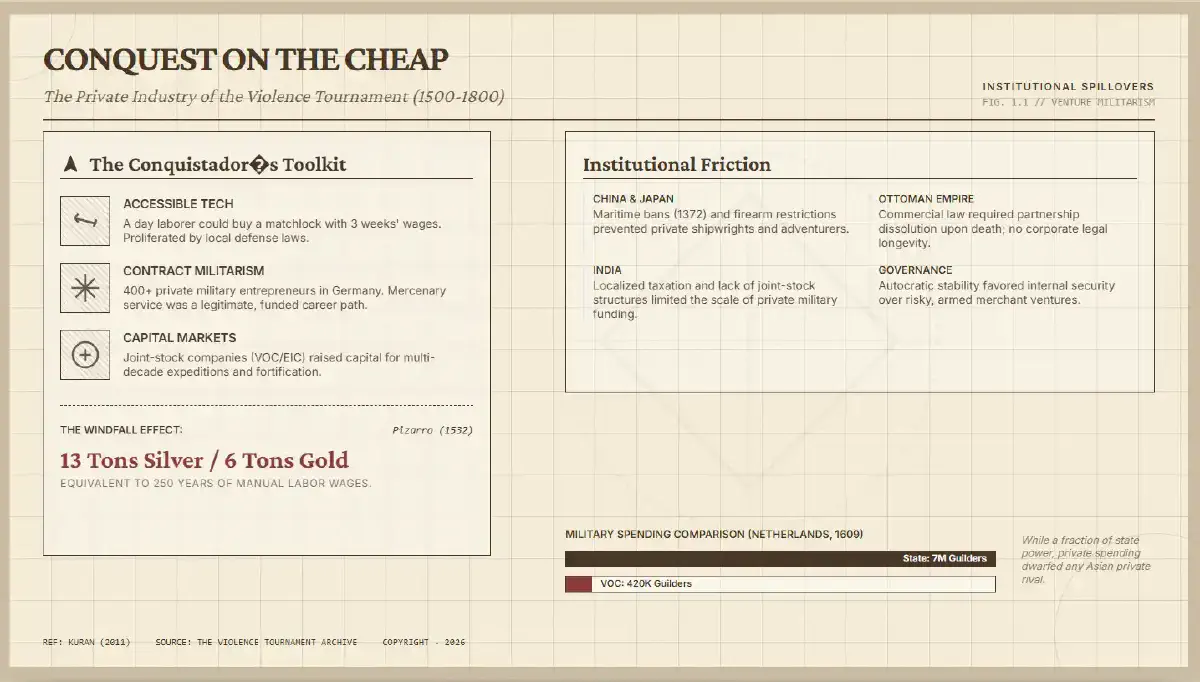
How? Because the gunpowder technology — broad as defined in the tournament model — was widely available. Spain had battle-hardened troops from its campaigns in Granada and Italy. Laws encouraged subjects to own weapons; loopholes made gun control ineffective. In early seventeenth-century Paris or London, a day labourer could buy a matchlock musket with two to three weeks' wages.
Cortés conquers Mexico
13 brigantines, 900 Europeans, 75,000 native allies — technology attracted allies.Pizarro's ransom
167 men capture Inca emperor; ransom of 13 tons silver and 6 tons gold — 250 years' wages for a Spanish labourer.Portuguese take Malacca
Strategic port captured; European-style fortress withstands 10:1 siege 1568.Dutch East India Company founded
Joint-stock corporation raises capital for fortified trading posts and naval warfare.Anson's silver
32 wagons of captured Spanish silver paraded through London; captain promoted to First Lord of the Admiralty.
Cortés's most dramatic technological feat was building thirteen brigantines — small armed galleys — to assault Tenochtitlan, the Aztec capital on an island in a lake. He had the ships constructed fifty miles away, then carried in pieces across rugged terrain and reassembled. The brigantines defeated Aztec canoes, ferried troops, cut off food supplies, and shelled buildings from canals. Without them, the siege would have failed.
The brigantines were not state property. Cortés built them using private funds and captured Aztec labour. But the knowledge of how to build them — and the skilled shipwrights, carpenters, and gunners who did the work — came from Europe's tournament. The same applies to the Portuguese fortress at Malacca, captured in 1511 and held against a 10:1 siege in 1568, or the Dutch fort at Batavia, or the Portuguese town of Chaul where 1,100 Europeans defeated a siege by 140,000 Indians in 1570-1571.
The Enabling Conditions#
Why was Europe's gunpowder technology so easily accessible to private adventurers? Three conditions mattered:
First, widespread familiarity. By the sixteenth century, firearms were common in Europe. French peasants owned muskets; city dwellers fired them during festivals. English law required men to possess arms for local defence. The Bill of Rights (1689) enshrined a right to bear arms. This was not true in China or the Ottoman Empire, where gun ownership was restricted.
Second, legitimate private military enterprise. European rulers had long relied on mercenaries, privateers, and military contractors. During the Thirty Years War, there were some 400 military entrepreneurs active in Germany alone. These contractors provided troops, supplies, and credit — often more efficiently than the state could. Private conquest overseas was an extension of this tradition, not an exception.
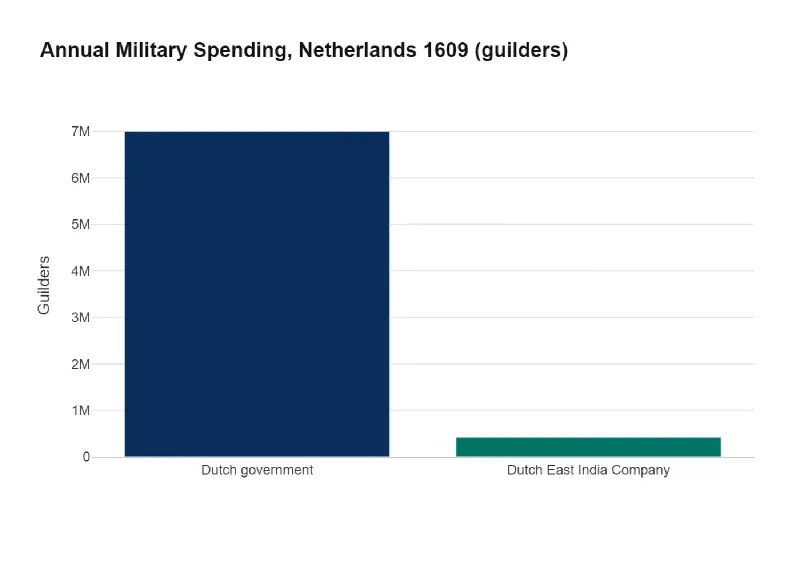
Third, access to capital. Conquistadores raised money from investors who expected a share of the plunder. By the seventeenth century, joint-stock companies like the Dutch and British East India Companies could raise enormous sums on Europe's capital markets. The Dutch East India Company's military spending in Asia was 420,000 guilders in 1609 — dwarfed by the Dutch government's 7 million guilders, but still far more than any Indian or Southeast Asian ruler's private enemies could muster.
The East India Company as Tournaments Spillover#
The British East India Company was not initially a territorial power. It was a trading company. But it operated in an environment where European rivals (the French, the Dutch) fought each other using military force. The Company had the right to conduct military operations, and it used that right aggressively.
The conquest of India was driven by a combination of state support (naval forces sent to fight the French, diplomatic backing) and private incentives. Company employees traded on their own account; their personal profits depended on excluding rivals and securing monopoly privileges. When the Nawab of Bengal attacked the Company's factories in 1756, Company men used their own army (and British naval forces) to retaliate. Within a decade, the Company had taken over Bengal and was collecting its taxes.
The crucial advantage the Company had over Indian rivals was lower political costs. It could draw on British tax revenue and capital markets; its military technology was more effective; it did not face succession disputes that discounted the value of victory. Elites preferred alliance with the Company because it offered credible military protection at a lower price than Indian rulers could match.
Barriers Elsewhere#
Outside Europe, private military enterprise was harder. China banned overseas trade and private gun ownership for long periods. Japan's Tokugawa shoguns prohibited Japanese from going abroad on pain of death, banned the construction of large ships, and restricted firearms. These policies were not irrational: they reinforced domestic security and kept military lords from gaining too much wealth from foreign trade. But they also prevented Japanese or Chinese equivalents of Cortés or the East India Company.
The Ottoman Empire faced a different obstacle: Islamic commercial law made joint-stock corporations with indefinite life spans difficult to establish. Partnerships had to be dissolved when a partner died — impractical for ventures with fixed capital invested in distant fortresses and ships. The Dutch East India Company, by contrast, could raise capital from hundreds of investors and hold assets for decades. The corporation, originally invented by the western Church to manage long-lived religious institutions, gave European entrepreneurs a crucial financial technology that Islamic merchants lacked (Kuran 2011).
Barriers to private military enterprise outside Europe China: Maritime bans (1372 onward); gun control; officials reluctant to support merchants abroad Japan: Death penalty for going abroad (after 1640); shipbuilding bans; gun control Ottoman: Islamic partnership law (dissolution upon partner death); no corporate legal personality India: Gun ownership more widespread, but no joint-stock companies; taxation still localised
The Windfall Effect#
Europe's perceived economic inferiority also mattered. Westerners in 1500 were convinced that Asia was wealthier — a belief that motivated Columbus, da Gama, and Cortés. When Cortés's gold reached Spain in 1520, it "created a sensation" (Grunberg 1994). Pizarro's ransom of 13 tons of silver and 6 tons of gold was more than he and his men could have earned in 250 years as Spanish labourers. The silver mines discovered in Mexico and Peru in the mid-sixteenth century funded Spain's wars and attracted other Europeans to the Americas.
No other civilisation had such windfalls. Zheng He's fleets (1405-1433) brought back ostriches and giraffes, not treasure. The Chinese emperor's reaction to exotic goods was deliberately blasé: "We do not have any desire for goods from distant regions." Without the prospect of windfall profits, there was less incentive for private expeditions.
Counterfactuals Revisited#
The tournament model's sensitivity to initial conditions suggests several plausible counterfactuals where private conquest would not have happened:
- If China had not banned overseas trade in 1372, Chinese merchants might have built fortified trading posts in Southeast Asia, competing with Europeans
- If Islamic law had permitted joint-stock corporations, Ottoman merchants might have raised capital for Indian Ocean expeditions
- If Spain had not found silver, the incentive for other Europeans to contest the Americas would have been weaker
None of these counterfactuals are certain. But they show that Europe's private conquest was not guaranteed — it depended on specific historical conditions that could have been otherwise.
By 1800, European states had absorbed the lesson: private conquest overseas was profitable, and they increasingly regulated and taxed it. The East India Company was brought under parliamentary control in the 1770s; the Dutch government took over the VOC in 1799. But the pattern was set. The tournament had produced not just state armies but an entire private military industry — and it had carried European power to every continent.
Article 6 examines how the tournament changed in the nineteenth century, when European wars became rarer but military innovation accelerated.