Geography Does Not Explain Fragmentation#
The simplest explanation for Europe's fragmentation is physical geography: mountains, irregular coastlines, river systems. It is also wrong.
China is actually more mountainous than Europe. Using three different definitions (elevation >1,000 metres, slope >15 degrees, World Bank classification), China's mountainous terrain ranges from 33 to 37 percent of its land area; Europe's from 6 to 11 percent (Yang 2011). Mountain ranges in Europe divide Spain from France and isolate Italy, but they do not define most national borders. In China, mountains shape provincial boundaries but not the empire's unity.
Coastline irregularity fares no better. Europe's coastline is indeed more rugged — but amphibious invasions were not historically difficult. Vikings, Muslims, Normans, and the English all launched successful amphibious assaults. England was successfully invaded eight times between 1066 and 1485. There was no "peninsula advantage" that preserved small states; Italy and Iberia remained divided despite their peninsular geography.
Fall of Roman Empire
Western empire collapses; centuries without strong states begin.Charlemagne crowned
Empire briefly reunites western Europe but fragments under his grandsons.Investiture Controversy
Pope Gregory VII excommunicates Emperor Henry IV; papacy asserts independence.Crusades
European knights channel martial energy outward; cultural evolution toward parochial altruism accelerates.Magna Carta
English nobles constrain king's taxing power — one path to low political costs.French invasion of Italy
Charles VIII's mobile artillery shocks Italian states; military revolution accelerates.
The Roman Collapse and Cultural Evolution#
The crucial difference between Europe and China is political history. China unified under the Qin in 221 BC and developed a bureaucracy that tied elites to the central state. When the Manchus conquered China in 1644, they simply took over the existing bureaucracy. The empire survived.
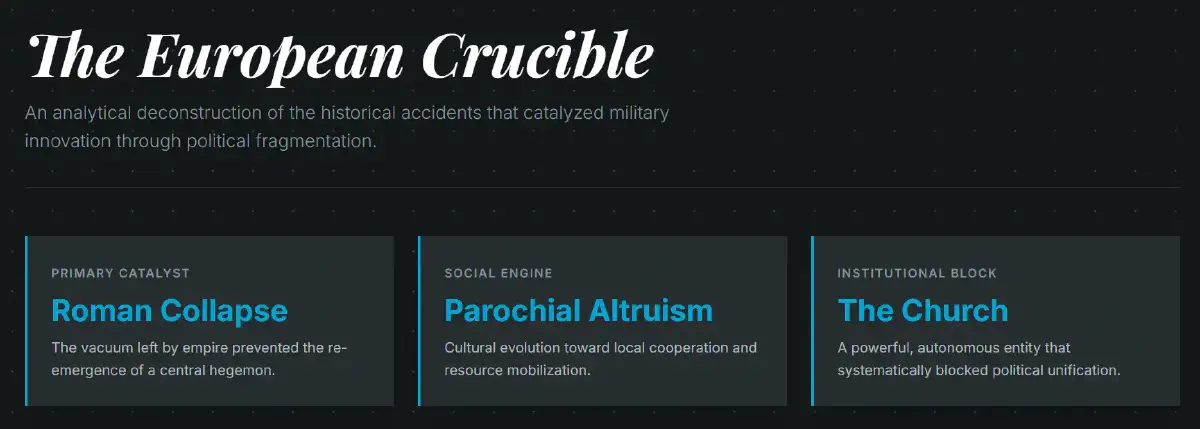
Europe took the opposite path. After the Roman Empire collapsed, western Europe had no strong states for centuries. Instead, it had warrior bands — groups held together by loyalty to a leader, solidarity with comrades, and hostility to outsiders. These bands fought constantly, without the fiscal systems or permanent taxation that characterise states.
This environment selected for what evolutionary anthropologists call "parochial altruism" — willingness to fight and die for one's own group, combined with hostility to outsiders. Experimental economics shows that such norms can evolve rapidly when groups that punish shirkers outcompete groups that do not (Bowles & Gintis 2011). The process is not inevitable; different equilibria are possible. But once established, parochial altruism becomes self-reinforcing. Warriors gain prestige and wealth; cowards are punished.
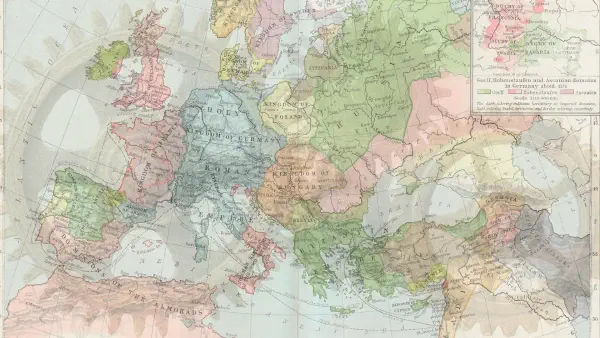
By the High Middle Ages, European knights had internalised these norms. War brought honour and the chance to win estates. Lords gave land to followers in exchange for military service. The result was political fragmentation: by 1300, the Frankish heartland had fractured into hundreds of principalities. No hegemon could emerge because local elites had both the means and the motivation to resist.
The Church as Anti-Hegemon#
Western Christianity provided a second counterweight to unification. The papacy actively worked to prevent any single ruler from dominating Europe. During the Investiture Controversy (11th-12th centuries), popes allied with Italian cities, German aristocrats, and Norman conquerors to block the Holy Roman Emperor's ambitions. Spiritual weapons — excommunication and interdict — could turn subjects against a king who challenged papal authority.
No other civilisation had an equivalent institution. Islamic religious authorities were divided among competing schools of law; the Ottoman sultan appointed and dismissed the Sheikh-ul-Islam. Chinese emperors controlled religious institutions. Orthodox Christianity in Byzantium and Russia was subordinate to the state. The Roman Catholic Church's political independence was unique, and it was a direct consequence of western Europe's post-Roman weakness. The Church built its own administrative structure when no state could stop it — then used that structure to keep states weak.
Why Political Costs Varied Within Europe#
Fragmentation alone does not explain low political costs. Europe had many small states; only some developed the capacity to mobilise resources cheaply. England, France, and Prussia succeeded; the Holy Roman Empire did not.
The mechanism was political learning — rulers figuring out how to raise taxes without provoking rebellion. The process typically occurred during or after wars. France's King Charles V won permanent taxes in the 1360s by using the revenue to suppress brigands — demonstrating that tax money provided security. Prussia's Great Elector Frederick William offered the nobility greater power over their serfs in exchange for military funding.
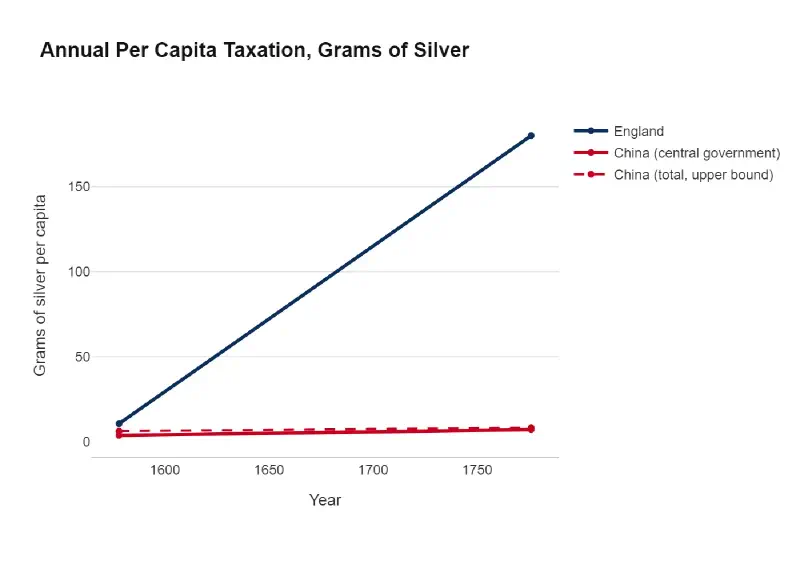
The Glorious Revolution of 1688-1689 was the most important single event. By giving Parliament control of the purse, it cut England's political cost of mobilising resources dramatically. Parliament could audit expenditures, hold ministers responsible, and vote generously for wars it supported. Financial innovation followed: long-term government debt jumped from nothing in 1693 to 45 percent of GDP in 1715. The debt was consolidated into perpetual annuities traded on a public market, lowering interest rates further.
Contingency: The Path Not Taken#
The most important implication of political history as ultimate cause is contingency. At several points, events could have taken a different turn that would have produced a radically different world.
If Charlemagne's empire had survived: Louis the Pious disrupted carefully laid succession plans to make room for a child by his second wife, triggering a civil war that fragmented the empire. If he had not, Charlemagne's empire might have persisted long enough to reshape elite incentives — creating a European hegemon like China, with slower military innovation and no global conquest.
If the Mongols had not conquered China: The Southern Song, a prosperous maritime state with commercial taxes and a powerful navy, might have continued its competition with the Jin and Western Xia. With no hegemon, East Asia could have produced its own tournament — and its own military revolution. By 1800, a fragmented China might have held off European gunboats or negotiated on equal terms.
If Nadir Shah had stayed in India: After defeating the Mughal army in 1739, contemporaries expected the Persian conqueror to stay and create a powerful state in northern India. Such a state might have frightened off the East India Company, delaying or preventing the British conquest of India — and with it, the British Empire's global reach.
These counterfactuals are not fantasy. They are statements about the plasticity of political history at critical junctures. The tournament model identifies the necessary conditions for sustained military innovation; history tells us which societies happened to meet them. Europe's success was not foreordained.
Falsifiable predictions
- Societies that experienced prolonged periods without strong states should show stronger parochial altruism norms
- States that developed representative institutions should have lower political costs of mobilising resources
- Exogenous shocks that fragment a hegemon (e.g., Mongol collapse) should produce military innovation
- Counterfactual scenarios where Europe unified early should predict no global conquest
The Riddle Remains#
Europe developed low political costs because its rulers learned, over centuries, to bargain with elites. It fragmented because the Roman collapse created centuries without strong states, allowing parochial altruism and an autonomous Church to flourish. It focused on gunpowder because geography and the Russian steppe buffer shielded it from nomads — a buffer that existed only because Europe was fragmented and Russia grew large.
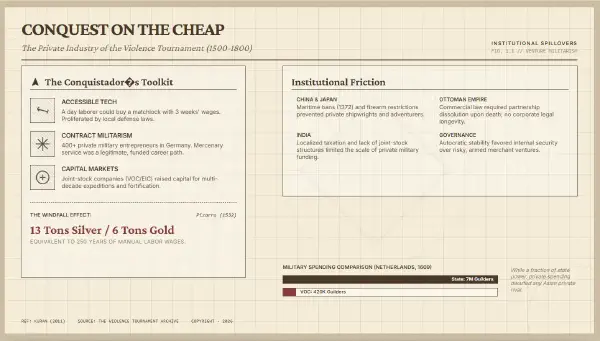
Articles 1-4 have explained why the tournament produced military innovation in Europe and not elsewhere. Article 5 asks how that state-funded innovation ended up in the hands of private adventurers who actually did the conquering.