China: The Nomad Trap#
China was at war as often as any European power — 56 percent of the time between 1500 and 1799 (Kung & Ma data). But 97 percent of those conflicts were against nomads: mounted archers from the steppe against whom gunpowder weapons were often ineffective. Firearms could not be used from horseback; artillery was useless against mobile raiders; supply lines strained to breaking point on the steppe.
China's emperors faced a strategic trilemma. Against nomads, the ancient technology of mounted archery remained optimal. But that technology had exhausted its improvement potential centuries earlier. Gunpowder weapons were useful against rebels and pirates — and crucially, against other gunpowder-using states like Japan in the 1590s Korean invasions. But the emperors could not focus exclusively on gunpowder. They had to divide resources between old and new technologies.
Ming Dynasty
97% of wars are against nomads; gunpowder innovation slows dramatically.Zheng He's fleets halted
Chinese admiral's expeditions to Africa end; focus remains on northern frontier.Korean invasions
Japan's gunpowder armies invade; China mobilises but war ends without sustained innovation.Koxinga defeats Dutch
Chinese loyalist takes Fort Zeelandia in Taiwan but cannot replicate European siegecraft after key defector dies.Macartney mission
British envoy notes Chinese fortifications are obsolete; matchlocks still in use, no flintlocks.
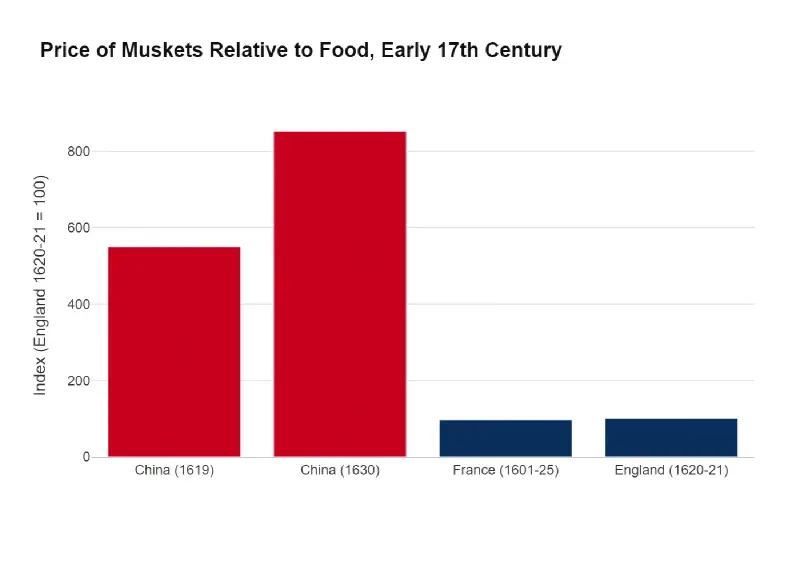
The consequence was a start-stop pattern of innovation. China had two periods of intense gunpowder warfare: the late fourteenth century (civil wars founding the Ming) and the late sixteenth to late seventeenth century (Japanese invasions, Manchu conquest). In between, innovation slowed. After 1683, when the Qing annexed Taiwan, nomads became the only major threat again, and by the mid-eighteenth century they were vanquished. Thereafter, China's gunpowder technology stagnated. By 1793, the Macartney mission reported antiquated matchlocks, cannons mounted on stone instead of carriages, and fortifications without European-style bastions.
The Hegemon Problem#
China's size was also an obstacle. A unified Chinese Empire was a hegemon — so large and populous that potential opponents hesitated to fight. When Japan's Toyotomi Hideyoshi invaded Korea in the 1590s, he lamented being "born in a small country" that left him "unable to conquer China because of a lack of troops" (Berry 1982).
In tournament terms, China's resource limit L₁ was so large that inequality (8) from Appendix A failed: ruler 1's expected earnings were negative because his opponent was too big. Potential challengers sat on the sidelines. Without challengers, there was no war, no spending, no learning-by-doing.
This was not inevitable. A fragmented China — as during the Southern Song (1127-1279) — might have sustained a tournament. But the Mongols ended that possibility when they conquered China in the thirteenth century. Thereafter, unification became self-reinforcing: the bureaucracy tied elites to the central state; Confucian ideology discouraged military careers; cultural homogenisation reduced ethnic fragmentation. By the early modern period, a unified hegemon was the default.
India: High Political Costs, Low Spending#
Eighteenth-century India offers the most damning evidence against any theory that simply "frequent war" explains innovation. After the Mughal Empire's collapse, India fragmented into warring states that fought constantly. Armies used gunpowder weapons. Markets for military goods and services flourished. By Kennedy's and Diamond's logic, India should have been an innovation powerhouse.
It was not. Nearly all advances came from European experts — French officers training Indian troops, British arms imported through the East India Company. Why?
The tournament model's answer is precise: Indian rulers faced high political costs of mobilising resources. The Mughal Empire had been decentralised; local elites controlled tax collection long before its collapse. Provincial governors gained autonomy; revenue that should have funded armies stayed in local hands. The kingdom of Mysore, despite fiscal reforms, had no regular tax revenue as late as 1725. Tipu Sultan's attempts to replace Brahmin revenue collectors with Muslims failed because the new officials lacked local land-value information (Subrahmanyam 1989).
Succession disputes further reduced the effective prize. In Europe, dynastic conflicts had become less lethal by the early modern period; rulers rarely lost their thrones after defeat. In India, rulers who won a war might still lose their position in the subsequent succession struggle. The expected value of victory was discounted by the probability of being overthrown.
The East India Company exploited this gap. With its lower political costs — drawing on British tax revenue, naval support, and more effective military technology — it could mobilise more resources than any Indian rival. It took Bengal's tax revenues, struck deals with local elites, and used the revenue to fund further conquests. The Company's low variable cost made it an attractive ally; elites preferred its protection to the uncertain promises of Indian rulers.
The Ottoman Empire: Stuck in the Middle#
The Ottoman Empire fell behind for multiple reasons. Like China, it faced nomad threats (Tatars, Persians) that required cavalry. As late as 1700, 40-50 percent of the Ottoman army was cavalry, versus 30 percent in France. Like Russia, it had to maintain galley fleets in the Black Sea and Mediterranean — an ancient technology with limited improvement potential.
But the deeper problem was political. The janissaries — military slaves who formed the core infantry — became an entrenched interest group that blocked reform. Unlike European rulers who negotiated with elites for taxes, Ottoman sultans relied on janissaries who eventually pocketed revenue and defied orders. By the eighteenth century, per capita tax revenues in the Ottoman Empire were far below European levels (Pamuk & Karaman 2010). When the Ottomans fought European powers, their lower spending meant higher probability of defeat — and indeed, their loss rate jumped from 30 percent (1500-1699) to 56 percent (1700-1799).
Comparative war loss rates, 1500-1799 Ottoman Empire: 30% of wars lost (1500-1699) → 56% lost (1700-1799) Russia: 36% lost (1500-1699) → 12% lost (1700-1799) Source: Levy 1983; Clodfelter 2002
The One-Way Flow of Expertise#
The ultimate proof of Europe's lead is the direction of technology transfer. From the sixteenth century onward, Europeans exported firearms, artillery, and military expertise to the rest of the world — not the reverse. European experts were hired throughout Asia and the Middle East. Jesuit missionaries helped Chinese emperors cast cannons. French officers trained Indian troops. Dutch shipwrights advised the Russian navy.
The only significant exception was the rocket, invented in India — a curiosity compared to the cascade of European innovations: flintlocks, bayonets, copper-sheathed hulls, mobile field artillery, star-shaped fortresses, volley fire tactics, naval broadsides, interchangeable parts, breech-loading rifles, machine guns, ironclad ships.
The tournament model predicts this asymmetry. Where the four conditions fail, innovation slows. Rulers in China, the Ottoman Empire, and India could adopt European technology — but only with a lag, and only when the whole package of complementary skills could be assembled. In Koxinga's case, victory over the Dutch in 1662 depended on a German defector who knew European siegecraft. Four years later, his heirs had forgotten how to besiege a Dutch fort.
Articles 1-3 have established the tournament mechanism and shown why only Europe sustained it. Article 4 now asks the hardest question: why did Europe develop low political costs while others did not? The answer lies in political history — and it reveals that the outcome was far from inevitable.