The Ruler's Calculus#
Thomas Hobbes identified three causes of war: competition (gain), diffidence (safety), and glory (reputation). In early modern Europe, all three operated, but glory was paramount. Rulers were raised to fight. The future Louis XIII fired actual muskets at age eight. Louis XIV instructed his son that war was how kings distinguished themselves.
But glory alone does not explain why Europe's rulers fought so much — 54 to 71 percent of the time between 1550 and 1800 (Wright 1942). The key is who bore the costs. Rulers captured a disproportionate share of the spoils (glory, territory, commercial advantage) while their subjects paid the taxes and suffered the devastation. In France and England, 40 to 80 percent of government budgets went directly to the military; including debt payments for past wars, the share exceeded 90 percent.
Because rulers did not personally bear the costs of defeat — no major western European monarch lost his throne after a foreign war between 1500 and 1790 — their downside risk was limited. The prize, meanwhile, included indivisible goods: glory could not be shared; victory over religious enemies could not be traded. These obstacles to peaceful settlement made war the default outcome.
Political Costs: The Hidden Variable#
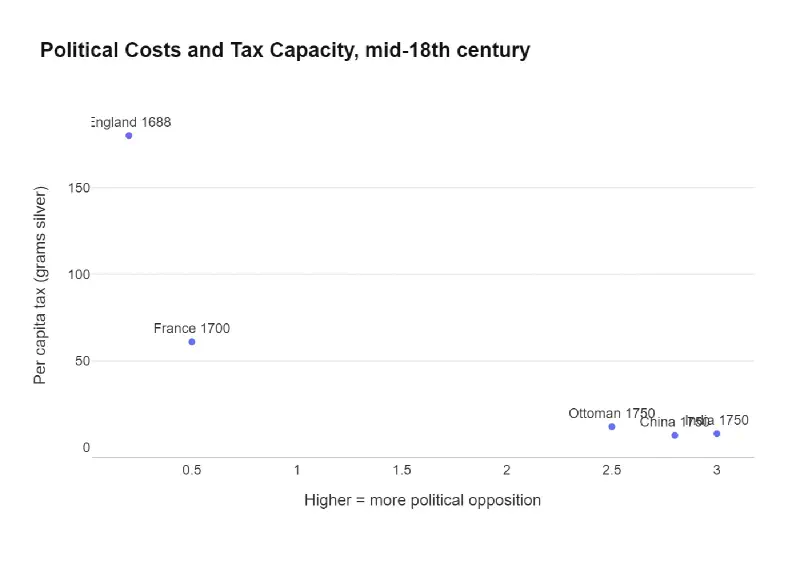
The tournament model's crucial insight is that military spending depends not just on the prize's value but on the political cost of mobilising resources. A ruler who faces tax revolts or elite opposition has a high "variable cost" — each unit of silver raised comes at a political price. A ruler with compliant elites and effective fiscal institutions has low costs.
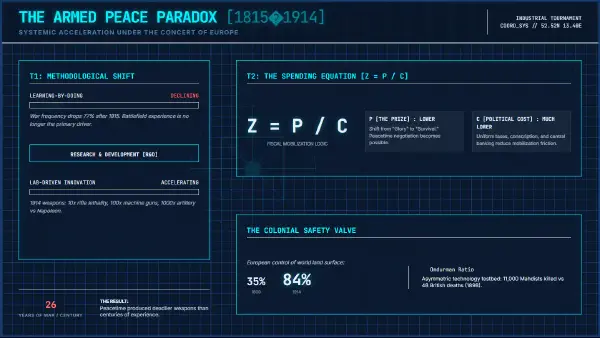
In equilibrium, total military spending by two warring rulers equals the prize divided by the sum of their political costs: Z = P / (c₁ + c₂). Heavy spending — and therefore rapid learning-by-doing — requires both a valuable prize and low total political costs.
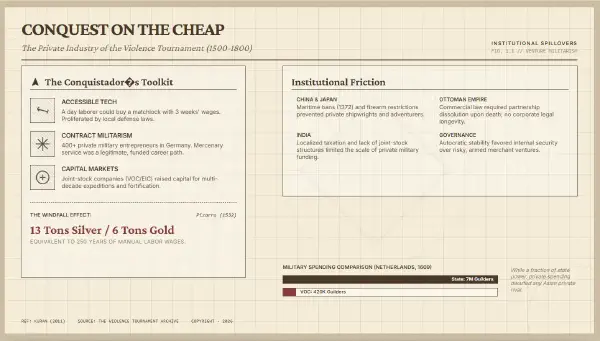
This is why eighteenth-century India, despite incessant warfare, did not generate innovation. Indian rulers faced cripplingly high political costs. The kingdom of Mysore, arguably the most effective fiscal state in South Asia, still had no regular tax revenue as late as 1725. Local elites siphoned off revenue; rulers lacked the information to assess land values; succession disputes cut the effective prize. Spending remained low, and innovation came from European experts, not Indian workshops.
The Learning-by-Doing Engine#
Military innovation in early modern Europe was primarily learning-by-doing, not research. Each unit of resources spent on war gave rulers a chance to discover a better technique — a more efficient cannon, a superior fortification design, a more effective drill. The more they spent, the more they learned.
The evidence for sustained productivity growth is overwhelming:
Firepower: French infantry's rate of successful fire per man increased from 0.2 shots per minute in 1600 to 2.0 in 1750 — annual labour productivity growth of 1.5 percent (Lynn 1997).
Naval power: Total factor productivity in the English navy rose at 0.4 percent per year between 1588 and 1680 (Glete 1993), a rate virtually unheard of in pre-industrial economies.
Weapons prices: The price of pistols relative to spades fell 83 percent between 1556 and 1706 in England. Regressions controlling for factor costs imply total factor productivity growth of 0.8 to 1.1 percent per year in weapons manufacturing — comparable to Industrial Revolution rates (Hoffman 2011).
These figures understate true productivity growth because they ignore improvements in tactics, organisation, provisioning, and troop discipline — all integral parts of the gunpowder technology.
The Diffusion Advantage#
Innovation spreads only if rulers can copy their enemies' advances. In western Europe, this condition held remarkably well. Embargoes failed — Charles V could not stop gunsmiths from Nürnberg selling firearms to his French enemy. Markets for military goods and services flourished; skilled officers, gun founders, and military architects sold their expertise across the continent.
After wars, armies systematically rearmed and reorganized based on battlefield lessons. The French redesigned their artillery after losing the Seven Years War (1756-1763). The British navy adopted copper sheathing after experiments revealed its anti-fouling properties — increasing fleet effective size by a third.
Outside Europe, diffusion was slower. Distance raised costs; complementary skills (metalworking, navigation) were often lacking; religious opposition blocked technology transfer in the Ottoman Empire. The Swiss cannon founder who perfected boring in France could transfer the technique to Spain only by importing a whole team of workers — but that was still possible. In China or India, such transfers were harder still.
The Nineteenth-Century Twist#
By 1800, the tournament had given Europe an enormous lead in gunpowder technology. But then something unexpected happened: European wars became less frequent. Between 1816 and 1913, western Europeans spent only 26 years at war per century, down from 115 years in 1650-1815 (Dincecco 2009).
Yet military technology did not stagnate. It accelerated. Research and development replaced learning-by-doing. Political reforms cut the cost of mobilising resources even further. And the prize — now including national survival rather than just glory — remained valuable enough to sustain spending.
Article 6 will examine this armed peace paradox. First, Article 3 asks the crucial comparative question: why did Asia's great powers, with their own long histories of warfare, fall behind?
Tournament equilibrium condition: War occurs when P ≥ b(1 + c₂/c₁)² — prize valuable, fixed costs low, political costs similar. Military spending in war: Z = P/(c₁ + c₂) — total spending equals prize divided by sum of political costs. Learning-by-doing: Innovation rate increases with Z; older technologies (cavalry archery) exhaust improvement potential.