The Time Machine Test#
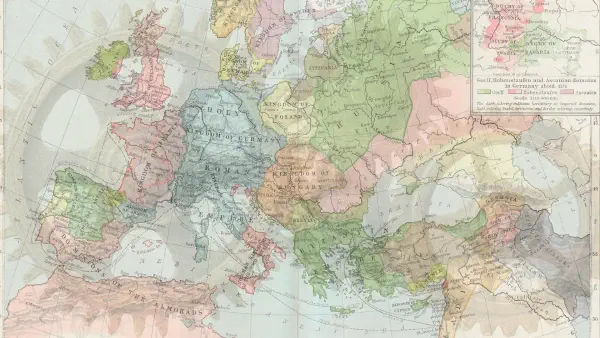
Imagine landing anywhere on earth in the year 900. Where would you settle? Not western Europe. By almost any measure — urbanisation, trade, scholarship, material comfort — the Muslim Middle East was richer and more advanced. Southern China was flourishing. Europe? Poor, politically chaotic, prey to Viking raids, its luxuries imported at exorbitant cost from Middle Eastern merchants.
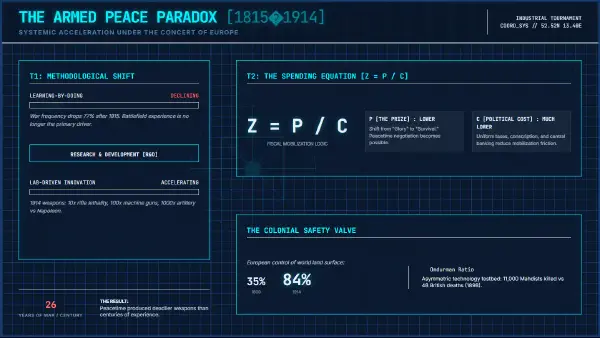
Now jump to 1914. The transformation is staggering. Europeans control 84 percent of the globe. Their languages, laws, and military technology dominate every inhabited continent. The only non-European power that dares challenge them — Japan — is busy copying their military know-how. Something fundamental changed in the intervening millennium.
The standard answers are too simple. Industrialisation began only around 1800, yet by then Europeans already held 35 percent of the world. Disease immunity helped in the Americas, but not against other Eurasians who shared the same exposure. Geography? China is actually more mountainous than Europe, not less. Culture? Japanese warriors were admired across Europe.
The Tournament Mechanism#
The answer lies in a mechanism economists call a "tournament" — a repeated competition where contestants exert extreme effort to win a prize. Think of Dominican baseball players forgoing education and taking steroids for a minuscule chance at the Major Leagues. Europe's rulers did something similar, but with infinitely higher stakes.
Between 1400 and 1800, western European rulers fought constantly — major powers were at war 54 to 71 percent of the time (Clodfelter 2002). They fought for prizes that could not be divided: glory, dynastic succession, commercial monopoly, victory over religious enemies. Because rulers bore few of the costs of war (their subjects paid taxes and died), while capturing most of the glory, they had powerful incentives to keep fighting.
Europe at nadir
Western Europe is poorer and more backward than China, India, and the Muslim world.Ming China
China's emperors fight nomads 97% of the time, diverting resources from gunpowder innovation.Vasco da Gama reaches India
Portuguese armed ships demonstrate European naval technology gap in the Indian Ocean.Cortés takes Tenochtitlan
13 brigantines and 900 Europeans — plus 75,000 native allies — defeat the Aztec capital.Glorious Revolution
Parliament gains control of the purse, cutting England's political cost of mobilizing resources.Industrial Revolution transforms war
Steam gunboats, rifled artillery, and machine guns widen Europe's military lead dramatically.
Four Conditions for Innovation#
Hoffman's tournament model identifies four conditions that must simultaneously hold for military technology to advance:
- Frequent war — rulers must fight repeatedly
- Massive spending — the prize must be valuable and rulers must be able to mobilise resources at low political cost
- Focus on gunpowder — not ancient technologies like cavalry archery or galley warfare
- Open innovation diffusion — rulers must be able to copy their enemies' advances
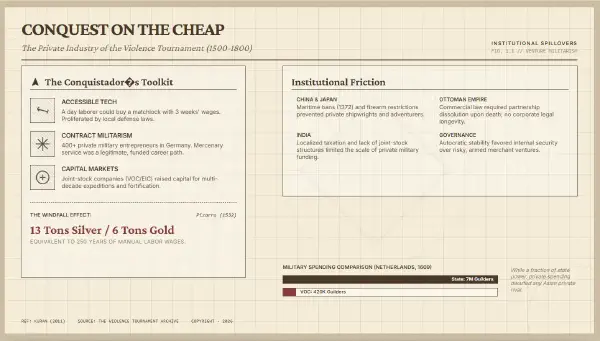
Western Europe met all four conditions, continuously, from the late Middle Ages onward. No other part of Eurasia did. China fought constantly but 97 percent of its wars were against nomads, where gunpowder was often useless. India had incessant warfare in the eighteenth century but rulers faced cripplingly high political costs to raise taxes. The Ottoman Empire had low tax revenues and had to divide resources between gunpowder and cavalry.
The consequence was relentless productivity growth. Between 1600 and 1750, the rate of successful fire per French infantryman increased tenfold — annual labour productivity growth of 1.5 percent, a rate that rivals modern industrial economies (Lynn 1997). The relative price of pistols in England fell by a factor of six between 1556 and 1706. By 1800, muskets cost three to nine times more (relative to food) in China than in England or France.
The Falsification Test#
This argument makes a sharp prediction: wherever the four conditions fail, military innovation should stall. Eighteenth-century India provides the crucial test. It had incessant warfare, active markets for military goods, and rulers quick to adopt new weapons. Hoffman's model predicts little homegrown innovation — and indeed, advances came from European experts. The Indian case falsifies any argument that simply "frequent war" or "competitive markets" explain Europe's lead.
War frequency data: Wright 1942; Levy 1983; Clodfelter 2002 Price data: Hoffman 2011, Economic History Review Tax revenue comparisons: Pamuk & Karaman 2010; Brandt, Ma & Rawski 2014 Productivity figures: Lynn 1997; Glete 1993
The Puzzle Remains#
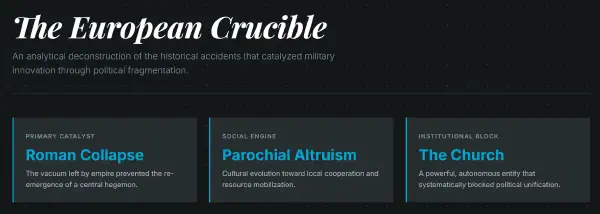
Why did Europe develop low political costs of mobilising resources while the Ottoman Empire did not? Why was Europe fragmented into competing states while China unified repeatedly? Why did European rulers prize glory while Chinese emperors preferred tribute systems? These are not accidents of geography or culture. They are the product of political history — a chain of contingent events that, at critical moments, could have gone differently.
Article 2 will examine how the tournament actually worked: the calculus of rulers deciding whether to fight, the role of borrowing and taxation, and the specific mechanism linking military spending to technological improvement.
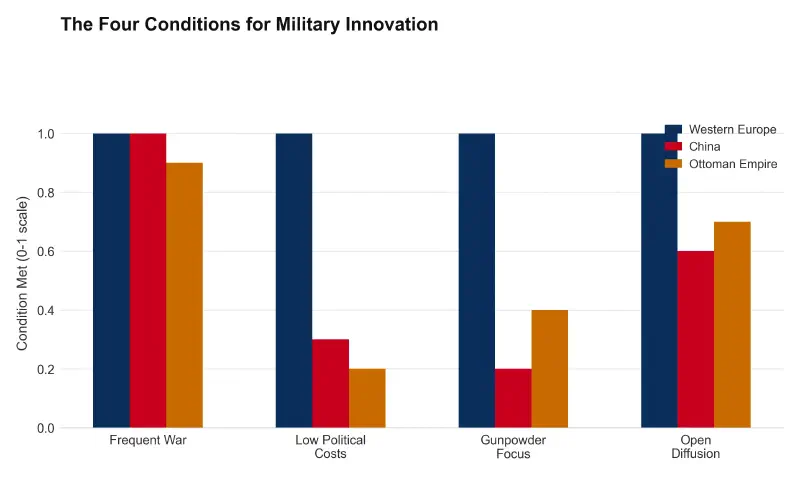
Europe was the only region where all four conditions were satisfied continuously — the rare equilibrium that produced both the tournament and the conquest that followed.