The Violence Tournament – Timeline of Key Events
·349 words·2 mins
Key events that shaped the trajectory of the violence tournament.
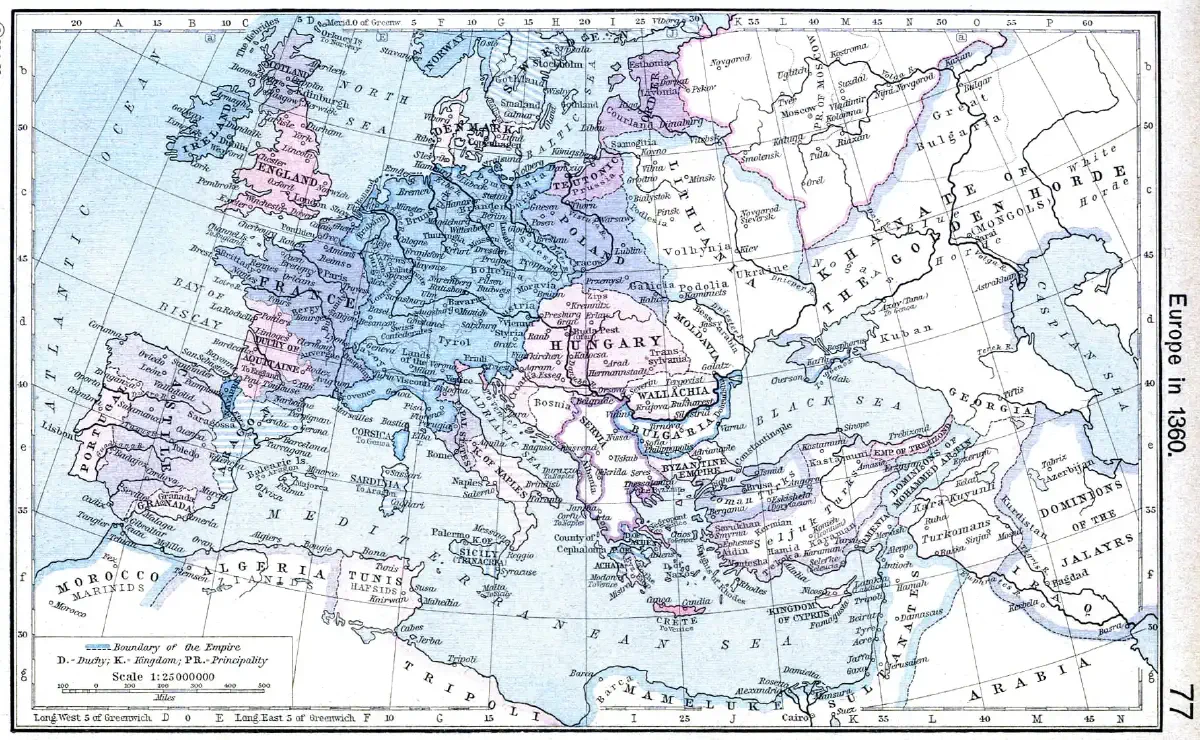
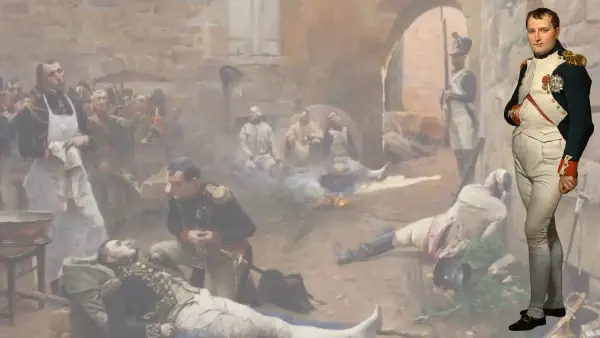
Article 1 – The Paradox of Backwardness Question: Why was pitiful Europe the one to conquer the world? Mechanism: The tournament — repeated competition among similarly-matched rulers. Shows the puzzle and introduces the four conditions.
Article 2 – The Four Levers of Conquest Question: What specific conditions turned Europe's warfare into innovation? Mechanism: Low political costs + valuable indivisible prize + gunpowder focus + open diffusion. Explains how the tournament worked and quantifies productivity growth.
Article 3 – Where the Tournament Failed Question: Why didn't China, the Ottomans, or India keep pace? Mechanism: Nomad diversion, hegemon intimidation, high political costs, forced technology division. Proves the four conditions are necessary by showing their absence stops innovation.
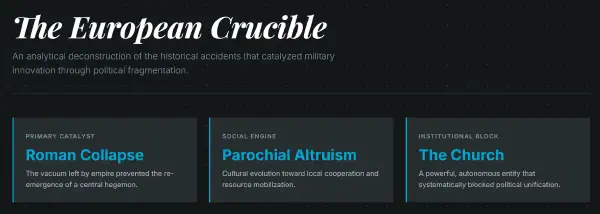
Article 4 – The Accidental Crucible Question: Why did Europe develop low political costs and fragmentation? Mechanism: Path-dependent political history — Roman collapse → parochial altruism → autonomous Church. Reveals contingency and ultimate causes.
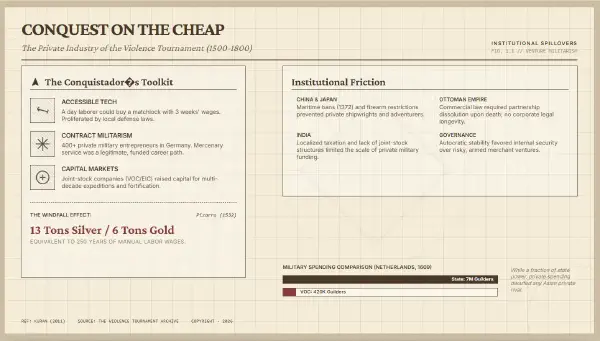
Article 5 – Conquest on the Cheap Question: How did private adventurers access state-developed technology? Mechanism: Spillover from state tournament + low barriers to gun ownership + corporate funding. Explains why European conquest was scalable and profitable.
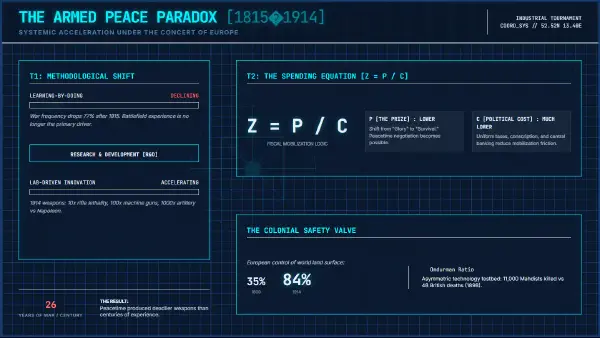
Article 6 – The Armed Peace Paradox Question: Why did military technology accelerate as wars became rarer? Mechanism: Research replaced learning-by-doing; falling political costs offset diminished glory. Shows tournament persistence under new rules.
Article 7 – The Price of Winning Question: Who gained from the tournament? Mechanism: Rulers captured glory; subjects paid taxes; colonies endured extraction; average Europeans saw ambiguous welfare. Synthesises the argument and answers "so what?"
Acemoglu, D., Johnson, S., & Robinson, J. A. (2005). The rise of Europe: Atlantic trade, institutional change, and economic growth. American Economic Review, 95(3), 546-579. https://doi.org/10.1257/0002828054201305
Allen, R. C. (2009). The British Industrial Revolution in global perspective. Cambridge University Press.
Bowles, S., & Gintis, H. (2011). A cooperative species: Human reciprocity and its evolution. Princeton University Press.
Dell, M. (2010). The persistent effects of Peru's mining mita. Econometrica, 78(6), 1863-1903. https://doi.org/10.3982/ECTA8121
Hoffman, P. T. (2011). Prices, the military revolution, and western Europe's comparative advantage in violence. Economic History Review, 64(S1), 39-59. https://doi.org/10.1111/j.1468-0289.2010.00568.x
Kuran, T. (2011). The long divergence: How Islamic law held back the Middle East. Princeton University Press.
Lynn, J. A. (1997). Giant of the Grand Siècle: The French Army, 1610-1715. Cambridge University Press.
Nunn, N. (2008). The long-term effects of Africa's slave trades. Quarterly Journal of Economics, 123(1), 139-176. https://doi.org/10.1162/qjec.2008.123.1.139
Pamuk, S., & Karaman, K. (2010). Ottoman state finances in European perspective, 1500-1914. Journal of Economic History, 70(3), 593-629. https://doi.org/10.1017/S0022050710000560
Parker, G. (1996). The military revolution: Military innovation and the rise of the West, 1500-1800 (2nd ed.). Cambridge University Press.