In 1799, the Dutch East India Company was formally dissolved. Its assets were seized by the Batavian Republic, the French-backed state that had replaced the Dutch Republic after the revolutionary wars. The company’s liabilities—debts accumulated over two centuries of warfare, administration, and declining profitability—were assumed by the state.
The final reckoning was stark. The VOC’s debt exceeded 120 million guilders.¹ This was not a trivial sum. It represented approximately 30 percent of the Dutch Republic’s GDP at the time—the equivalent of a modern corporation leaving a $30 to $40 trillion debt for the United States government to absorb.
The question that runs through the VOC’s history is simple: was it worth it? For the Dutch state, the company that had been celebrated as the engine of the Golden Age ultimately became a fiscal burden. But the story is more complicated than a simple rise-and-fall narrative. The relationship between the VOC and the Dutch state changed fundamentally over time, following a pattern that reveals the life cycle of state-backed corporate power.
The Benefits: What the Dutch State Gained#
In the 17th century, the VOC was widely seen as a national asset. Its contribution to the Dutch economy was multifaceted and, in the early decades, overwhelmingly positive.
The most direct channel of benefit was customs and excise revenue. VOC ships, like all Dutch ships, paid duties on imported goods. In the company’s peak years, VOC imports were valued at 18 to 21 million guilders annually.² Even at modest duty rates, this generated significant revenue for the state. More importantly, the VOC’s trade stimulated the broader Dutch economy: shipbuilding, insurance, port services, and the financial sector all grew around the company’s operations.
The indirect benefits were even more significant. The VOC’s success made Amsterdam the financial capital of Europe. The market for VOC shares was the world’s first organized stock exchange, and the techniques developed there—trading, short selling, options—were later applied to government debt. By the mid-17th century, the Dutch Republic could borrow at lower interest rates than any other European power, a financial advantage that historians attribute in part to the capital market development sparked by the VOC.³
There was also a strategic dimension. The VOC financed its own military operations in Asia, projecting Dutch power without direct cost to the state. This was not a trivial benefit. In the 17th century, European states were constantly at war. The ability to outsource naval power to a corporation was a significant advantage, allowing the Dutch Republic to focus its limited military resources on European conflicts.
The Costs: The Rising Burden#
The benefits, however, did not persist. By the late 17th century, the VOC’s profitability was declining. Competition from the English East India Company, rising military costs, and administrative inefficiency eroded the company’s margins. Annual returns fell from the extraordinary levels of the early decades to roughly 3.5 to 4 percent after 1650—comparable to the yield on government bonds. After 1730, profits were “vanishingly small.”⁴
As profits declined, the state’s indirect benefits diminished. Customs revenue from VOC trade remained substantial, but the company’s share of Dutch economic activity shrank. The VOC still mattered, but it was no longer the dynamic engine of growth it had been.
The costs, meanwhile, were rising. The VOC’s military operations, once a source of strategic advantage, became a drain on the company’s finances. The wars to maintain the spice monopoly, suppress local resistance, and counter European competitors consumed an ever-growing share of revenues. By the 18th century, the company was spending more on administration and defense than it was earning from trade.⁵
The state also provided direct support, though it was limited until the final decades. In 1606, the Zeeland Estates granted the VOC a 300,000 guilder subsidy for fortifications—a modest sum relative to the company’s scale. More significant was the implicit guarantee: the VOC’s debt was backed by the Dutch state, which allowed the company to borrow at lower rates than its true creditworthiness would have justified. This subsidy was invisible but real.
The Reckoning: 1796–1799#
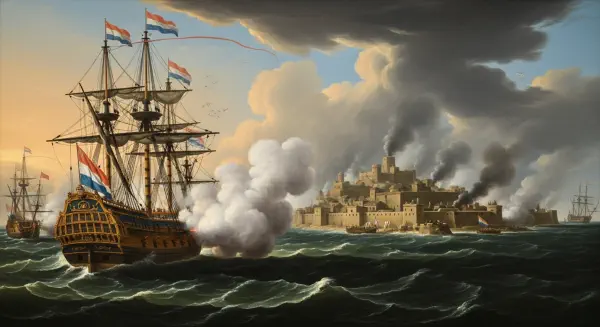
The VOC’s final crisis came in the 1780s, when the Fourth Anglo-Dutch War exposed the company’s military weakness. British naval forces captured key VOC trading posts, and the company’s finances collapsed. When the revolutionary Batavian Republic was established in 1795, the VOC was already effectively insolvent.
The final balance sheet, when it came, was stark. The VOC’s debt exceeded 120 million guilders. The company had no realistic prospect of repaying it. The state assumed these liabilities, effectively nationalizing the company’s losses while privatizing its remaining assets.⁶
This outcome—the socialization of losses after decades of private gains—is the defining feature of the VOC’s relationship with the Dutch state. For the first century of its existence, the company generated substantial benefits for the Dutch economy without requiring direct state support. For the second century, it became a declining asset, and finally a liability.
The Lifecycle of State-Backed Corporate Power#
The VOC’s trajectory follows a pattern familiar to economic historians: the lifecycle of the state-backed corporation. In the early phase, high monopoly rents generate exceptional returns for investors and spillover benefits for the state. In the maturity phase, competition and rising costs erode profitability, but the corporation remains economically relevant. In the decline phase, fixed costs—especially military and administrative overhead—consume an increasing share of revenues. In the final phase, the state absorbs the liabilities, either through explicit bailout or through the assumption of debt.
This pattern is not unique to the VOC. The British East India Company followed a similar trajectory, requiring parliamentary bailouts in the 1770s and ultimately being dissolved after the Indian Rebellion of 1857. More recently, the pattern has repeated in industries from banking to automotive manufacturing: private profits, socialized losses.
Lessons for the Present#
The VOC’s history offers three lessons for thinking about corporate power today.
First, the economic weight of a corporation is not a reliable measure of its long-term value to the state. The VOC’s GDP share in the 1630s was extraordinary, but that did not prevent its eventual collapse. High profits today do not guarantee sustainability tomorrow.
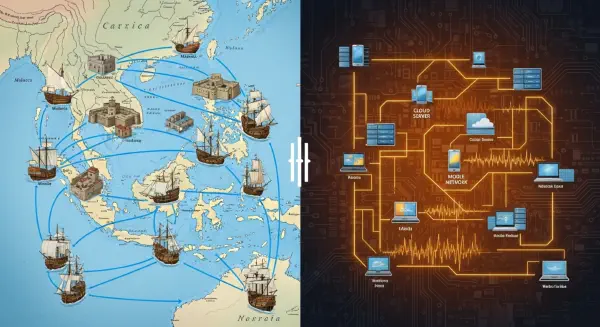
Second, the cost structure of a corporation matters more than its revenue. The VOC’s physical control system created high fixed costs that ultimately made the company unprofitable. Modern digital platforms have lower fixed costs, but they face different vulnerabilities: regulatory intervention, technological disruption, and the inherent brittleness of systems built on user consent rather than coercion.
Third, the pattern of privatized gains and socialized losses is not a historical anomaly. It is a recurring feature of state-backed corporate power. The VOC was not the first or the last company to generate exceptional returns for investors while ultimately leaving the state to absorb its liabilities.
The Final Balance#
When the VOC was dissolved in 1799, the Dutch state assumed more than 120 million guilders in debt. The company that had been celebrated as the engine of the Golden Age had become a fiscal burden. But the final balance sheet is not the whole story.
For the first century of its existence, the VOC generated extraordinary returns for its investors and significant spillover benefits for the Dutch economy. It catalyzed the development of modern capital markets, built the infrastructure of Dutch global trade, and established Amsterdam as the financial center of Europe. These were real benefits, even if they proved unsustainable.
The VOC’s story is not a simple morality tale about greed or imperial overreach. It is a story about the architecture of power: how corporations capture value, how they translate economic weight into political influence, and how the systems they build eventually become too costly to maintain. The $8 trillion valuation was a myth. But the structural reality of the VOC—a corporation that was also a state, whose power was measured in ships and forts, whose legacy shaped the course of global capitalism—is more interesting than any myth.