In 1720, a Dutch merchant named Johan van der Beek wrote a letter to his son in Batavia, lamenting the state of the VOC’s operations. “The company’s ships still sail,” he wrote, “but the profit has gone out of them. The cost of keeping the peace is greater than the value of what we trade.”¹
Van der Beek was observing a structural reality that would eventually bring the VOC to collapse. The company had built a system of control that was extraordinarily effective—and extraordinarily expensive. Controlling physical supply chains required maintaining a permanent military presence across thousands of miles of ocean. Every ship, every fortress, every soldier added to the cost base. By the 18th century, the VOC had become a victim of its own success.
This tension—between control and cost, between monopoly and maintenance—is the subject of Part 3. To understand it, we must move beyond simple comparisons of market capitalization and examine the VOC as a networked control system. When we do, we discover that modern digital platforms like Apple and Microsoft are pursuing a similar strategy of control, but with a fundamentally different cost structure. The difference explains not only why the VOC ultimately failed but also why today’s platform monopolies may face their own crises of sustainability.
The VOC as a Physical Control System#
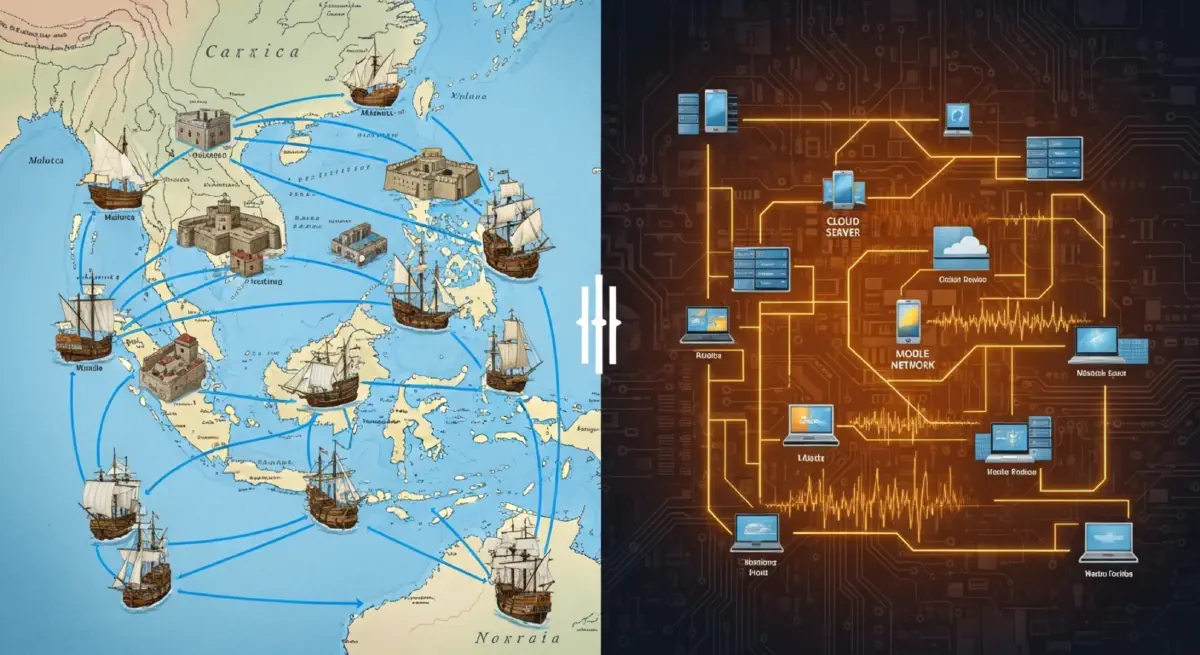
From a systems engineering perspective, the VOC can be modeled as a network designed to capture, direct, and extract value from the flow of goods. Its architecture consisted of three layers: nodes, edges, and control mechanisms.
The nodes were physical locations: the Spice Islands (production), Batavia (regional headquarters), and Amsterdam (financial and commercial hub). Each node had a specific function in the value chain. The Spice Islands produced high-value goods at low cost. Batavia aggregated and processed those goods. Amsterdam distributed them to European markets.
The edges were maritime routes: the Cape of Good Hope route connecting Europe to Asia, the Sunda Strait leading to the Spice Islands, and the Malacca Strait controlling access to the East Indies. These were not merely shipping lanes. They were chokepoints—geographic features that could be controlled by a relatively small force.
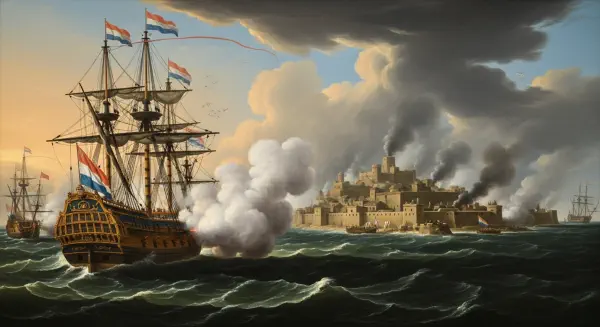
The control mechanisms were military and administrative. The VOC maintained a fleet of warships to patrol these routes and blockade competitors. It built fortresses at key chokepoints: Fort Rotterdam in Makassar, Fort Orange on the island of Banda, and a network of fortified trading posts across the archipelago. It also maintained a system of contracts and coercion with local producers, including the systematic destruction of clove trees on islands not under VOC control to maintain artificial scarcity.²
This system was extraordinarily effective at generating profits in the 17th century. Between 1602 and 1700, the VOC paid average annual dividends of approximately 2 million guilders, often exceeding 50 percent of profits. An initial investment in 1602 would have grown thirteenfold by 1650.³
But the system had a fatal flaw: high fixed costs. Every fortress required garrisoning, every ship required maintenance, every trading post required administrators. As the VOC expanded, these costs grew faster than revenues. By the 1680s, the company was spending more on military operations and administration than it was earning from trade.⁴
The Cost of Physical Control#
The VOC’s cost structure reveals the fundamental economics of physical control systems. Consider the company’s military expenditures. At its peak in the 1660s, the VOC maintained:
- 100 to 150 armed ships
- 10,000 to 15,000 soldiers and sailors
- Dozens of fortresses and trading posts across Asia
- A permanent administrative apparatus in Batavia
These were not one-time costs. Ships had to be replaced every 10 to 15 years. Soldiers had to be paid, fed, and transported. Fortresses required constant maintenance. The cost of administering the spice monopoly—enforcing contracts, suppressing resistance, fighting competitors—consumed an ever-growing share of revenues.⁵
This pattern is familiar to students of empire. Physical control systems exhibit diminishing returns: each additional unit of control requires more resources than the previous one. The VOC’s expansion into new territories, far from generating proportional profits, increased the scope of territory that required defense. By the 18th century, the company was trapped in a classic overextension cycle, spending more to protect its empire than it was earning from it.
The Modern Alternative: Digital Control Systems#
Now consider the architecture of modern digital platforms. Apple and Microsoft have built systems of control that rival the VOC’s in their effectiveness, but with a radically different cost structure.
Apple’s system can be modeled in similar terms. The nodes are devices (iPhone, iPad, Mac), developers, and data centers. The edges are internet connections, cloud services, and APIs. The control mechanisms are the App Store, iOS restrictions, and hardware-software integration.
Unlike the VOC’s physical nodes, Apple’s nodes are distributed across millions of user devices—devices that users themselves purchase and maintain. This is a critical difference. The VOC had to build and maintain its own infrastructure. Apple’s users build and maintain the infrastructure for it. Every iPhone sold is a node in Apple’s network that Apple did not have to pay to construct or operate.⁶
The control mechanisms also differ fundamentally. The VOC enforced monopoly through military force—a high-cost, high-conflict approach. Apple enforces monopoly through code and contracts. Developers cannot bypass the App Store without jailbreaking, which voids warranties and degrades functionality. Users cannot easily switch ecosystems because their data, purchases, and habits are locked into Apple’s system.
The cost of this digital control is minimal. Apple does not need to garrison the App Store with soldiers. It does not need to build fortresses to protect its market share. Its control mechanisms are embedded in software, which scales to millions of users at near-zero marginal cost.⁷
The Trade-Off: Resilience vs. Efficiency#
This comparison reveals a fundamental trade-off in the architecture of control. Physical systems are costly to maintain but resilient. The VOC’s control over the spice trade, once established, was difficult to challenge. Breaking its monopoly required a naval war that few competitors could afford. Physical infrastructure—forts, ships, trained personnel—could not be replicated quickly.
Digital systems are cheap to operate but brittle. Apple’s control over its ecosystem depends on the continued acceptance of its rules by users and developers. A regulatory change, a security breach, or a shift in consumer sentiment could undermine it much faster than a VOC competitor could build a navy. The European Union’s Digital Markets Act, which requires Apple to allow alternative app stores, demonstrates this vulnerability.⁸
The VOC’s physical system ultimately failed because its costs grew unsustainably. Apple’s digital system may fail because its control mechanisms, being based on consent and lock-in rather than coercion, are subject to regulatory and market pressures that did not constrain the VOC.
The Structural Shift from Hard to Soft Control#
The evolution from VOC to Apple represents a broader shift in the nature of economic power. In the 17th century, power was physical. Control required controlling territory, supply chains, and production sites. This was expensive and required constant maintenance, but it was also resilient and difficult to challenge.
In the 21st century, power is informational. The most valuable companies control not physical territory but digital ecosystems. They capture value through lock-in, network effects, and control of platform access. This form of power is cheaper to maintain but more vulnerable to disruption—whether from regulators, competitors, or shifts in user behavior.
The VOC’s fate offers a warning for today’s platform monopolies. Physical empires can become overextended; digital empires can become brittle. The difference is that physical empires fail slowly, as rising costs erode profitability. Digital empires may fail quickly, as a single regulatory decision or technological shift undermines the entire architecture of control.
In Part 4, we will examine the VOC’s final act: its transformation from economic engine to fiscal liability for the Dutch state. The cost-benefit analysis of the VOC over its two-century lifespan reveals a pattern that should give pause to anyone who believes that corporate power, once established, is permanent.