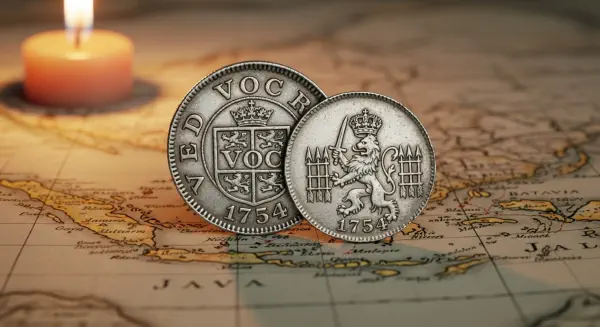
In 1621, the VOC’s Governor-General, Jan Pieterszoon Coen, wrote a letter to the company’s directors in Amsterdam that remains one of the most chilling documents in corporate history. He was responding to complaints about the cost of maintaining a military presence in the Maluku Islands, the source of the world’s nutmeg and cloves. Coen’s answer was simple: peace in the spice trade was impossible without monopoly, and monopoly was impossible without force. “We cannot trade without war,” he wrote, “nor wage war without trade.”¹
This fusion of commerce and coercion was the VOC’s defining feature. It was not merely a company that happened to have a military. It was an entity whose corporate charter explicitly authorized it to act as a sovereign power. The question for historians is not whether the VOC was valuable—it was, immensely—but how we compare its power to the corporations of our own era. Part 1 dismantled the $8 trillion valuation myth, replacing it with a GDP-share equivalent of $1 to $1.5 trillion. That number places the VOC in the same economic weight class as Apple, Microsoft, and Saudi Aramco. But economic weight is only one dimension of power.
To understand what the VOC truly was, we must compare it to modern corporations not by market cap alone, but by the nature of the power they exercise. The result is a startling conclusion: while modern firms are larger in absolute economic terms, the VOC’s hybrid nature—part company, part state—gave it a form of power that no corporation today can claim. Yet this power came with a cost structure that ultimately proved unsustainable.
Comparing Economic Weight: The GDP-Share Method Revisited#
The most disciplined way to compare economic scale across centuries is to measure each entity’s share of global GDP. This method, introduced in Part 1, avoids the distortions of inflation and currency conversion by asking a simpler question: what fraction of the world economy did the entity represent?
For the VOC at its 1637 peak, the calculation is as follows: market capitalization of 78 million guilders; Dutch GDP of 300 to 400 million guilders; therefore, the VOC represented 20 to 25 percent of the Dutch economy. The Dutch Republic itself accounted for 4 to 5 percent of world GDP. Multiplying these shares yields a VOC share of global GDP of 0.8 to 1.25 percent.²
To translate this to modern terms, we apply this share to current world GDP of approximately $105 to $110 trillion. The result is $1 to $1.5 trillion—the VOC’s economic weight in today’s dollars, measured by its relative importance in the global economy.
Now consider the largest modern corporations. Apple and Microsoft each have market capitalizations around $3 trillion. World GDP is approximately $105 trillion, so each represents roughly 2.5 to 3 percent of global GDP. Saudi Aramco, with a market cap of $2 to $2.5 trillion, represents 2 to 2.3 percent.³
By this measure, modern firms are larger than the VOC in terms of global economic weight. Apple and Microsoft are roughly twice the VOC’s relative size. This is the first surprise for those accustomed to the $8 trillion claim. In absolute terms, adjusted for the scale of the global economy, the largest corporations today exceed the VOC’s economic footprint.
The Difference in Power: Coercion vs. Consent#
But economic weight is not the only measure of power, and the VOC’s true significance lies elsewhere. To see this, we must look not at the size of its balance sheet but at the nature of its authority.
The VOC’s charter granted it powers that would be unimaginable for a modern corporation. It could:
- Build fortresses and maintain a standing army and navy.
- Wage war, negotiate treaties, and form alliances with foreign powers.
- Administer colonial territories and impose taxes.
- Execute, imprison, and punish individuals in its territories.⁴
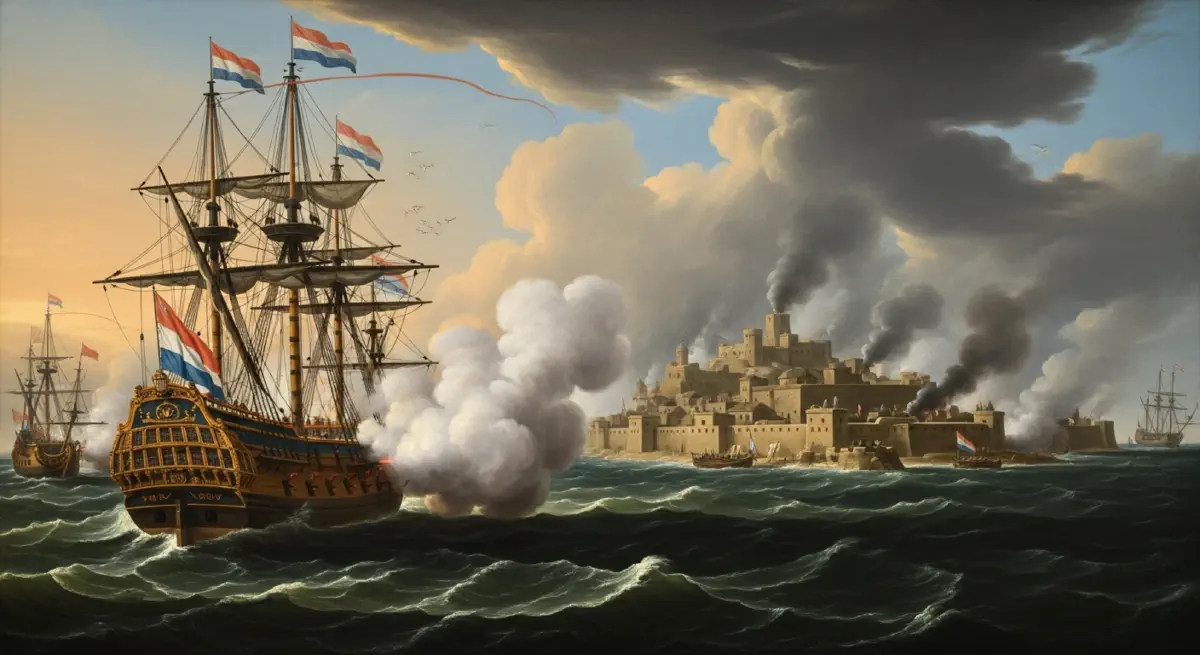
These were not theoretical powers. The VOC used them ruthlessly. Between 1621 and 1623, Coen orchestrated the conquest of the Banda Islands, where local nutmeg growers resisted VOC control. The company’s response was genocide: an estimated 90 percent of the Bandanese population was killed, enslaved, or fled. The survivors were forced into indentured labor, and the VOC established a monopoly over the world’s nutmeg supply that lasted until the 19th century.⁵
No modern corporation possesses anything like this authority. Apple cannot declare war on Android. Microsoft cannot execute competitors. Saudi Aramco, despite its control of a strategic resource, operates within the sovereign framework of the Saudi state. The power of modern firms is economic and regulatory, not military and territorial.
This distinction is fundamental. The VOC’s power was exercised through coercion, backed by the threat of violence. Modern corporations, by contrast, exercise power through consent, lock-in, and the shaping of markets. Apple does not force anyone to buy an iPhone. It creates an ecosystem so compelling that users choose to remain within it. Microsoft does not compel businesses to use Windows. It establishes technical standards and integration points that make switching costly.⁶
The Architecture of Monopoly: Physical vs. Digital#
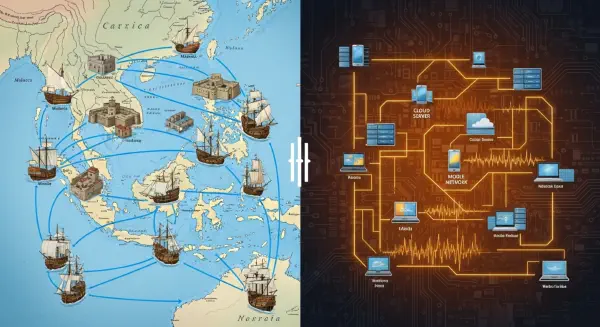
The VOC’s monopoly was built on control of physical supply chains. The spice trade depended on a handful of islands in the Maluku archipelago. By seizing these islands, destroying clove trees on any island not under its control, and forcing growers to sell only to the company, the VOC created artificial scarcity. Nutmeg that cost pennies to produce sold for hundreds of guilders in Amsterdam.⁷
This was a monopoly of geography. It required controlling chokepoints—the Strait of Malacca, the Cape of Good Hope, the Sunda Strait—and enforcing that control with naval power. The VOC maintained a fleet of over 100 ships at its peak, a military force larger than the navies of many European nations.
Modern tech giants, by contrast, exercise monopoly through control of digital chokepoints. Apple’s App Store is the only gateway for software on iOS devices. Developers cannot reach iPhone users without passing through Apple, which charges commissions of 15 to 30 percent. Microsoft’s dominance in enterprise software is built on technical standards and file formats that create switching costs measured in years of retraining and data migration.
But these digital monopolies are not enforced by warships. They are enforced by code, contracts, and intellectual property law. The power is real, but it operates through different mechanisms. A developer who refuses to accept Apple’s terms cannot reach iPhone users. A business that abandons Windows must rewrite its entire IT infrastructure. The result is lock-in without coercion—a form of power that is, in some ways, more durable than the VOC’s military monopoly.
The Structural Shift: From Hard Control to Soft Control#
The comparison between VOC-era monopolies and modern digital platforms reveals a fundamental shift in how economic power is exercised. In the 17th century, power was physical. Controlling territory, shipping lanes, and production sites was the basis of wealth. The VOC’s power was hard, rooted in geography and enforced by violence.
Today, the most valuable companies control not territory but systems. Apple controls an ecosystem of hardware, software, and services. Microsoft controls the infrastructure of corporate computing. Amazon controls the platform through which a third of US e-commerce flows. These are soft control systems, based on standards, protocols, and user habits rather than military force.
This shift has profound implications for how we measure corporate power. The VOC’s power was visible and explicit—forts, ships, soldiers. Modern corporate power is often invisible, embedded in the architecture of daily life. The fact that we cannot easily compare them is not a failure of analysis. It is a reflection of how fundamentally the economy has changed.
The Unfinished Comparison#
In Part 3, we will push this analysis further, modeling the VOC and modern platforms as networked control systems. We will examine how each system captures, directs, and extracts value from flows of goods, data, and capital. This systems engineering approach reveals the deep structure of power that underlies both 17th-century monopolies and 21st-century platforms.
For now, the lesson is clear. The VOC was not simply an earlier version of Apple or Microsoft. It was a different kind of entity altogether—a corporation that was also a state, whose power was measured in cannons and ships rather than code and contracts. Comparing them requires more than converting guilders to dollars. It requires understanding the architecture of power itself.