
VOC: The World’s First Corporate Superpower – A Four‑Part History
Key Insights#
The popular claim that the VOC was worth $7–8 trillion in modern dollars is methodologically unsound, relying on flawed inflation adjustments that ignore fundamental changes in economic structure. A more defensible GDP-share method yields a modern equivalent of $1 to $1.5 trillion.
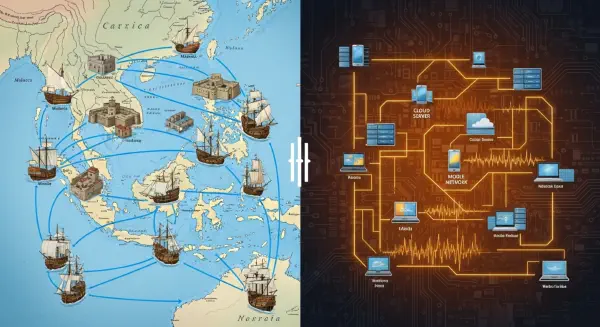
Modern corporations like Apple and Microsoft exceed the VOC in GDP-share terms, but the nature of their power differs fundamentally. The VOC exercised hard power through military force and territorial control; modern platforms exercise soft power through ecosystem lock-in and control of digital access.
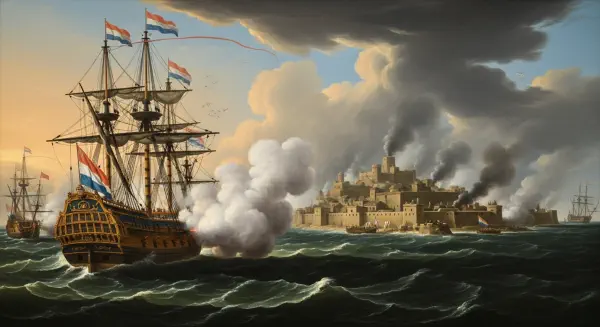
The VOC’s physical control system—based on geographic chokepoints, naval power, and coercion—carried high fixed costs that ultimately made the company unprofitable. Modern digital platforms have lower fixed costs but face different vulnerabilities: regulatory intervention, technological disruption, and the inherent brittleness of consent-based systems.
The VOC’s relationship with the Dutch state followed a clear lifecycle: strong positive benefits in the 17th century, declining returns in the 18th century, and a final phase in which the state absorbed more than 120 million guilders in debt. This pattern of privatized gains and socialized losses recurs in state-backed corporate enterprises across history.
The VOC’s true significance lies not in its inflation-adjusted valuation but in its institutional innovations—permanent capital, transferable shares, secondary markets—that created the blueprint for modern corporate capitalism.
References#
Gelderblom, O., de Jong, A., & Jonker, J. (2013). The formative years of the modern corporation: The VOC, 1602–1623. The Journal of Economic History, 73(4), 1050–1076.
de Vries, J., & van der Woude, A. (1997). The First Modern Economy: Success, Failure, and Perseverance of the Dutch Economy, 1500–1815. Cambridge University Press.
Petram, L. (2014). The World’s First Stock Exchange. Columbia University Press.
Maddison, A. (2001). The World Economy: A Millennial Perspective. OECD Publishing.
Maddison Project Database. (2020). Historical GDP estimates.
Steensgaard, N. (2017). The VOC, the Dutch East India Company, 1602–1799. University of Massachusetts Dartmouth.
Gelderblom, O., & Jonker, J. (2004). Completing a financial revolution: The finance of the Dutch East India trade and the rise of the Amsterdam capital market, 1595–1612. The Journal of Economic History, 64(3), 641–672.