The Salt Merchant’s War#
In 874, a failed salt smuggler named Huang Chao launched an uprising in the impoverished region south of the Yangtze. By 879, he controlled Guangzhou, the southern port through which passed much of China’s maritime trade. Contemporary Arab merchants reported that 120,000 foreign traders—Persians, Arabs, Jews, and Southeast Asians—died in the city’s fall.
Huang Chao was not An Lushan. He claimed no steppe ancestry, commanded no professional army, and offered no coherent alternative to Tang rule. His movement was something more terrifying: a pure expression of peasant rage against a system that had failed them for generations.
The drought of 873 had killed perhaps 40 percent of the population in some counties. Taxes continued regardless. Landlords seized the fields of the dead. When peasants fled, officials conscripted their neighbors to pay the missing households’ taxes. By 874, the conditions for explosion existed across half the empire.
The Yangtze Lifeline#
The Tang survived the eighth-century rebellion because the south remained loyal and productive. Rice from the Yangtze delta, tea from Fujian, and silk from Sichuan flowed north along the Grand Canal, funding armies and feeding capitals. The canal carried perhaps 4 million tons of grain annually at its peak—enough to support 500,000 people in Chang’an alone.
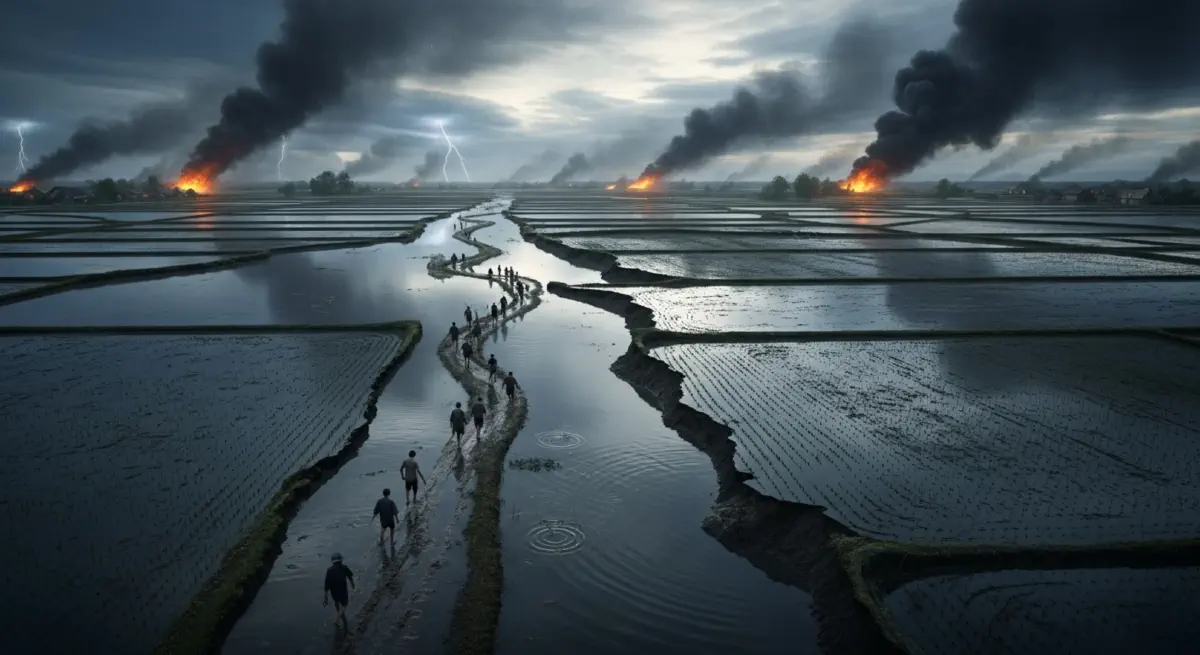
Huang Chao understood this dependence. In 879, after capturing Guangzhou, he turned his army north toward the canal. His forces, now swollen with desperate peasants and opportunistic bandits, swept through the rich prefectures of Jiangxi and Anhui. They destroyed dikes, burned granaries, and killed anyone connected to the landowning class.
The canal stopped flowing. In Chang’an, grain prices rose 400 percent in six months. Soldiers in the Shence Army, still the empire’s best-paid troops, received their rations irregularly. Desertion increased. For the first time, the court’s military arm began to fail.
The Shattered Legitimacy#
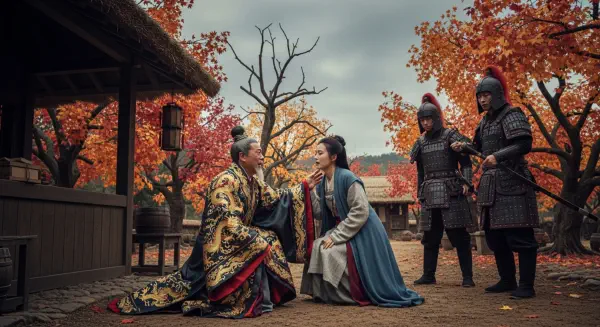
The Tang response to Huang Chao revealed how completely the state’s moral authority had collapsed. Imperial armies, when they fought, behaved as badly as the rebels. In 882, a Tang commander named Zhou Ji recaptured a Yangtze town from rebel forces, then executed every resident who had cooperated with the occupation—perhaps 30,000 people. His report to the emperor celebrated this as victory.
Peasants faced an impossible choice: rebel armies that seized their grain and conscripted their sons, or imperial armies that treated them as traitors regardless of loyalty. By 883, perhaps 8 million people had died in the Huang Chao Rebellion—roughly equivalent to the entire population of France at the time.
The intellectual class noticed. Poet Luo Yin, who lived through the rebellion, wrote: “The empire’s distress has reached its peak. The officials do not govern, the army does not fight, the people do not produce. Only the bandits act with purpose.”
The Shatuo Solution#
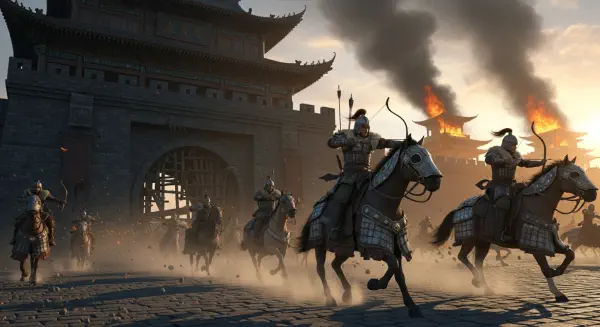
Desperate, the Tang court repeated the Uighur gambit with new players. In 883, they invited the Shatuo Turks, a steppe confederation based in northern Shanxi, to suppress Huang Chao. The Shatuo chieftain, Li Keyong, arrived with 10,000 horsemen—cavalry armed with compound bows that could pierce armor at 200 meters.
The Shatuo destroyed Huang Chao’s army in a series of battles in 884. Huang Chao fled east, where his own nephew killed him to claim the reward money. But the cost of this victory exceeded anything the Uighur alliance had extracted.
Li Keyong demanded and received the governorship of Hedong—modern Shanxi province—a strategic territory controlling access to the capital. He established his own administration, minted his own coins, and ignored court directives. The Tang had invited a wolf to kill a boar, and the wolf decided to stay.
The Thousand Coffins#
When Huang Chao’s rebels entered Chang’an in 880, they reportedly carried banners reading “The Scholar Class Has Betrayed the People.” This propaganda contained a bitter truth: the Tang examination system, designed to select talent regardless of birth, had instead created a hereditary elite that protected its privileges against both peasants and emperor.
By 884, when the rebellion finally ended, perhaps 16 million people had died—a death toll exceeding World War I’s military casualties. The south lay devastated. The canal required rebuilding. The Shatuo Turks controlled the north. And the Tang emperor, Xizong, had spent most of the rebellion in Sichuan, returning only after his saviors had made him irrelevant.
In the next post, we will examine how the post-rebellion order produced China’s first true warlord era, as military governors who had once pretended loyalty stopped pretending entirely.