
The Night the Music Stopped#
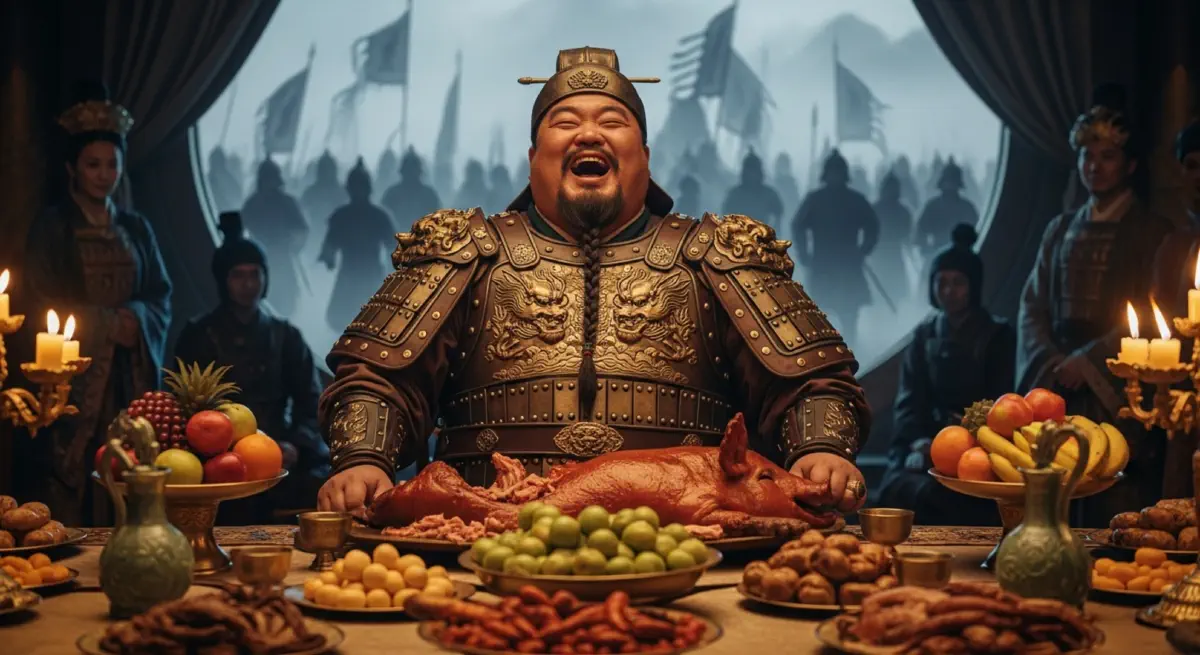
On December 16, 755, General An Lushan hosted a lavish banquet in his sprawling Fanyang headquarters. The Sogdian-Turkic general, so obese that he reportedly required two servants to help him mount his horse, laughed and toasted with his guests while 150,000 of his finest soldiers silently broke camp. By dawn, they were marching south toward the capital.
For Emperor Xuanzong, the news arrived fifteen days later like a physical blow. The 70-year-old monarch had ruled for forty-three years, presiding over what historians still call the golden age of the Tang. Chang’an, the eastern terminus of the Silk Road, housed perhaps one million people—a metropolis of Zoroastrian fire temples, Nestorian Christian monasteries, and markets stocked with Persian turquoise and Indian pepper. Poets like Li Bai and Du Fu wandered its avenues. State revenues exceeded 20 million tons of grain annually.
And now a man the emperor had treated like a son, whom his favorite consort had reportedly bathed and dressed as if he were an infant, had turned his army toward the throne.
How does an empire spanning 5.4 million square kilometers—larger than the modern European Union—shatter so completely that within fifteen years it would never again command the loyalty of its own provinces?
The Rot Beneath the Gold#
The central argument of this series is that the Tang dynasty did not fall to external invaders or peasant uprisings in the conventional sense. It collapsed because its success created centrifugal forces its archaic administrative structure could not contain. The An Lushan Rebellion was not the disease but the rupture—the moment when a system strained to breaking finally burst.
What followed was not a single death but a century-long decomposition. By 907, when the last Tang emperor abdicated, the dynasty had lost effective control of its territory so gradually that many contemporaries barely noticed the moment of transition. The empire became a ghost that continued to issue edicts while real power flowed through networks of military governors, salt smugglers, and eunuch-controlled palace armies.
This is the story of that decomposition.
The Frontier Feedback Loop#
The Tang military system contained a fatal contradiction from its founding in 618. Early emperors maintained a garrison militia system—farmers who trained seasonally and returned to their fields. But by 737, the costs of defending a 7,000-kilometer frontier from Tibetans in the west to Khitans in the northeast forced a radical shift.
The court created nine permanent frontier commands, each controlling 30,000 to 90,000 professional soldiers. These armies required consistent provisioning. A single cavalry horse consumed 3.6 metric tons of fodder annually. A soldier required 250 kilograms of grain per year. Moving this volume over land cost more than the food itself—by some estimates, 60 percent of grain shipped from central China was consumed by the porters and pack animals transporting it.
The solution was to make frontier commanders self-sufficient. They received authority to appoint their own subordinates, collect local taxes, and even manage horse-breeding programs. By 750, the nine military governors controlled perhaps 80 percent of the empire’s field forces. The most powerful among them, a man named An Lushan, governed three separate commands simultaneously—a territory larger than France.
The Cosmopolitan Contradiction#
Tang identity was simultaneously the dynasty’s greatest strength and its Achilles’ heel. The imperial family itself claimed both Han Chinese and steppe nomadic ancestry. They rode horses, hunted with eagles, and employed Sogdian merchants as diplomats. This cosmopolitanism allowed them to rule a multi-ethnic empire without constant rebellion.
But it also meant that frontier commanders like An Lushan—fluent in six languages, comfortable in both saddle and court—could imagine themselves as legitimate contenders for power. When An Lushan looked at the emperor, he did not see a divinely ordained figure separated by an unbridgeable cultural chasm. He saw a man who had achieved what any sufficiently ambitious steppe aristocrat might achieve.
The court’s own propaganda contributed to this perception. Tang emperors claimed the “Mandate of Heaven,” but they also presented themselves as khagans to their Turkic and Uighur subjects. Xuanzong himself had been crowned on the steppes in a felt-raising ceremony in 747, literally lifted on a white felt rug by nine tribal chiefs in the traditional Turkic accession ritual. What message did this send to men like An Lushan?
The Consort’s Shadow#
No account of the Tang collapse can ignore Consort Yang Yuhuan. Historical sources describe her as plump by modern standards—the Tang ideal—with a moon-shaped face and a talent for music that matched the emperor’s own. Xuanzong, himself a composer of some skill, became so infatuated that he neglected court business for days at a time.
This personal indulgence had structural consequences. The emperor’s obsession allowed his chief minister, Yang Guozhong—the consort’s cousin—to consolidate unprecedented power. Yang Guozhong purged rivals, manipulated grain prices for personal profit, and repeatedly provoked An Lushan to demonstrate his own loyalty. When An Lushan failed to kiss the minister’s shoe in a court ceremony, Yang Guozhong reportedly began whispering to the emperor that the general planned rebellion.
The irony is exquisite: An Lushan likely did not plan to revolt in 755. His son remained in Chang’an as a hostage. His base of power depended on imperial favor. But Yang Guozhong’s provocations created a classic security dilemma—the general came to believe that if he did not strike first, he would be destroyed.
The Long Descent#
The rebellion that followed would kill perhaps 36 million people—one-sixth of the global population at the time. It would reduce Chang’an to a shell of its former glory. It would create a political order in which provincial governors passed their positions to their sons like hereditary fiefdoms, acknowledging imperial authority only when convenient.
But the seeds of this destruction were planted in decades of prosperity. The Tang did not fall because it was weak. It fell because its success encouraged the very forces that would tear it apart. In the next post, we will examine how the rebellion’s first year created a political monster that no one—not even An Lushan himself—could control.