The Ledger of Deception#
The economic reality of the modern “Circus Maximus” is a magnitude of deception that precedes every major event and a trail of disappointment that follows [Zimbalist]. Promoters of the Olympics and the World Cup make lofty claims about the economic benefits to be gained from hosting these extravaganzas, yet independent scholarly investigation is virtually unanimous: they have no positive impact on a city’s employment or output [Zimbalist]. Instead, the “useful work” of building a society is halted to build “white elephants”—venues and infrastructure with no viable use after the games [Zimbalist]. This is the final stage of the beguilement: a massive transfer of wealth where the public picks up the tab while the private interest “reaps the spoils” [Zimbalist, search.txt].
The Winner’s Curse#
Economists call it the “winner’s curse”—the phenomenon where the winner of an auction for a mega-event inevitably overbids, paying far more than the object’s true worth [Zimbalist]. This is made unavoidable because the groups pushing each city’s bid are representing their own private interests, not the city’s [Zimbalist].
The Siphoning Machine#
The bids are driven by construction companies, insurance firms, local media, and investment bankers who will get lucrative contracts regardless of the event’s ultimate success [Zimbalist]. These groups hire PR firms to make elaborate claims of economic benefits, lowballing the costs to get a political “green light” [Zimbalist]. For the 1976 Montreal Games, the mayor boasted the Olympics could no more have a deficit than a man could have a baby; the final tab created a debt it took the city 30 years to pay off [Zimbalist].
The Displacement of the Poor#
To prepare for these “nonsensical circuses,” host cities often must clear land, which means relocating whole communities [Zimbalist, search.txt]. In the run-up to the 2014 World Cup and 2016 Rio Olympics, an estimated 250,000 people were displaced [Zimbalist]. These families, often the poorest in society, are moved miles away from their jobs and schools so that high-end real estate and “tourist-ready” zones can be constructed [Zimbalist]. Profits from these new developments are privatized; the human and financial costs of the displacement are socialized [Zimbalist, search.txt].
The White Elephant Graveyard#
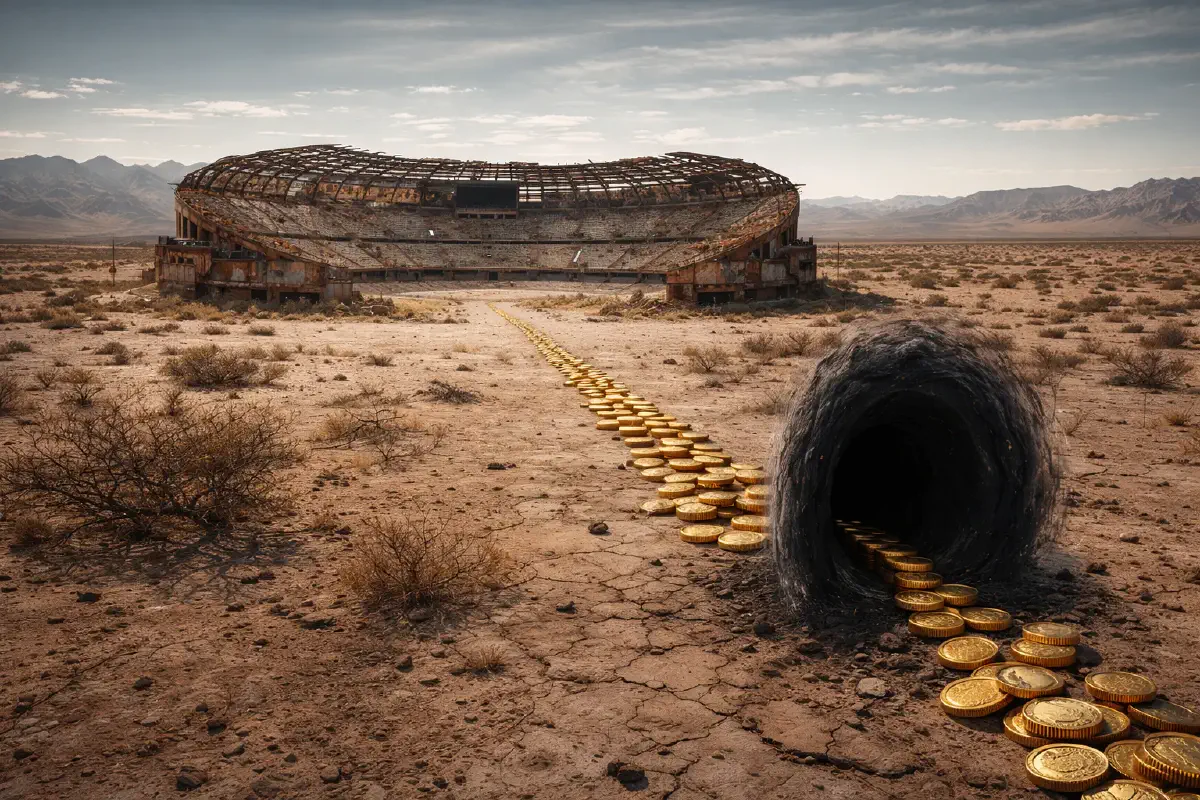
The cascade of effects leaves behind a “ghost town of Olympian extravagance” [Zimbalist]. In Athens, 21 out of 22 stadiums built for the 2004 games are derelict or underused, costing $784 million annually just to maintain [Zimbalist]. In South Africa, stadiums with 40,000 seats were built in cities with no professional soccer teams, becoming “cavernous ghost towns” where the public must pay millions in ongoing maintenance while basic public services remain underfunded [Zimbalist].
Reclaiming the Spirit of Play#
The modern sports-industrial complex has successfully sublimated our natural physical practice into a tool for “control and siphoning” [search.txt, Rowe]. We have moved from the “useful work” of our ancestors to a state of “mediatized passivity” where we cheer for tribes that do not exist and pay for circuses that do not benefit us [search.txt, Rowe, Zimbalist].
If we are to save sports, we must decouple them from the entertainment ethic and the greed of the “top hats” [Novak, Rein et al.]. We must recognize that the “glory” promised by mega-events is an illusion intended to mask the “magnitude of the deception” [Zimbalist]. The winner is not the team on the field, but the elite who bolster their power and gain money from the “nonsense circuses” while we are distracted by the next match [search.txt]. It is time to stop being children watching cartoons and start being citizens who ask: Who really wins when we watch? [search.txt].