The Fever of the Faction#
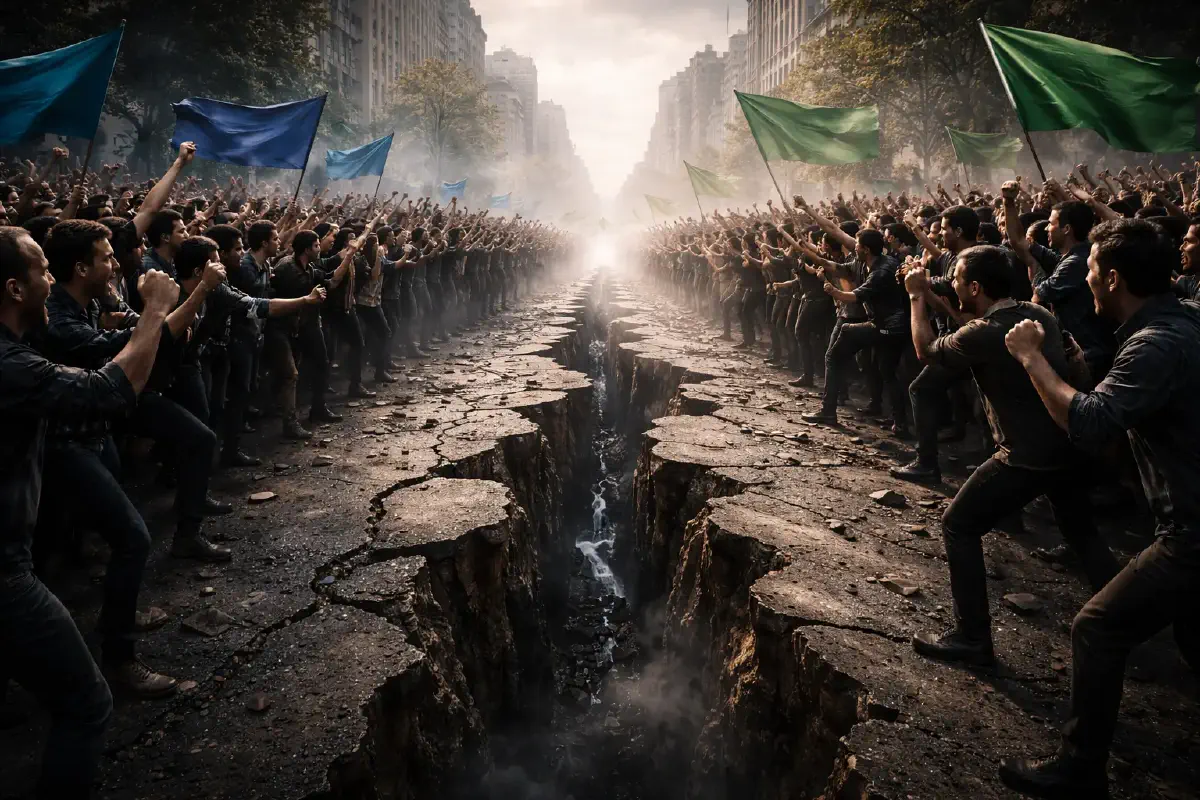
A week before an “Old Firm” match between Glasgow’s Celtic and Rangers, the tension in the city is almost tangible [Kuper]. This is not the organic tension of a community; it is a “ninety minutes’ hate” engineered around religious and historical grievances [Kuper]. In Glasgow, the red, white, and blue of Rangers faces the green and white of Celtic in a ritual that has outlived the actual religious beliefs of its participants [Kuper]. Fans are often “back-stabbed” just for wearing the wrong colors in the wrong neighborhood [Kuper]. This is the darker side of sports: it has become a “fragmenting element” that divides populations into rivaling tribes, transforming a game into a safe, controlled outlet for ancient animosities [search.txt, Kuper].
The Manufactured Divide#
Sports fandom provides a ready-made community in an increasingly atomized world, but this community is often built on the exclusion and hatred of the “other” [search.txt, Foer]. This “engineered tribalism” channels aggression horizontally—fan against fan—rather than vertically against the structures of power [search.txt].
Identity as a Weapon#
In the Balkans, Red Star Belgrade became the most successful “rivaling tribe” in Serb history, with fans who explicitly claimed to have “started the war with Serbia” at their home ground [Kuper]. The “Bad Blue Boys” of Dynamo Zagreb and the fans of Red Star used the stadium as a laboratory for the ethnic cleansing that followed the collapse of Yugoslavia [Foer]. In these contexts, a sports club ceases to be a team and becomes a cipher for ideology and love, but also for hatred and death [Kuper].
The Globalization of Hatred#
Rather than globalization homogenizing these differences, it has often intensified local sectarianism [Foer]. In Glasgow, the “Old Firm” rivalry survives because the fans enjoy the “pornographic pleasure” of the conflict [Foer]. In Budapest, the fans of Ferencvaros use the stadium to hiss like the release of Zyklon B and unfurl banners about the trains leaving for Auschwitz, specifically targeting their “Jewish” rivals at MTK Hungaria [Foer]. Globalization has simply provided these tribes with better communication tools to coordinate their hate and broader markets to sell their “manufactured” rivalries [Foer].
The Fragmentation of Unity#
The cascade of these effects is the erosion of national and class solidarity [search.txt]. Sports rivalries provide a safely contained battleground where deeper social, regional, or political divides can play out without threatening the status quo [search.txt]. By dividing a country into “rivaling tribes,” rulers can ensure that the populace is too busy fighting over a “stupid match” to unite against economic inequality or political mismanagement [search.txt].
The Ritual of Resentment#
We must recognize that the “loyalty” celebrated in sports is often a form of “granfalloonery”—a proud and meaningless association of human beings [Novak]. In cities like Columbus, Ohio, or Glasgow, citizens are “not free” to admit indifference to the local team without being categorized as “freaks” [Novak]. This social pressure forces individuals into tribal roles that serve the interests of those at the top of the sports-industrial complex [search.txt, Novak]. While we cheer for our tribe, we are ignoring the fact that our common humanity is being fragmented for the sake of the “nonsense circuses” that maintain the power of the few [search.txt].