The Echoes of the Arena#
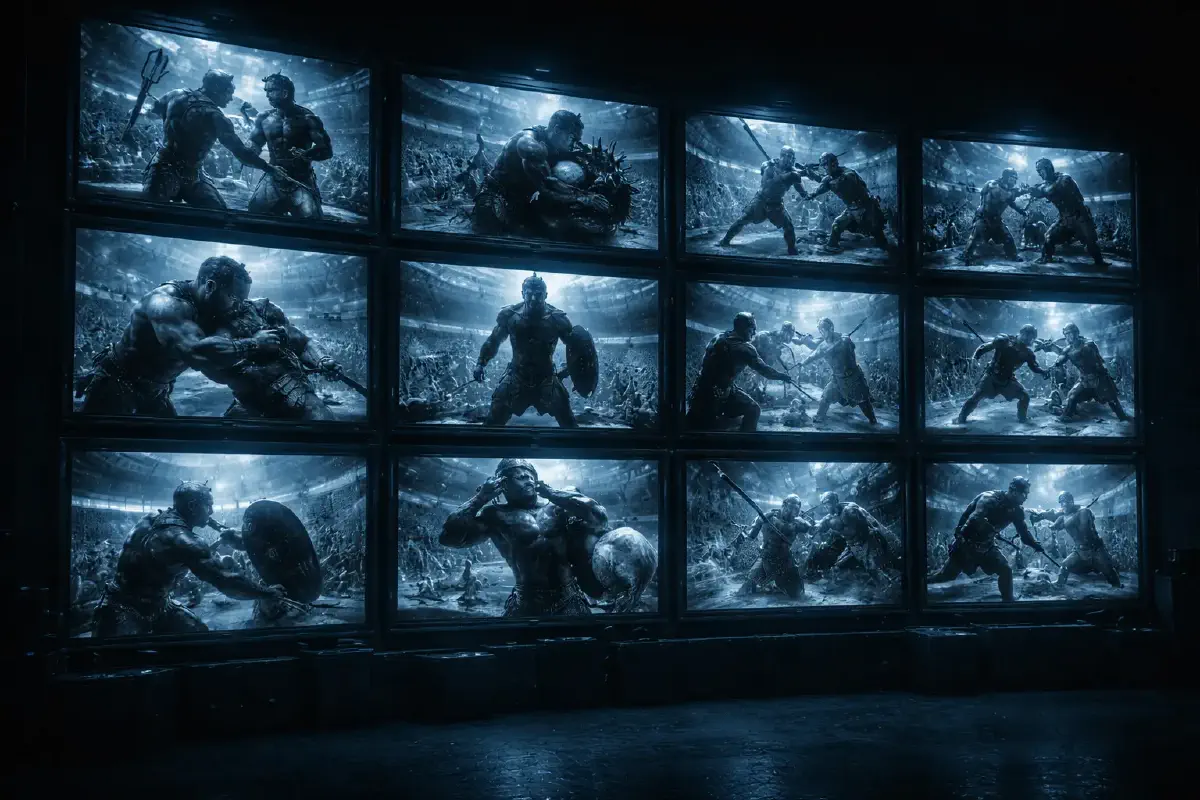
Historically, the act of watching spectacles was a calculated instrument of statecraft rather than a simple form of entertainment [search.txt]. The Roman model of panem et circenses—“bread and circuses”—was the first large-scale realization of the spectacle as a tool for the “beguilement of the people” [search.txt]. In the Roman munera, gladiators and slaves fought to the death not to celebrate human excellence, but to appease a restless populace and demonstrate the absolute power of the elites [search.txt]. While the Greeks viewed their Olympics as a religious festival honoring human potential, the Romans decoupled the spectacle from civic virtue, turning it into a mechanism of pacification [search.txt]. Today, the “Media Sports Cultural Complex” has taken this Roman blueprint and industrialized it through the power of global telecommunications [Rowe].
The Mediatized Mirror#
The modern transformation of sports into a mass spectacle is a direct consequence of urbanization and the standardization of rules [search.txt]. As masses of people moved into close quarters during the Industrial Revolution, a market for mass entertainment was forged, leading to the codification of games into predictable, sellable units [search.txt].
The Industrialization of Sight#
The process of “mediatization” has ensured that sports are no longer just represented by the media but are fundamentally changed by them [Rowe]. In the nineteenth century, sports began a transition from amateur “folk play” into codified disciplines designed for paying spectators [Rowe]. This evolution reached its zenith with the arrival of television, which has a nearly unrivaled capacity to simulate and amplify the experience of physical attendance [Rowe]. This has created an “armchair culture” where the immediacy of the game is captured and packaged as a product, making sports content pervasive in everyday life [Rowe].
The Digital Panopticon#
Technology has intensified this entanglement, moving the spectacle from the stadium to the computer and the mobile device [Rowe]. The cumulative television audience for the 17 days of the 2008 Beijing Olympics was estimated at 4.7 billion viewers, a figure that represents the most successful “beguilement” in human history [Rowe]. This proliferation of media channels has created a space where audience demand is systematically stimulated, and “premium” content like sports becomes the single most valuable asset for capturing consumer attention [Rowe].
The Degradation of Autonomy#
The consequence of this mediatized dominance is the potential degradation of sports’ original values [Rowe]. There is a significant analytical anxiety that television now dominates sports to the point of altering their very rules—introducing tie-breaks, shot-clocks, and commercial breaks—to suit the requirements of advertisers [Rowe]. The original “wonderland” of sport, once perceived as a sacred space beyond politics and economics, has been fully colonized by the entertainment ethic [Novak, Rowe].
The Passive Citizenry#
We are now living in a world where the spectacle has become an “escapist” tool, designed to divert attention from societal issues through emotional release [search.txt]. The mass appeal of the modern circus lies in its ability to offer universally interesting activities that individuals look forward to, reinforcing a loop of diversion that prevents critical engagement with the “real world” [search.txt]. As the spectacle grows more sophisticated, the distinction between the citizen and the consumer vanishes, leaving behind a population treated more like children watching cartoons than adults engaged in the management of their own lives [search.txt].