After HCI and HCI Rate tell you how much and how fast, there is a third question — who, specifically — whose answer changes what the data means.#
A previous piece in this series introduced two metrics: the Human Cost Index (HCI), which measures cumulative battle deaths as a proportion of the affected population, and the HCI Rate, which divides that proportion by the conflict's duration to reveal the annual velocity of killing. Both confirmed what careful observers had long suspected: Gaza, measured correctly, is not one conflict among many. It is in a statistical category with no modern precedent for a sustained armed conflict.
But there is a third question the data can answer, and it is in some ways the most forensically important of the three.
Who is being killed?
The Principle of Distinction#
International Humanitarian Law rests on several foundational principles. The most fundamental is the principle of distinction: parties to a conflict must distinguish between combatants — those engaged in hostilities — and civilians, who are not. Attacks may be directed only at combatants. Civilians must be protected.
This is not a contested provision. It is enshrined in the Geneva Conventions, in their Additional Protocols, in customary international law, and in the Rome Statute of the International Criminal Court. No party to any armed conflict — state or non-state — disputes it publicly. The disagreements are always about application, not principle.
The data, however, offers a way to measure application.
Women and children are non-combatants in virtually all circumstances. They are not soldiers. They do not carry weapons. In almost every armed conflict ever documented, combatant deaths are the majority. This is expected: wars are, on their face, fought between armed forces. When women and children form a large share of total casualties, it signals something systematic — not the friction of war, not the tragic but incidental deaths of civilians caught in crossfire, but a pattern that the principle of distinction was either violated or never operationally in effect.
What the Baseline Looks Like#
To evaluate Gaza's civilian share, you need a baseline: what does it look like in conflicts where the principle of distinction was imperfectly but meaningfully observed?
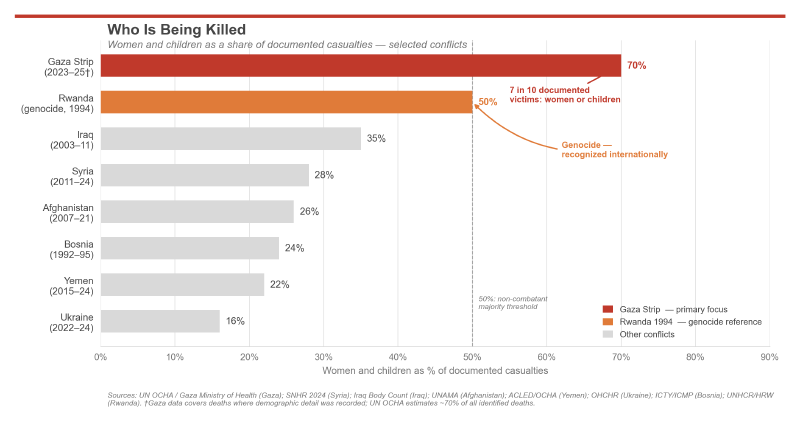
Ukraine's war against Russia, which involves large conventional military forces on both sides, registers 16% women and children among the documented dead. That is a tragedy of almost incomprehensible scale — but it is also a war fought primarily between armies, producing a casualty profile consistent with that.
Yemen's conflict, which has featured widespread airstrikes on civilian infrastructure and deliberate blockades of humanitarian access, registers 22%. Afghanistan over two decades of insurgency: similar range. Iraq's long conflict: comparable. Syria — whose government used barrel bombs, chemical weapons, and siege warfare against its own urban civilian population, and whose tactics the UN Security Council condemned in numerous resolutions — registers 28%.
Bosnia-Herzegovina, whose war gave us the phrase "ethnic cleansing" as a descriptor of organized atrocity rather than metaphor, registers 24%. A significant portion of Bosnia's documented deaths were the result of deliberate massacres of civilian men and boys — including the Srebrenica genocide, where approximately 8,000 Muslim men and boys were executed in a single week. Even so, the overall proportion of women and children in the casualty record is 24%.
Then there is Rwanda. In April to July 1994, Hutu militias and elements of the Rwandan army systematically killed an estimated 800,000 people in 100 days. The international community recognized this as a genocide. The central evidentiary argument for that determination was not only the scale — it was the method and the target. The documented casualty profile shows approximately 50% women and children. The killing was not the collateral outcome of military operations against armed groups. It was the organized extermination of a civilian population defined by ethnicity.
Rwanda's 50% is the recognized evidentiary signature of a conflict that was not, in any meaningful sense, distinguishing between combatants and civilians.
Gaza's Number#
Gaza's documented casualty proportion of women and children is 70%.
Seven in ten.
Of every ten people whose deaths were recorded, documented, and attributed to the conflict, seven were women or children. This is not an estimate or a projection — it is the result of death records maintained by Gaza's Ministry of Health, cross-referenced and verified by UN OCHA, covering the period from October 2023 through the ceasefire in October 2025.
70% is twenty percentage points higher than Rwanda. It is nearly three times Ukraine's proportion. It is two and a half times Bosnia's. It exceeds every documented conflict proportion from the UCDP database for conflicts with significant total casualties.
To visualize what that proportion means: in a typical military confrontation — soldiers against soldiers, armed groups against armed forces — women and children might comprise 15 to 20% of incidental casualties. Bosnia, at 24%, is already elevated. Syria, at 28%, is flagged in the literature as exhibiting indiscriminate warfare. Rwanda, at 50%, is the genocide benchmark.
Gaza is at 70%.
The Territory Explains the Data#
Gaza is 365 km² — roughly the area of Detroit, or the Isle of Wight. Before October 2023, it held approximately 2.3 million people, making it one of the densest populated territories on earth. When the Israeli military issued mass evacuation orders to the north and concentrated the population into declared "safe zones" in the south that were subsequently struck by airstrikes and ground operations, the civilian concentration increased further. There was no exit. The Rafah crossing was closed. The sea was blockaded.
In an urban environment of that density, where approximately 40 to 45% of the total population consists of children under 18, and where the population was ordered into specific locations and then subjected to sustained high-explosive bombardment, a 70% non-combatant casualty proportion is the foreseeable arithmetic outcome.
That foreseeability is not a defense under international law. Under the principle of proportionality — a companion rule to distinction — attacks are unlawful when the expected civilian harm is excessive in relation to the anticipated military advantage. Under the principle of precaution, parties must take all feasible measures to avoid civilian casualties. The data does not adjudicate these questions. But it does establish the evidentiary foundation from which those questions must be answered.
What Three Metrics Together Show#
Article 1 in this series established that Gaza's HCI — 3,397 per 100,000, or approximately 3.4% of the entire population killed — is more than three times Bosnia's ratio and more than double Syria's. It established that Gaza's HCI Rate — 1,618 per 100,000 per year — is 6.25 times Bosnia's benchmark rate, which was itself considered extreme.
Adding the civilian share completes the evidentiary picture.
A conflict with an extremely high HCI could still, in theory, represent a war fought primarily against an armed force — casualties accumulate, but they accumulate against combatants. A conflict with a high HCI Rate could represent intense but focused military engagement. Neither condition describes Gaza.
When all three metrics are considered together — extraordinary scale (HCI), extraordinary speed (HCI Rate), and overwhelming non-combatant proportion (civilian share) — the data converges on a single description: a conflict in which the civilian population was, in statistical terms, the primary casualty of the violence.
A Note on Indirect Deaths#
These figures cover only documented battle-related deaths. The Lancet published an estimate in January 2025 suggesting that when indirect mortality — deaths caused by infrastructure collapse, health system failure, contaminated water, famine — is included, the total death toll may exceed 186,000. That is a 2.4× multiplier over the direct battle death figure of 78,000.
This multiplier is consistent with, though somewhat higher than, documented indirect mortality ratios in Bosnia and Iraq. It does not change the civilian share calculation derived from documented deaths. But it substantially increases the total human cost represented by the HCI and HCI Rate figures. A 2.4× multiplier applied to Gaza's HCI Rate produces an adjusted figure of approximately 3,900 per 100,000 per year — roughly 85% of Rwanda's genocide-phase rate, sustained for ten times as long.
The Methodological Honesty#
The data in this piece comes from institutions with no unified political agenda. UCDP is a Swedish academic consortium. UN OCHA is a humanitarian body mandated to serve all affected populations. The Gaza Ministry of Health's records have been independently verified by multiple international medical and human rights organizations. The women and children proportions for comparison conflicts come from ICTY, OHCHR, Human Rights Watch, ACLED, and UNAMA — bodies that have documented atrocities across the full spectrum of political alignments.
The convergence of these sources around the same proportions is not the product of advocacy. It is what the deaths look like when counted.
What the Data Can and Cannot Do#
Data cannot prosecute a case. It cannot issue an arrest warrant. It cannot convene a tribunal. It cannot write the Security Council resolution that did not pass, or the arms embargo that was not imposed, or the ceasefire that took over a year to negotiate.
What data can do is make a certain kind of denial untenable. It can make it impossible, in good faith, to describe a 70% non-combatant casualty rate in a conflict with an HCI six times Bosnia's as a military operation conducted with meaningful adherence to the laws of war.
Numbers are not neutral — but they are also not impressionistic. The three metrics developed in this series — HCI, HCI Rate, and civilian share — do not carry a political argument. They carry a precise description of events that happened, measured with the tools that the research community has built over forty years to make such descriptions possible.
When those tools are applied to Gaza, the description is unambiguous.
A Note on Sources#
Conflict data: Uppsala Conflict Data Program (UCDP) Battle-Related Deaths Dataset v25.1, covering 1989–2024. Gaza 2023–25: supplementary estimate using UCDP methodology, adjusted for Lancet GMS January 2025. Population denominators: UN/World Bank figures for the affected territory at conflict onset. HCI and HCI Rate: author's calculations from UCDP dataset.
Women and children casualty proportions:
- Gaza: UN OCHA / Gaza Ministry of Health (continuously updated through ceasefire, October 2025)
- Ukraine: OHCHR quarterly monitoring reports, 2022–2025
- Syria: SNHR 2024 Annual Report; Syrian Observatory for Human Rights cross-check
- Yugoslavia/Bosnia: ICTY post-conflict documentation; ICMP database
- Yemen: ACLED / UN Panel of Experts annual reports
- Afghanistan: UNAMA annual civilian casualty reports
- Iraq: Iraq Body Count database
- Rwanda: Human Rights Watch 1994 documentation; UNHCR/ICTR records
Lancet indirect mortality estimate: Khatib et al., The Lancet, July 2024.