The Night Nobody Wanted to Do the Arithmetic#
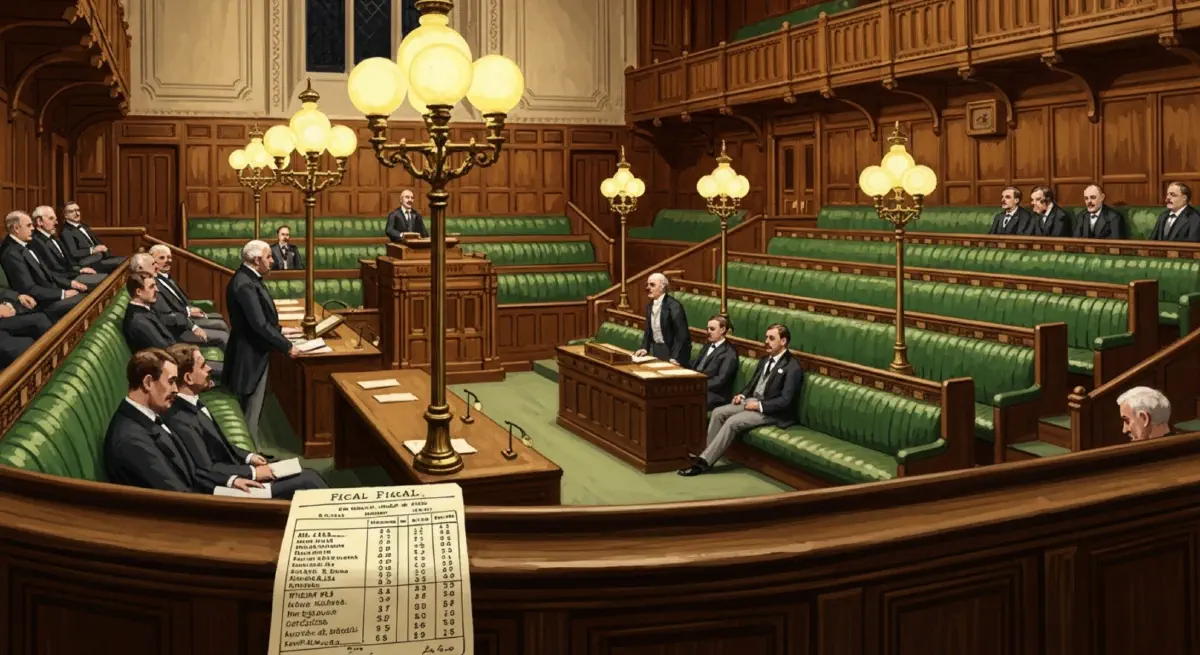
On the evening of June 12, 1879, in the third consecutive night of debate on the East India Revenue Accounts, Mr. Smollett of Dunbarton rose in the House of Commons and read aloud a table. It was not a speech designed to move the passions. It was an accounting. India’s fiscal deficit in 1873–74 had been £5,360,000. In 1877–78 it had been £8,334,000. Over seven years, from 1873 to 1880, the accumulated deficit stood at approximately £34,500,000. “The state of Indian finance,” Smollett said, “is not only serious, but most alarming.”
He was right, and he was ignored.
The same evening, Gladstone — the most formidable parliamentary intellect of the age — said the administration was approaching “a point whereat, unless we are alive to the full gravity and urgency of the situation, the course of events may bring us into a position in which we shall have but one question to face — namely, the question of assuming responsibility for Indian Expenditure as a charge upon the British Treasury.” He called it a “tremendous contingency.” He asked for radical retrenchment. He asked for an honest accounting. Parliament agreed with him, passed a procedural resolution, and adjourned.
It would be convenient to say that the 1879 debate was a missed turning point. In fact it was something more structurally revealing: a system demonstrating that it had no mechanism for holding itself accountable. The men in that chamber were not stupid, and many were not dishonest. But they were operating within an administrative structure designed to make the real costs of empire legible only when someone was angry enough to force a set of figures into the record — and even then, to disperse that anger over three nights of eloquent speeches before it could become policy.
This series applies to that system what it consistently refused to apply to itself: a cost-benefit analysis. Not a moral verdict, but a fiscal one.
What the Debate Was Really About#
The Structural Puzzle#
The 1879 debate was nominally about exchange rates and the value of the silver rupee. But beneath the currency arguments — Lowe’s gold standard scheme, Goschen’s silver absorption theory, Cross’s bi-metallic arithmetic — ran a structural question that none of the speakers could avoid for long: was Britain making money from India, or was it costing money to run?
The uncomfortable answer was: both, depending entirely on who you asked and which ledger you opened. The Government of India ran deficits. The Home Charges — the annual transfers India made to Britain to service its London-held debt, pay pensions to retired officers living in England, and cover the administrative costs of the India Office in Whitehall — were rising without check. Smollett’s table showed those charges had grown from 84.97 million rupees in 1868 to 189 million rupees in 1879: a 122% increase in eleven years. By 1879, the Home Charges were consuming the equivalent of India’s entire net land revenue. The land tax — extracted from 250 million farmers — was, in effect, being entirely remitted to London.
At the same time, British merchants were profiting from Indian trade, British manufacturers were supplying Indian railways, and a thin stratum of shareholders in companies operating across India and the wider empire were receiving dividends. The puzzle was not that the empire was obviously profitable or obviously costly. The puzzle was that these two statements could both be true simultaneously, and that no accounting framework existed which could reveal whose gains and whose losses were producing that coexistence.
The Three Questions This Series Answers#
Academic historians have circled this puzzle for 150 years. Three questions organized the debate then and still organize it now.
The first is the treasury question: setting aside all political and strategic considerations, did the net fiscal position of the British state improve or deteriorate as a result of empire? This is the question Parliament tried hardest to avoid, because honest engagement with it required treating Indian finances and British finances in a single ledger — which the administrative structure was specifically organized to prevent.
The second is the distributional question: even if some aggregate national account could be constructed showing that empire “paid” or “didn’t pay” in net terms, that aggregate conceals everything important. The critical question is not whether the sum was positive or negative, but who within Britain was on which side of the ledger. A system can simultaneously extract net benefit for the nation’s wealthiest 2% while imposing net costs on the remaining 98% — and it would show as “profitable” in aggregate accounting while being deeply regressive in distributional reality.
The third is the opportunity cost question: what did Britain not build, not invest, not develop, because capital and political attention were absorbed by the imperial project? This question almost never appeared in the Hansard debates, and it is still the least-discussed dimension of the economic cost-benefit literature. The Royal Navy patrolled global trade routes that protected British commerce — but it was paid for by British taxpayers, not British merchants. The Indian Army was expanded to hold India — but it was paid for by Indian taxpayers, not British stockholders. These are subsidies. Their beneficiaries and their cost-bearers were different people.
The Framework Nineteenth-Century Parliament Couldn’t Build#
The Hobson Diagnosis#
In 1902, John Atkinson Hobson published Imperialism: A Study — a book that synthesized three decades of economic arguments that had been circulating in exactly the halls where the 1879 debate took place. Hobson’s central claim was stated with an economist’s precision: although the New Imperialism “has been bad business for the nation as a whole, it has been good business for certain classes and certain trades within the nation.”
This formulation is the cleanest entry point into the cost-benefit analysis this series applies. It identifies the problem not as empire’s profitability in the aggregate, but as the gap between aggregate account and distributional reality. A system that transfers costs to the public while concentrating gains to the private — whether in 1879 or 2025 — is a system structured for capture, not for growth.
Davis and Huttenback’s 1986 study, Mammon and the Pursuit of Empire — the most rigorous quantitative examination of the British Empire’s economics ever conducted — confirmed Hobson’s diagnosis with eighty years of additional data. They found that imperial companies, on average, produced lower returns than domestic companies over the full 1860–1912 period. They found that the British middle-class taxpayer subsidized imperial defense, effectively paying an insurance premium whose beneficiaries were the small class of investors with sufficient capital to hold imperial securities. And they found that the dependent empire — Crown India and Africa — attracted only a tiny fraction of British private capital flows, demolishing the claim that empire served primarily as a productive investment vehicle for the nation.
Why the Deficit Was Never Really about Exchange Rates#
The 1879 debate is remarkable for the sophistication of its monetary economics and the near-total absence of distributional analysis. Goschen’s aria on the silver market covered five pages of Hansard and remains technically impressive 145 years later. Cross’s demolition of the bi-metallic remedy was careful and correct. But neither speaker placed the monetary question in its fiscal context: that the reason the exchange depreciation was catastrophic was not primarily because it made government remittances more expensive, but because it revealed how dependent the entire structure had become on a set of transfers — the Home Charges — that the Indian population had no political means to contest.
Gladstone glimpsed this. He said: “I have a double apprehension: first, that the measures taken may be comparatively narrow; next, that in point of time they may lag behind the necessities of the case — necessities which are constantly and rapidly accumulating.” He identified the political economy of the problem without quite naming its structural source. The Home Charges were not a technical glitch in the currency mechanism. They were the mechanism through which a fiscal transfer was insulated from parliamentary accountability on both ends: Parliament in London could not challenge them without challenging the entire India Office structure, and the Legislative Council in Calcutta had no authority over them at all.
Setting the Terms for What Follows#
This series is not a rehashing of the “drain theory” — the argument, associated with Dadabhai Naoroji and later Utsa Patnaik, that Britain extracted a calculable sum of capital from India over the colonial period. That argument is important and largely correct. This series approaches the same structural problem from a different angle: what the British state’s own documents, in the form of Hansard records, colonial annual reports, and Davis and Huttenback’s quantitative analysis, reveal about the internal distribution of the imperial enterprise’s costs and benefits.
The primary sources used in this series have stood in archives for a century. The Hansard record of June 12, 1879 is not a contested document. The India Home Charges statement of 1906, showing £19,463,757 transferred to Britain in a single year, is a printed parliamentary paper. The Colonial Office Blue Book from Basutoland in 1931, showing that the Native Tax raised £125,665 from 570,000 people while European administrators earned between £200 and £850 per year, is a public record. These are not polemical claims. They are the empire’s own accounting, read carefully.
The next post takes the India ledger and opens it fully: what was transferred, through what mechanism, with what justification, and what the formal accounting concealed that Gladstone and Smollett could only gesture toward in 1879.