The Imperial Balance Sheet
The Series at a Glance#
Five posts. One question: did the British Empire pay — and for whom?
This series treats empire as a balance sheet rather than a moral category. It asks the structural questions that parliamentary debate in 1879, 1906, and beyond consistently skirted: what did the British treasury actually extract, what did it actually spend, and who within Britain experienced the gap as a gain or a loss? The answer, assembled from Hansard records, colonial annual reports, and the most rigorous academic cost-benefit study ever conducted of the British Empire, is neither the triumphalist narrative nor the simple moralizing critique. It is something more specific, and more damning: a system whose costs were socialized across the British public and the colonial population, while its gains concentrated in a narrow financial and administrative elite.
The method is the same used throughout this site: primary sources, quantitative data, and an analytical narrative that refuses abstractions. The Hansard debates of June 1879 are not historical colour — they are fiscal testimony. The Home Charges are not political grievance — they are an accountable transfer mechanism. The wage tables from Basutoland in 1931 are not anecdote — they are evidence of structural extraction.
Key Findings#
- India’s fiscal deficit 1873–1880 exceeded £34.5 million in seven years — not from famine alone, but from a structural imbalance between Home Charges and revenue, acknowledged in Parliament but never remedied at scale.
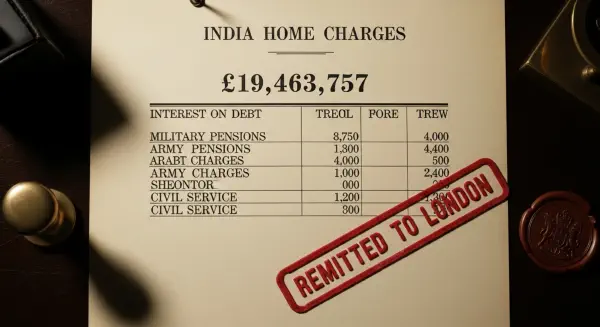
- India’s Home Charges rose 122% between 1868 and 1879 — from 84.97 million rupees to 189 million rupees — consuming, by 1879, the equivalent of India’s entire net land revenue. By 1904–05, the annual transfer to Britain was formally documented at £19,463,757.
- Davis and Huttenback’s definitive study (1986) found that imperial investment produced lower average returns than domestic investment — and that the British middle-class taxpayer subsidized imperial defense, effectively transferring wealth to the small investor class connected to imperial finance.
- The dependent empire — Africa and Crown India — received only approximately 3% of private British capital flows, demolishing the claim that empire was a vehicle for productive investment in colonized territories.
- Basutoland in 1931 ran a fiscal deficit. European administrators earned £200–£850 per year. Native workers earned £24–£204 per year. Native Tax raised £125,665 from a population of 570,000 people. This colony cost more to administer than it returned — a liability, not an asset, on the imperial balance sheet.
- The conclusion is not that empire failed. It succeeded — at concentrating gains. Gladstone said it in 1879: “however inconvenient and disagreeable, this is not the main difficulty to be contended with.” The main difficulty was that no accounting framework existed that could hold the system responsible.
Series Structure#
| Post | Title | Core Question |
|---|---|---|
| Part 1 | The Question Parliament Avoided | What is the cost-benefit frame, and why did 19th-century politics resist it? |
| Part 2 | What the Ledgers Show — India | How much did India transfer to Britain, and through what mechanism? |
| Part 3 | The Distribution of Spoils | Who in Britain received the gains from empire? |
| Part 4 | The Grammar of Extraction — Two Colonies | What did small, peripheral colonies cost versus contribute? |
| Part 5 | A System Designed for Capture | What is the structural verdict, and what does it explain about modern extractive architectures? |
Primary Sources#
- Hansard, June 12 1879 — “East India Revenue Accounts: The Financial Statement — Adjourned Debate, Third Night.” Speeches by J.K. Cross (Bolton), Gladstone (Greenwich), Smollett, Goschen, Rathbone. UK Parliament.
- Hansard, February 19 1906 — India Home Charges statement. Parliamentary printed accounts including the Schedule of Home Charges for 1904–05, total £19,463,757.
- Davis, Lance E., and Robert A. Huttenback. Mammon and the Pursuit of Empire: The Political Economy of British Imperialism, 1860–1912. Cambridge University Press, 1986.
- Colonial Office Blue Book: Basutoland, 1931. Annual Report on the Social and Economic Progress of the People of Basutoland. His Majesty’s Stationery Office.
- Colonial Office Blue Book: Gold Coast, 1946. Annual Report on the Gold Coast, 1946. His Majesty’s Stationery Office.
- Patnaik, Utsa. “Revisiting the ‘Drain’, or Transfer from India to Britain in the Context of Global Diffusion of Capitalism.” In Agrarian and Other Histories: Essays for Binay Bhushan Chaudhuri, edited by Shubhra Chakrabarti and Utsa Patnaik. Tulika Books, 2017.
- Cain, P.J., and A.G. Hopkins. British Imperialism: Innovation and Expansion, 1688–1914. Longman, 1993.
- Tomlinson, B.R. The Economy of Modern India, 1860–1970. Cambridge University Press, 1993.