The Gap Between the Policy and the Road Home#
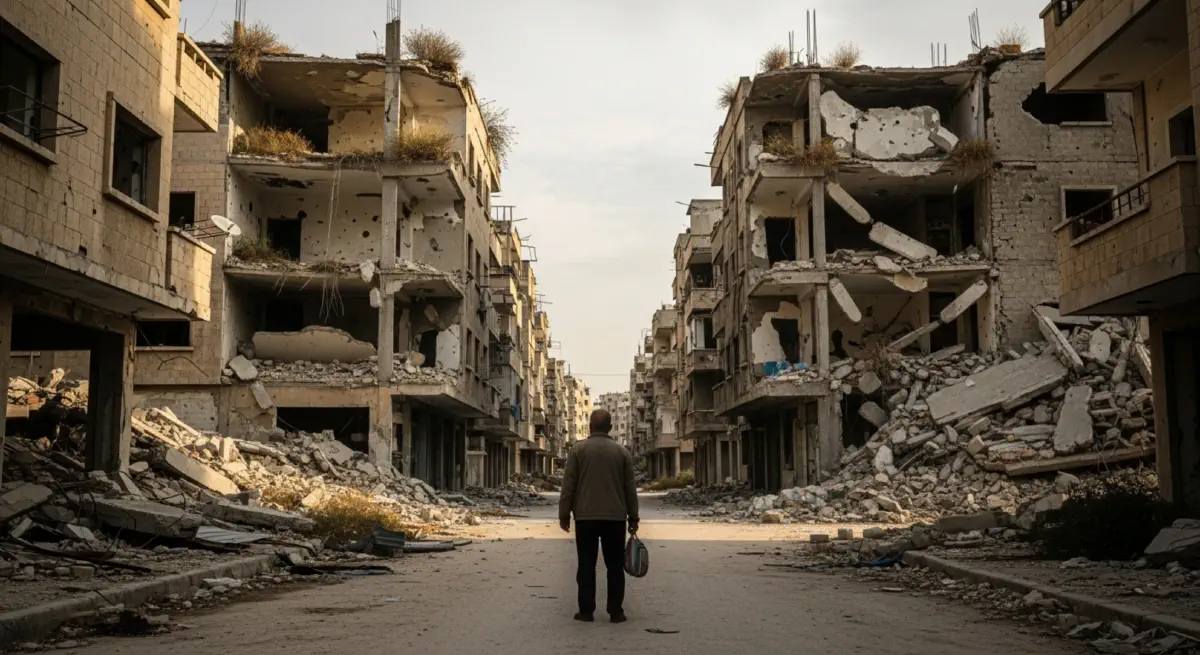
In 2018, the Syrian government issued a series of statements — amplified by Russian diplomatic channels and regional Arab governments moving toward normalization with Damascus — declaring that the conditions for Syrian refugee return had been established. Security had been restored in former opposition-held areas. Reconstruction was underway. The government welcomed the return of its citizens.
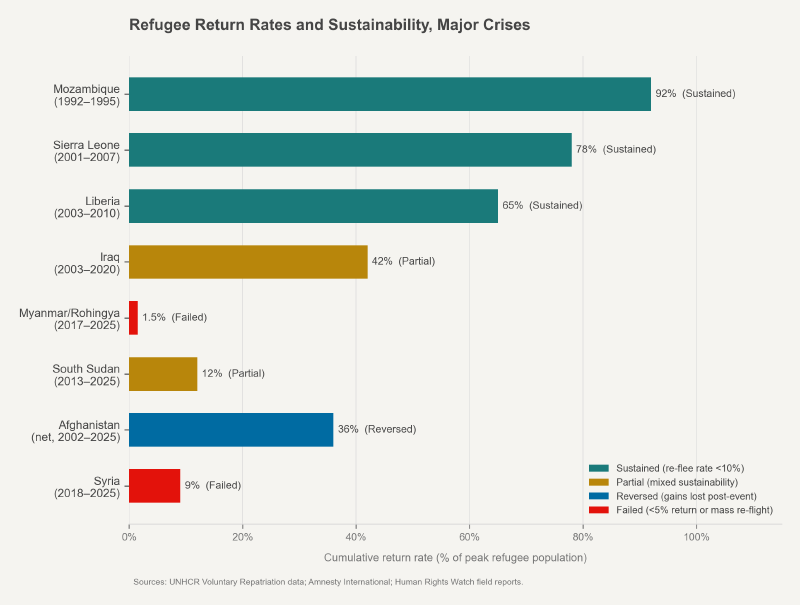
UNHCR's data on voluntary repatriation to Syria through December 2025: approximately 485,000 documented returns from the total refugee caseload, against a registered refugee population of 5.4 million. That is a return rate of approximately 9% across seven years. Of the returnees, UNHCR and NGO monitoring organizations — operating under severe access restrictions inside Syria — documented cases in which returning refugees were detained, had property confiscated, received conscription notices upon crossing the border, or found that legislation passed during the conflict (specifically Syria's 2018 Property Law No. 10) had transferred legal title of their homes to new owners. A subset of documented returnees re-fled within months and re-registered as refugees in Lebanon or Jordan.
Syria's 9% return rate is not unusual. It is close to the median for major modern refugee crises that nominally "ended." Afghanistan, South Sudan, Somalia, the Central African Republic — each has generated return statistics that diverge sharply from the policy rhetoric surrounding them. The 2021 Taliban takeover of Afghanistan produced the inverse: UNHCR had been facilitating returns of approximately 800,000 Afghans per year in the period 2017–2020. After August 2021, that figure collapsed, and Afghanistan's net migration balance swung sharply back toward outflow.
The Three Conditions the Doctrine Requires#
The UNHCR Framework#
UNHCR's doctrine on voluntary repatriation stipulates three conditions that must be met before the organization can facilitate or endorse returns: the return must be voluntary (free from coercion), safe (protection guaranteed from persecution, violence, and physical harm), and dignified (returnees should not face destitution or degradation of status upon return). These three conditions are individually difficult to assess; taken together, they have almost never been fully met in any major post-conflict return situation of the past 30 years.
The voluntariness condition is the first to erode. Pressure on displaced populations to return can be direct — expulsion from host country territory, withdrawal of refugee status, termination of food aid — or indirect — deteriorating camp conditions, enforcement actions against informal employment, social pressure from host community resentment. Lebanon has, at various points since 2019, pressured the Syrian refugee population through all of these channels. Jordan has conducted large-scale deportation operations, later criticized by UNHCR, in 2018 and 2023. Turkey, facing domestic political pressure, has both conducted deportations it described as voluntary and maintained a policy of not granting refugees permanent settlement.
When returns occur under these conditions, UNHCR recording them as "voluntary" reflects a technical definition — the individual signed a voluntary repatriation form — rather than a description of the choice architecture. People sign forms to avoid deportation. They accept returns that are not fully safe because the alternative is a deteriorating camp with declining services. The data on voluntary repatriation, unaccompanied by data on the conditions under which the decision was made, vastly overstates the degree to which returns are truly unconstrained.
The Safety Condition and Its Measurement Problem#
The safety condition depends on information that is systematically difficult to obtain: what is actually happening to returnees after they cross the border? Host country governments and origin country governments both have political interests in projecting positive return narratives. International organizations operating inside Syria, Afghanistan, or South Sudan do so under access restrictions imposed by governments that will not permit monitoring of detention, property confiscation, or targeted violence against returnees.
The evidence that does exist is fragmentary but consistent. The Syria Justice and Accountability Centre, drawing on insider documentation obtained from Syrian opposition networks, documented at least 750 cases of refugees who were arrested upon return between 2017 and 2024 — most of them men conscripted into the Syrian Arab Army or detained by intelligence services. Amnesty International's 2021 report on Syria returns found that 13 out of 66 documented returnees had been detained, tortured, or killed after crossing from Lebanon into Syria. The Syrian government disputes these figures and denies systematic targeting of returnees.
In Afghanistan, the Human Rights Watch documented cases of Taliban targeted killings of former government employees, civil society activists, women in professional roles, and ethnic Hazaras — groups whose return would be most physically dangerous — within months of the 2021 takeover. UNHCR declared Afghanistan insufficiently safe for involuntary returns in September 2021 and has maintained that position. Despite this, Pakistan — which hosts 3.4 million Afghan refugees — conducted a large-scale deportation campaign in 2023 and 2024, forcibly returning an estimated 500,000 Afghans, including people with UNHCR registration cards, in defiance of the agency's guidance.
Dignified Return and the Economics of Reconstruction#
The third condition — dignified return — depends on material infrastructure: housing, productive assets, employment, functioning public services. It is the condition most clearly tied to economic investment rather than political will alone.
UNHCR and World Bank estimates of what sustainable return to Syria would require — at a minimum, stabilization of property rights, reconstruction of destroyed neighborhoods, restoration of basic utilities, and demobilization of armed groups — run into the hundreds of billions of dollars. The World Bank's 2017 Syria Damage Assessment estimated total reconstruction costs at $170–250 billion. By 2024, after continued damage and economic deterioration, updated estimates from the Syria Recovery Trust Fund placed total economic losses above $500 billion.
International donors have not committed to Syrian reconstruction while the Assad government remains in power, citing accountability requirements that the government refuses to meet. The result is a catch-22: return cannot be dignified without reconstruction; reconstruction will not be funded while the government responsible for the destruction remains; and the government has no material incentive to support reconstruction without the diplomatic normalization that comes from refugees returning. The 485,000 who have returned did so into this stasis — neighborhoods that exist only partially, economies operating at a fraction of pre-war output, and a state apparatus that has not resolved the legal status of the property and conscription issues that make return dangerous.
The Afghanistan Reversal#
Afghanistan is the case that concentrates the failure of return policy in its most compressed form. Between 2002 and 2020, UNHCR facilitated or recorded the return of approximately 5.3 million Afghan refugees — the largest sustained voluntary repatriation in the organization's history. The World Bank, USAID, and multiple bilateral donors contributed tens of billions of dollars in reconstruction and institution-building assistance. By 2019, Afghanistan had a constitution, an elected parliament, a central bank, functioning universities, and a formal economy that had grown at roughly 9% annually from 2005 to 2012.
In August 2021, the Taliban took Kabul in eleven days. The government that the international community had spent two decades building collapsed in under a fortnight. Most of its institutions dissolved within weeks. The educated, urban, women-headed professional class that had formed in part because of international investment began to leave immediately, in a new displacement wave that reversed a substantial fraction of the returns that had been achieved.
The net effect — if one subtracts from the 5.3 million who returned between 2002 and 2020 the estimated 3.4 million who fled after 2021, and the continuing outflow since — is a repatriation program that consumed roughly 20 years and billions of dollars and produced a net positive outcome for fewer than 2 million people. That is not an argument against the attempt; it is an argument about the degree to which refugee policy divorced from sustainable political solutions produces results that can be undone almost instantly by a security collapse.
What the Data Shows About Who Goes Back#
UNHCR's statistical data on voluntary repatriation, when disaggregated by origin country and conflict type, shows patterns that the aggregate return figures obscure.
Returns are significantly higher from conflicts that ended with political resolution and security guarantees rather than military victory by one side. Mozambique's post-civil war repatriation in the 1990s — conducted after the 1992 Rome General Peace Accords established a genuine power-sharing framework — repatriated approximately 1.7 million refugees with a re-flee rate that was among the lowest ever recorded. Sierra Leone and Liberia, where peace agreements were followed by internationally monitored disarmament and transitional justice processes, produced sustainable returns in the 2000s. The common variable was not economic reconstruction per se — Mozambique in 1992 was extremely poor — but the resolution of the security conditions that had made staying dangerous.
By contrast, returns from conflicts that ended through military victory — one side defeating the other without political negotiation — show consistently lower voluntariness, higher rates of coercion, and significantly higher rates of renewed flight. Syria is the clearest current example; Rwanda's post-genocide repatriation of Tutsi refugees involved coercion by the RPF-dominated government that is extensively documented; Eritrea's repatriation from Sudan after the 1991 independence included returns to a government that was already consolidating the authoritarian control that would eventually generate its own new refugee outflow.
The implication for policy is uncomfortable: the most effective predictor of sustainable return is the nature of the political settlement that ended the conflict, and the factors that make political settlements possible — willingness to share power, existence of credible enforcement mechanisms, international guarantees — are exactly those that authoritarian states and military victors have strong incentives to refuse. Designing return policy around the assumption that these conditions will materialize is designing policy for a world that the data shows rarely exists.
The Displacement Economy and What It Has Built#
This series began with a statistic — 117 million people forcibly displaced — and traced its implications across five dimensions: the permanence of "temporary" displacement, the unequal distribution of burden across host countries, the reproduction of statelessness across generations, the economics of a response system that has calcified around camps, and the failure of return as a resolution mechanism.
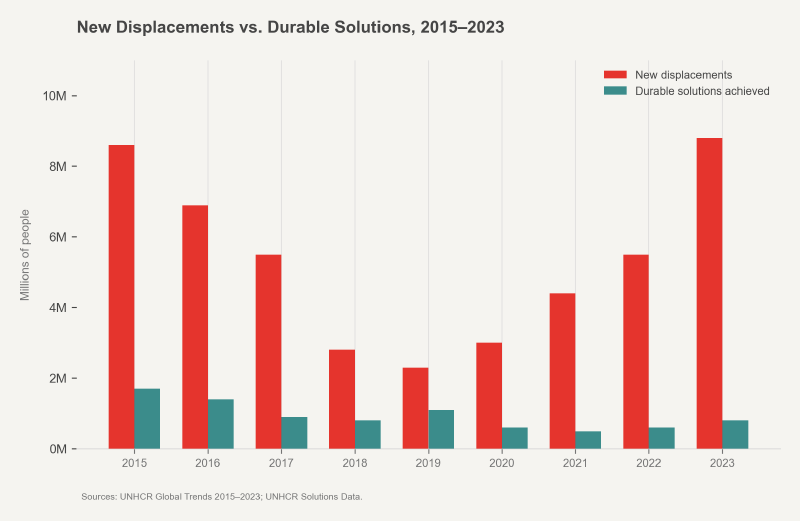
The pattern that emerges is not primarily a story of insufficient resources, though funding gaps are real. It is a story of a system built around a theory of displacement — that it is temporary, that people will return, that host countries share burden proportionally, that statelessness is exceptional — that the data now comprehensively disproves.
The Displacement Persistence Score, the Host Country Burden Index, the statelessness gap between official and estimated figures, the per-year cost arithmetic of encampment, and the return rate data for every major post-2000 crisis tell the same story in different registers: the international system has built a permanent housing structure for a condition it describes as temporary, funded it on an emergency basis for decades, and organized the political conversations about it around solutions that the evidence shows do not work at scale.
The 117 million do not need better descriptive rhetoric. They need resolution mechanisms calibrated to the actual constraints of their situations: statelessness requires legal reform by governments that resist it; return requires security conditions that military victory does not produce; burden-sharing requires a quantitative framework that existing international agreements refuse to provide. Measuring the problem precisely — as this series has attempted — is the precondition for prescribing solutions that match the scale of what has been built.
What has been built, in 34 years of Kakuma, 14 years of Zaatari, 9 years of Cox's Bazar, and 78 years of Palestinian exile, is not a crisis. It is a displacement economy: a system with its own institutional logic, its own funding mechanisms, its own labor market, and its own intergenerational reproduction. Understanding it as an economy rather than a crisis is the first step toward designing a response that could plausibly resolve it.