Year 14 of an Emergency#
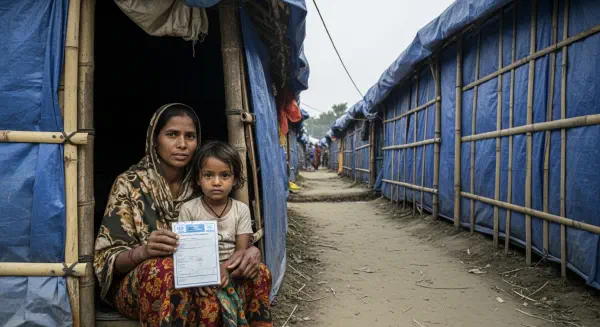
On July 28, 2012, the first Syrian families arrived at a newly established site in the Mafraq Governorate of northern Jordan, approximately 11 kilometers from the Syrian border. UNHCR and Jordanian civil defense had prepared the site for roughly 10,000 people. Within weeks, the population had exceeded 30,000. By 2013, it had surpassed 150,000, making Zaatari the largest Syrian refugee camp in existence and, by some metrics, the fourth largest urban agglomeration in Jordan.
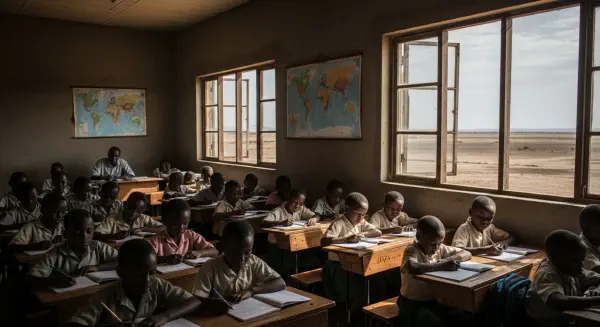
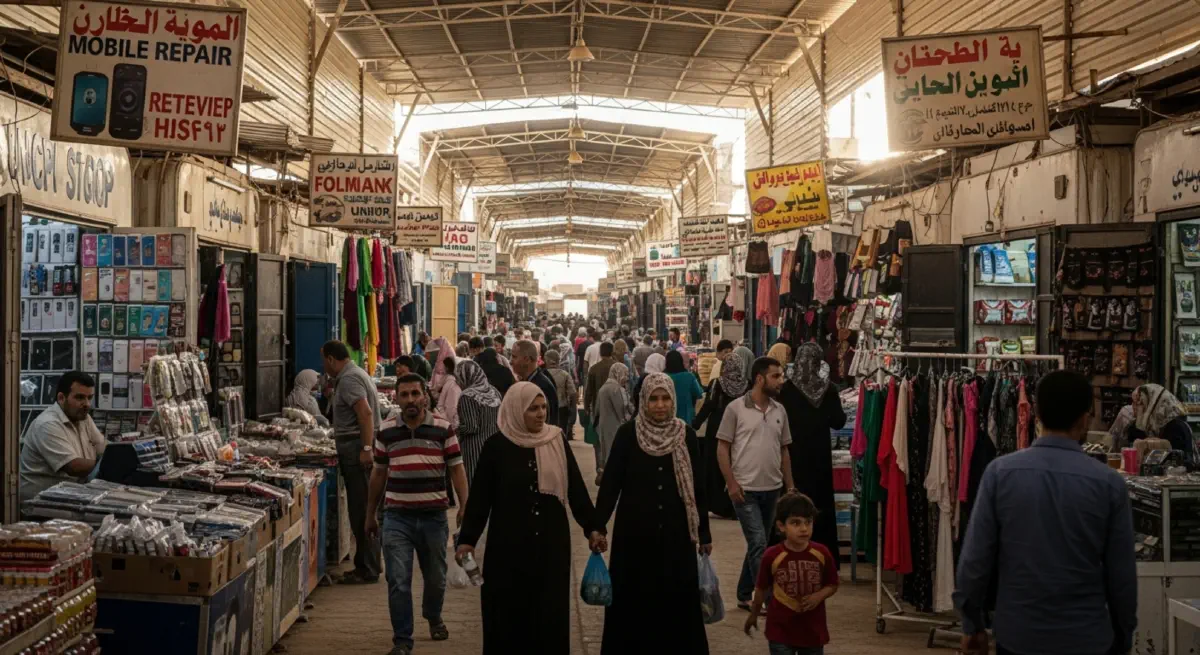
The camp was designed for crisis response. What it became is something more difficult to categorize. Zaatari's main thoroughfare — Champs-Élysées, as its residents named it with deadpan precision — has approximately 2,500 shops. There is a solar power installation producing 12.9 megawatts of electricity, funded by the German government, that provides 24-hour power to most of the camp. There are 32 schools serving 22,000 students, a hospital with surgical and obstetric wards, three banks offering remittance services, and a nascent manufacturing sector producing wedding dresses and artificial flowers for sale in Jordan and export to the Gulf.
As of 2026, Zaatari has been operating for 14 years. The population — currently approximately 147,000 — includes teenagers who were toddlers when they arrived and children who were born in the camp and have never been outside it. The camp has a second-generation population. It has a local economy. It has a class structure. What it does not have is an exit strategy.
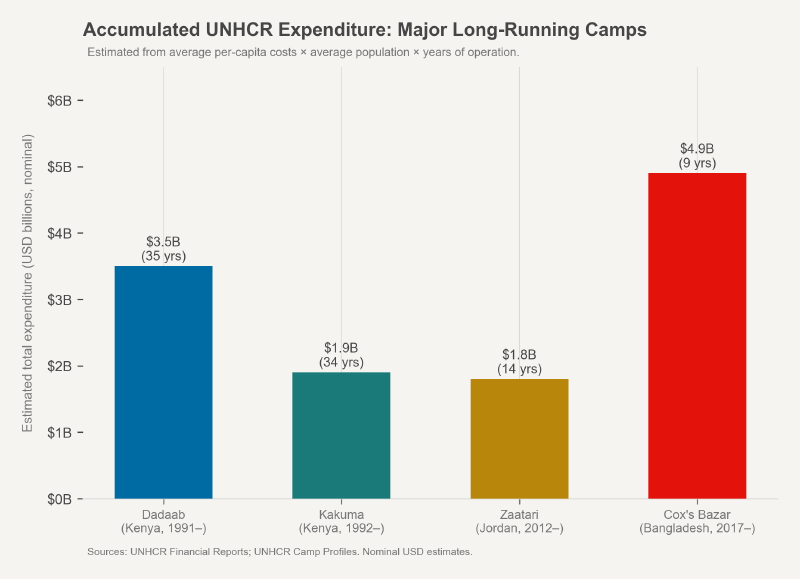
UNHCR's total expenditure on Zaatari from 2012 through 2024, across all donor contributions, is estimated at approximately $1.8 billion. That figure has been authorized annually, for 14 years, under emergency humanitarian response frameworks — the same frameworks used to respond to earthquakes and floods, adapted now for a situation that has acquired the demographic permanence of a city.
The Arithmetic of Encampment#
What Camps Actually Cost#
UNHCR's per-capita expenditure in refugee operations varies substantially by country and context, but the global average for direct camp operations — covering food, shelter, health care, water and sanitation, education, and UNHCR administration — falls between $300 and $700 per person per year. The lower end represents lean operations in low-cost contexts with significant government support (Uganda, parts of Sub-Saharan Africa). The upper end represents complex operations in middle-income host countries with high logistics costs and extensive service provision (Lebanon, Jordan, Turkey).
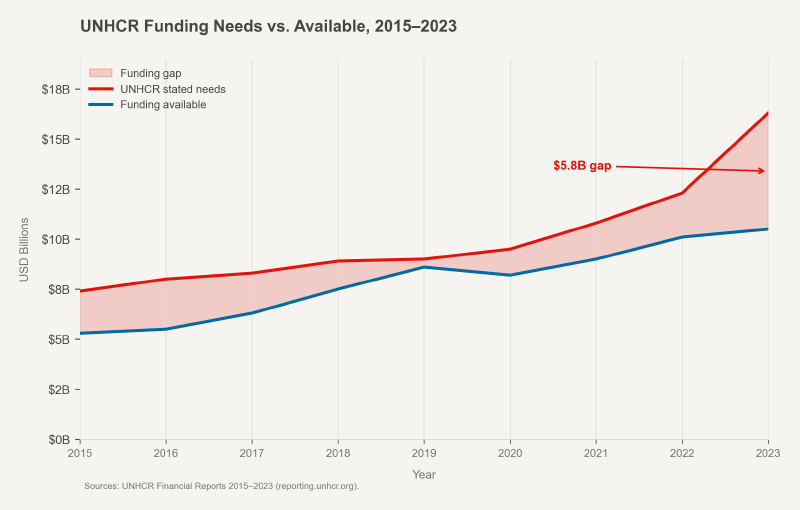
Applying a median of $500 per person per year to the world's 43.4 million refugees for one year produces a global refugee operation cost of approximately $21.7 billion annually. Actual UNHCR expenditure in 2023 was $10.5 billion — roughly half the calculated need. The gap between what UNHCR requires and what donors provide has grown every year since 2015: in 2023, the funding gap stood at $5.8 billion, the largest in UNHCR's history.
For individual long-running operations, the arithmetic of accumulated cost is stark. Kakuma camp in Kenya has operated since 1992 — 34 years. With an average population of approximately 140,000 and an average per-capita cost of $400 (reflecting Kenya's relatively lean operation), the total expenditure through 2026 is approximately $19 billion in nominal terms, or roughly $12 billion in 2023 dollars. Dadaab — opened in 1991 — has a comparable spending history. Cox's Bazar, opened in 2017 with an enormous population and high per-capita costs, has already accumulated several billion dollars in expenditure.
These numbers are not criticisms of the spending. The people in these camps require food, water, medical care, and shelter. Without UNHCR's operations, they would die. The point is different: the world is not spending emergency humanitarian dollars on a temporary emergency. It is spending them, year after year, on a permanent condition that it continues to describe as an emergency because acknowledging its permanence would require a different response — one that the permanent political conditions of the international system make impossible to agree upon.
The Integration Alternative#
The economic argument for local integration — allowing refugees to settle permanently in host communities, work legally, and access host country services rather than parallel humanitarian systems — has been studied rigorously since the early 2000s. The consistent finding across this literature is that integration costs less over time than encampment, generates positive economic externalities for host economies, and produces better outcomes for displaced people across every measured dimension: health, education, income, and legal status.
The World Bank's 2016 study of Uganda's integration model — refugees with the right to work and move freely, settled in agricultural communities rather than camps — found that refugees contributed approximately $85 million to Uganda's GDP through economic activity that would not have occurred under encampment. A 2019 Betts et al. study of Ugandan refugees found that 21% of refugees owned businesses employing host community nationals — a direct inversion of the standard "competition for jobs" narrative used to oppose integration.
For Jordan specifically, a World Bank analysis of the Syrian refugee presence found that while the influx had increased labor market competition in low-wage sectors, it had also stimulated demand for goods and services, supported construction activity, and contributed to Jordan's import and transit economy. The net economic effect was closer to neutral than either the "economic drain" or the "economic benefit" narratives captured.
The economic case for integration is not controversial in the research literature. It is politically impossible in most host contexts. Jordan's political economy is defined by a social contract in which water-scarce, resource-limited Jordan provides subsidized services to its citizens in exchange for political stability. Extending that contract to 750,000 Syrian refugees would require either a massive increase in resources — which Jordan cannot self-finance — or a dilution of service provision to Jordanians, which the government will not countenance. The result is a policy of encampment that is economically suboptimal, sustained by political necessity, and funded on an emergency basis indefinitely.
Donor Fatigue and the Funding Architecture#
The humanitarian system operates on a model of voluntary contributions from donor governments, channeled through UNHCR and other implementing organizations. This model has structural properties that make long-term response to long-term crises increasingly unreliable.
The pattern of donor contributions to the Syria Regional Refugee Response, which covers Jordan, Lebanon, Turkey, and Egypt, illustrates the dynamics. In 2013, the response plan requested $4.4 billion and received $2.6 billion — a 59% coverage rate. By 2016, coverage had fallen to 48%, with a larger absolute gap. By 2022, the response plan requested $6.0 billion and received $3.1 billion — a 52% coverage rate in a year when the Ukraine crisis was drawing unprecedented funding flows that squeezed competing responses.
Donor fatigue is real — but it is also directional. The Ukraine response, launched in March 2022, attracted $3.1 billion in UNHCR donor commitments in its first year. The Syria response, in its tenth year, attracted less. Sudan, which generated more new IDPs in 2023 than any crisis since tracking began, received less than 30% of its requested humanitarian funding in 2024. The implicit hierarchy of donor attention — European crises receive more funding, faster, than African or Middle Eastern crises — is not just a moral failure. It is a resource allocation distortion that produces differential outcomes for people in structurally similar situations.
The OECD Development Assistance Committee (DAC) data, which tracks official development assistance flows including humanitarian aid, corroborates this. In 2023, total ODA from OECD-DAC donor countries was $211 billion — a record. But the humanitarian share — approximately $18 billion — was split between Ukraine and all other crises in a ratio that organizations working in Sub-Saharan Africa and the Middle East described as unprecedented in its skew toward a single conflict.
The Humanitarian Industrial Complex#
The sustained scale of the humanitarian system — UNHCR alone has 18,000 staff across 137 countries, with an operations budget exceeding $10 billion annually — has generated a form of institutional inertia that scholars of humanitarianism have noted, with varying degrees of discomfort, for the past two decades. The term "humanitarian industrial complex," borrowed critically from Eisenhower's famous warning, captures the structural interest that large humanitarian organizations have in the perpetuation of the crises that fund and justify them.
This is not an accusation of bad faith. The individuals who work in UNHCR, MSF, IRC, CARE, and hundreds of implementing NGOs are, almost universally, motivated by genuine concern. The institutional dynamic is subtler: organizations designed to respond to crises develop operational expertise, hiring pipelines, donor relationships, and logistical infrastructure in specific geographic and thematic areas. Resolving a crisis permanently would eliminate the institutional function that crisis maintenance has created. The incentive structure, in the language of organizational economics, does not reward resolution.
UNHCR's own literature acknowledges the tension. A 2019 internal evaluation of UNHCR's durable solutions programming found that "the gap between the organization's stated commitment to durable solutions and its operational practice of emergency response management" remained wide, and that organizational incentives systematically favored emergency response — which attracts donor funding more readily than the slower, politically difficult work of integration or return facilitation.
None of this is to suggest that the camps should be closed without resolution of the crises that created them. It is to observe that the system currently spending tens of billions of dollars per year on maintaining displaced populations in camps has limited institutional motivation to advocate forcefully for the political resolutions that would end the need for those camps. The result is an equilibrium that is simultaneously very expensive and very stable — and that leaves the people inside the camps in a condition that the annual reports describe as temporary and the data describes as permanent.
The next post asks what would have to be true for return to work — and examines the gap between what the data shows about return and what the international policy framework assumes about it.