The Condition That Has No Exit#
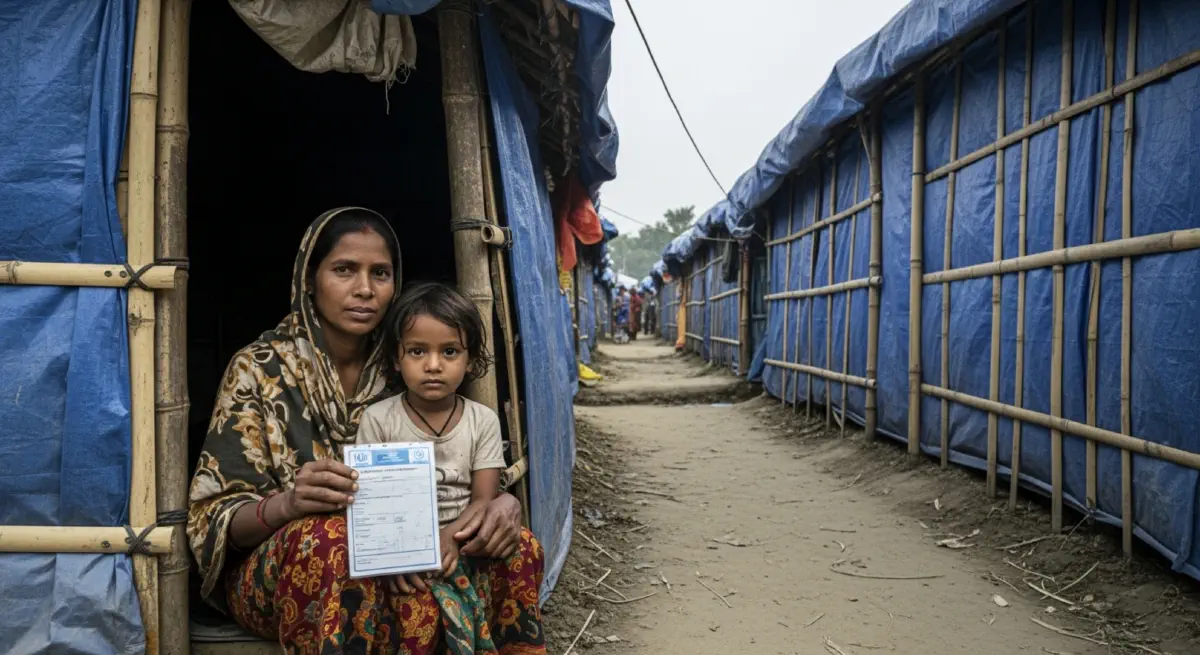
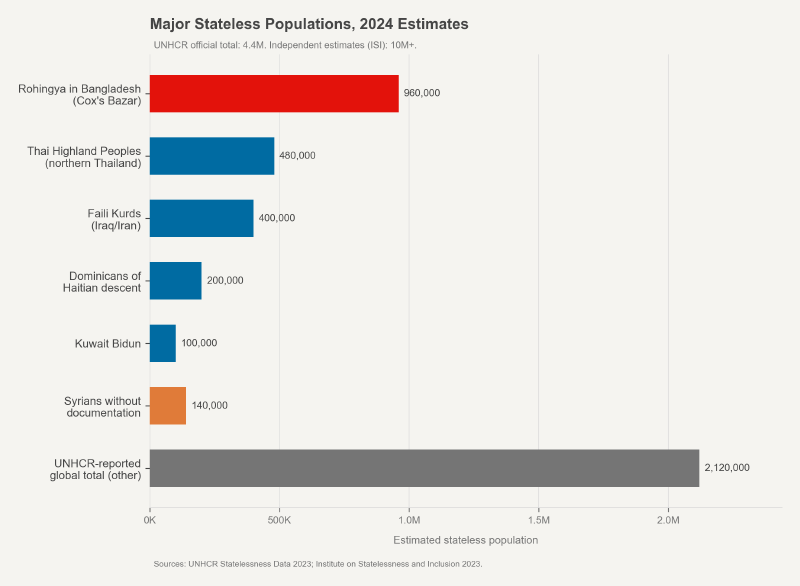
In October 2017, Myanmar's military conducted what UN investigators later described as "textbook ethnic cleansing" — a campaign of targeted killings, mass rape, village burning, and forced expulsion aimed at the Rohingya Muslim minority population in Rakhine State. By the end of that year, approximately 700,000 Rohingya had fled across the border into Bangladesh, joining the 200,000 who had arrived in previous waves since 1978. They settled, initially in improvised shelters and then in the sprawling settlement that became Cox's Bazar — today the world's largest refugee settlement, with approximately 960,000 residents across 34 camps in a 27-kilometer stretch of coastal Bangladesh.
Every Rohingya in Cox's Bazar is stateless.
Myanmar's 1982 Citizenship Law — passed by the military government — recognized 135 official "national races." The Rohingya were not among them. The law classified them as illegal immigrants from Bangladesh despite documentation of Rohingya presence in Arakan going back centuries. Bangladesh does not recognize them as citizens either. They carry identity cards issued by UNHCR and the Bangladesh government that identify them as "Forcibly Displaced Myanmar Nationals" — a designation that confers protection and rations but no legal status in any country's citizenship framework.
The children born in Cox's Bazar after 2017 were born stateless. The children of those children, if the situation remains unresolved, will be born stateless. Statelessness is inherited not through genetics but through the deliberate architecture of nationality law — a law that can exclude an entire ethnic group from legal belonging with the stroke of a parliamentary vote.
The Numbers, Acknowledged and Hidden#
What UNHCR Counts#
UNHCR's 2023 Global Trends report documented 4.4 million stateless people in 94 countries. As a global statelessness figure, this number is presented with appropriate caveats: it represents only those stateless populations that governments have identified and reported to UNHCR. It excludes populations in countries that do not report, populations whose statelessness is contested or unrecognized by the government that created it, and populations that have lost documentation proving citizenship without any formal process of denationalization.
The Institute on Statelessness and Inclusion, whose mandate is precisely to measure what official figures exclude, estimates the real global total at above 10 million. Their methodology triangulates UNHCR figures with civil registration data, birth registration rates, and documented cases of nationality law discrimination in countries that do not report to UNHCR. The 10 million figure is now the standard reference in academic and advocacy literature on statelessness. The gap between 4.4 million and 10 million is not a matter of disputed methodology — it is a matter of political will to count people whom governments prefer not to acknowledge.
The Major Stateless Populations#
Beyond the Rohingya, the largest stateless populations identified by UNHCR and ISI research include:
The Kuwait Bidun — approximately 100,000 people descended from nomadic tribal groups who were present on Kuwaiti territory before the state was formed in 1961 but who failed to register for citizenship during the narrow window the government provided. Three generations later, their grandchildren are still Bidun — a word meaning simply "without" in Arabic, from the formal term bidun jinsiyya, "without nationality." They were born in Kuwait, attend schools in Kuwait, and have no other country to claim. Kuwait's position is that they are primarily Iraqi nationals seeking to exploit Kuwait's welfare state — a claim contested by the Bidun themselves and by UN investigators.
The Dominicans of Haitian descent — an estimated 200,000 people of Haitian ancestry whose Dominican citizenship was retroactively annulled by a 2013 Constitutional Court ruling that reinterpreted the Dominican Republic's birthright citizenship framework to exclude anyone born to undocumented parents, retroactively to 1929. With a single court decision, a population whose oldest members had been citizens for more than seven decades ceased to be citizens. Many had never been to Haiti and did not speak Haitian Creole. They became stateless in the country where they were born.
The Thai Highland Peoples — approximately 480,000 members of hill tribe communities in northern Thailand, primarily Hmong, Karen, Akha, and Lahu, who were present in Thailand before the modern state drew its northern borders but who were excluded from nationality registration processes conducted when civil registration systems were established. Their descendants remain unregistered generations later, often unable to access education, health care, or legal employment within Thailand.
The Faili Kurds — approximately 400,000 Kurds expelled from Iraq in the 1970s and 1980s by the Ba'athist government on the grounds that they were "Persian agents" and therefore Iranian nationals. Iran did not and does not consider them Iranian citizens. They became, by government decision, citizens of nowhere.
How Statelessness Reproduces#
Statelessness persists and grows through a mechanism that requires no active malice to perpetuate — only the operation of ordinary nationality law in the absence of specific protections. The mechanism is birth registration.
Most countries that practice birthright citizenship — jus soli — confer nationality automatically to children born on their territory. But many countries practice jus sanguinis — citizenship through descent — or conditional birthright citizenship that excludes children of undocumented parents. In these systems, a child born to stateless parents inherits their parents' statelessness, unless a special exception is made. Most legal systems contain no such exception.
The 1961 Convention on the Reduction of Statelessness, signed by 78 states as of 2024, requires signatories to grant nationality to children born in their territory who would otherwise be stateless, and to not strip nationality in a way that would render persons stateless. But the convention's coverage is partial — it leaves out countries that have not acceded, including many of those generating the largest stateless populations — and its enforcement mechanism is nonexistent. States that choose to create or maintain stateless populations face no binding international consequence for doing so.
UNHCR tracks birth registration rates as a proxy indicator for statelessness risk. In 2022, approximately 166 million children under the age of five in low-income countries lacked a birth certificate. A child without a birth certificate exists, in the legal sense, only contingently — their citizenship must be established through proof of parentage, community membership, or bureaucratic exception. Any disruption in that chain — displacement, destruction of records, a change in government — can produce statelessness where there was documented citizenship before.
Syria illustrates the registration collapse that occurs during prolonged displacement. Before 2011, Syria had a functioning civil registration system tied to family books maintained at local courts. The conflict destroyed much of that infrastructure, displaced the populations who had been registered, and resulted in an estimated 120,000 to 160,000 Syrian children born between 2011 and 2024 who lack birth certificates for either Syria or any country of asylum. These children are not formally stateless under international law — Syria's jus sanguinis system grants citizenship through descent regardless of place of birth — but without documentation, establishing that descent claim is practically impossible.
The Rohingya: Manufactured Statelessness#
The Rohingya case is the most documented contemporary instance of state-manufactured ethnic statelessness, and it repays close analysis because it makes visible the political mechanics of a process that in other cases operates more quietly.
The 1982 Citizenship Law was not the beginning of Rohingya exclusion. It was its formalization. The Rohingya had been politically targeted since the 1950s and 1960s — periods in which successive Burmese governments attempted to classify them as Bengali immigrants rather than Burmese nationals — but they had retained civic status under British-era frameworks that had simply not been legislatively overturned. The 1982 law overturned them decisively, by enumerating the 135 recognized national races and omitting the Rohingya entirely.
The consequence unfolded across decades. Rohingya in Myanmar were progressively barred from higher education, civil service employment, and freedom of movement. The "two-child policy" imposed in Rakhine State from 2005 limited Rohingya families by administrative edict in a way that applied to no other ethnic group. The 2017 military campaign — which the UN Fact-Finding Mission concluded had been conducted with "genocidal intent" — expelled the remaining population across the border. The nationality law was not incidental to. It was the precondition for. Stripping citizenship made the Rohingya legally alien in their own country, which made their expulsion administratively logical rather than recognizable as what it was.
The approximately 960,000 Rohingya in Cox's Bazar cannot return to Myanmar without citizenship restoration — a step the Myanmar government (now military junta after the 2021 coup) has refused categorically. Bangladesh will not offer citizenship to a non-Bangladeshi population. The international community cannot resettle 960,000 people in third countries. The only pathway to legal personhood for these families is a political decision by a government that refuses to make it.
The children born in Cox's Bazar since 2017 are now between 1 and 9 years old. They have grown up in a camp. They have attended UNHCR-funded schools whose curriculum cannot teach them about a future outside the camp because no viable future outside the camp currently exists for them. Their parents fled genocide. Their statelessness is the legal residue of that genocide — the mechanism by which the expulsion is made permanent without being formally acknowledged as permanent.
The 1954 and 1961 Conventions and Their Structural Gap#
The international legal framework addressing statelessness rests on two conventions: the 1954 Convention Relating to the Status of Stateless Persons, which establishes minimum rights for stateless people identified as such, and the 1961 Convention on the Reduction of Statelessness, which requires states to prevent statelessness at birth and to not strip nationality arbitrarily. Both have been in force for decades. Neither has prevented the situations described in this post.
The structural gap is enforcement. Unlike the 1951 Refugee Convention — which has a dedicated implementing agency (UNHCR) authorized to monitor compliance and provide protection — the statelessness conventions have no comparable institutional mechanism. UNHCR has a statelessness mandate, but it is advisory and lacks the binding authority that would allow it to compel states to issue or restore nationality. The conventions cannot require Myanmar to include the Rohingya in its citizenship framework. They cannot require Kuwait to naturalize the Bidun. They cannot reverse the Dominican Constitutional Court's decision.
What the conventions can do, and what UNHCR's #iBelong campaign (launched in 2014 with a ten-year target of ending statelessness by 2024) attempted to operationalize, is create political pressure and technical assistance for states to reform their nationality laws. The ten-year deadline passed in 2024. The global stateless population was larger than when the campaign began.
The gap between 4.4 million counted and 10 million estimated stateless people is not a measurement problem. It is a portrait of a category the world's states have found it convenient to leave unmeasured, because what is measured must eventually be accounted for. The next post follows the money: what the international community actually spends on the people it cannot count, and what that spending accomplishes — or fails to accomplish — over decades of accumulated investment in the wrong solution.