The Country That Never Gets Credit#
In the summer of 2015, the image of a drowned Syrian child on a Turkish beach caused a brief, intense rupture in European politics. Germany opened its borders, and Chancellor Angela Merkel's phrase — Wir schaffen das, "We can manage this" — became the defining political statement of the European refugee crisis. In the 12 months that followed, Germany received approximately 890,000 asylum applications, the highest single-year intake of any European country in post-war history. The global media described it as an extraordinary act of generosity.
In the same period, Lebanon was hosting 1.1 million Syrian refugees in a country of 5.5 million people — a ratio of one refugee for every five citizens, in a country whose economy was already fragile, whose electricity infrastructure was producing fewer than four hours of power daily, and whose political system was paralyzed by sectarian coalition dynamics that made any coherent policy response nearly impossible. Lebanon received comparatively little attention and negligible financial compensation for what it was absorbing. Germany received the Nobel Peace Prize nomination.
The difference between how these two situations were represented in global discourse is not a matter of political accident or media bias alone. It reflects something structural: the absence of a metric that makes the relative burden comparable. A country hosting 890,000 refugees in a population of 82 million is doing something measurably different from a country hosting 1.1 million refugees in a population of 5.5 million. Without normalization, those two numbers — 890,000 and 1.1 million — appear similar, or even make Germany look more generous in absolute terms. With normalization, the comparison inverts entirely.
Building the Host Country Burden Index#
The Metric and Its Logic#
The Host Country Burden Index (HCBI) is defined as:
HCBI = (Refugee Population ÷ Host Country Population) × (Global Median GDP per Capita ÷ Host Country GDP per Capita)
The first term — refugee population as a fraction of total host population — captures demographic pressure: the degree to which a country's existing social infrastructure must absorb additional demand. The second term — the ratio of global median GDP per capita to host country GDP per capita — captures economic capacity: how wealthy or poor a country is relative to the world median when it is asked to absorb that pressure.
The effect of multiplying these two terms together is to produce a number that is high when a country hosts a large refugee population relative to its size and is economically poor relative to the global median. A rich country hosting a large absolute number of refugees but at low demographic concentration, and with strong economic capacity, will produce a low HCBI. A poor country hosting a proportionally enormous refugee population with weak economic infrastructure will produce a high HCBI.
The global median GDP per capita for 2023, from World Bank data, was approximately $13,800. This figure serves as the reference point: countries above this value are penalized downward in the burden calculation (they can absorb displaced people more readily), and countries below it are penalized upward (absorption is proportionally more costly).
The Results#
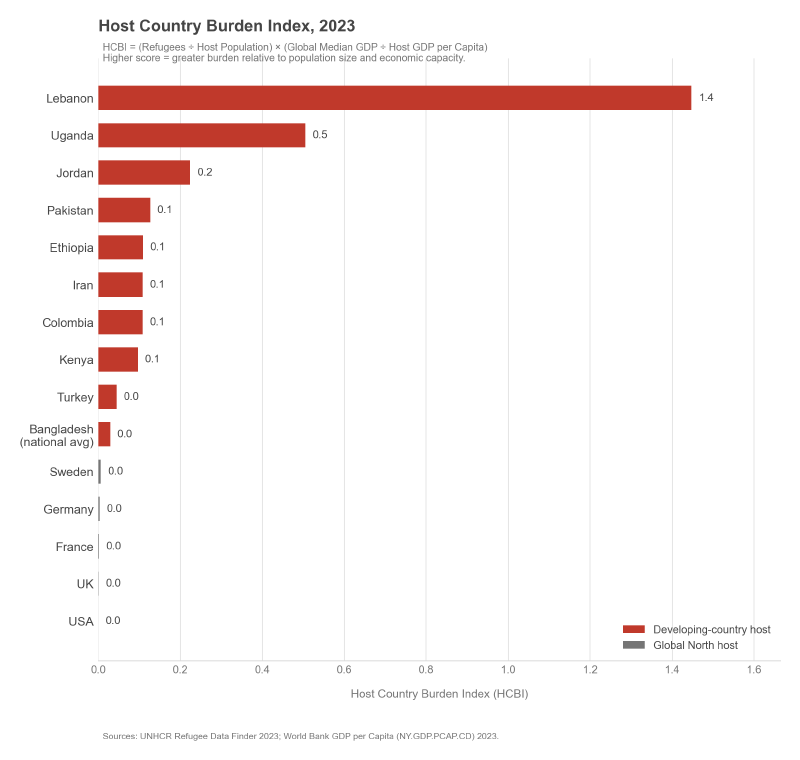
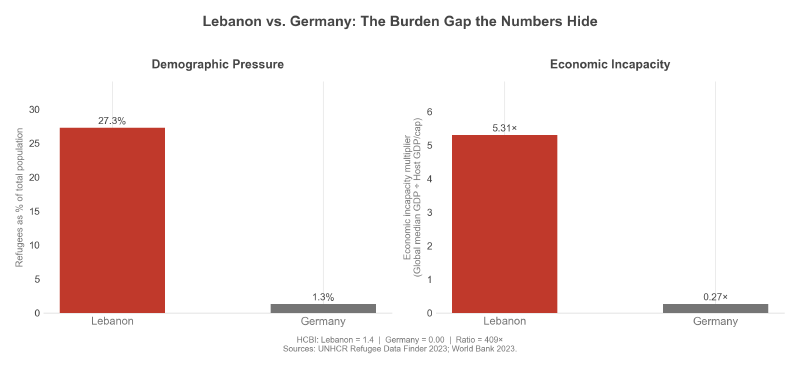
Lebanon's HCBI, calculated for 2023, is approximately 89. That number represents the product of a 27.3% refugee-to-population ratio — 1.5 million Syrian refugees in a population of 5.5 million — and an economic incapacity multiplier of approximately 5.4, derived from Lebanon's severely depressed GDP per capita (roughly $2,600 in 2023, after the collapse of the Lebanese pound eliminated a substantial fraction of real purchasing power). Lebanon absorbs the largest proportional refugee caseload of any country in the world, in the most economically constrained environment of any major host country.
Jordan's HCBI is approximately 22. It hosts 750,000 registered Syrian refugees in a population of 10.5 million — a ratio of 7.1% — with a GDP per capita of approximately $4,400. Jordan has received more international support than Lebanon, including successive World Bank concessional loans and bilateral budget support from the United States and Gulf states, but its burden by this measure remains more than double that of Turkey.
Turkey's HCBI is approximately 11. It hosts the world's single largest refugee population in absolute terms — 3.6 million Syrians — but in a country of 85 million, the demographic ratio is 4.2%. Turkey's GDP per capita in 2023 was approximately $13,000, close to the global median, which limits the economic incapacity multiplier. Turkey has received €6 billion from the European Union under the 2016 EU-Turkey agreement — a figure that, while contested in its adequacy, represents a meaningful transfer.
Uganda's HCBI is approximately 18. Uganda hosts 1.6 million refugees — primarily from South Sudan, the DRC, and Somalia — with a policy framework that is notable for permitting refugees to work, own land, and move freely. As a result, Uganda is frequently cited as a model of refugee management. Its GDP per capita of approximately $930 — a fraction of the global median — produces a high economic incapacity multiplier even at a demographic ratio lower than Jordan's.
Germany's HCBI, for 2023, is approximately 1.4. Its 1.1 million Ukrainian refugees represent roughly 1.3% of a population of 84 million, in a country whose GDP per capita of approximately $51,000 places it among the world's wealthiest. The absolute resource commitment Germany has made — including housing provision, language training, and labor market integration support — is significant in dollar terms. The burden it represents, normalized against Germany's capacity, is approximately 64 times smaller than Lebanon's.
What the Index Reveals About "Responsibility-Sharing"#
The language of "burden-sharing" and "responsibility-sharing" has been a constant in international refugee policy discourse for decades, but it has almost never been operationalized with a metric that makes comparisons meaningful. The 1951 Refugee Convention and its 1967 Protocol allocate protection obligations to the country of first asylum — which in practice means that the countries closest to major conflict zones, most of which are developing states with limited economic capacity, absorb the vast majority of the world's refugee population.
UNHCR's 2023 data confirms this pattern: 75% of refugees globally are hosted in developing and lower-middle-income countries. The top five host countries by absolute numbers — Turkey (3.6 million), Iran (3.4 million), Germany (2.1 million, including all categories), Colombia (2.9 million Venezuelans), and Uganda (1.6 million) — include three developing-country neighbors of crisis zones for every one wealthy European state.
The Global Compact on Refugees, adopted by the UN General Assembly in 2018, explicitly committed signatory states to "more equitable sharing of the burden and responsibility for hosting and supporting the world's refugees." It did so without any binding mechanism, agreed quota, or quantitative framework. The commitment exists in language; the burden, measured correctly, remains concentrated in the countries least equipped to bear it.
The Lebanon Extremity#
Lebanon's situation deserves separate treatment not merely because its HCBI is the world's highest, but because it illustrates what the index captures that raw numbers cannot: the compounding effect of hosting an enormous displaced population inside a country whose own systems have already been degraded by crisis.
The Lebanese state was already in structural failure before the Syrian war began. Its electricity grid — never repaired since the 1975–1990 civil war — was supplying approximately six hours of power daily in 2010. Its water infrastructure was aging and under-maintained. Its political system, governed by the Ta'if Agreement's sectarian power-sharing formula, lacked the executive capacity to respond coherently to any large-scale policy challenge. Its public finances were carrying a debt-to-GDP ratio above 150%.
Into this system arrived 1.5 million Syrian refugees — roughly 27% of Lebanon's pre-crisis population — between 2011 and 2016. The pressure on water infrastructure, schools, electricity, and the informal labor market was immediate and severe. Lebanese host communities, already economically marginal in rural areas near the Syrian border, found themselves competing with displaced Syrians for daily labor wages that had collapsed under the supply shock.
The HCBI does not capture the pre-existing fragility. It captures the ratio of new demand to existing capacity. What Lebanon's HCBI of 89 represents is the product of an enormous demographic ratio applied to a country that was already operating close to the margin before the influx. The resulting strain is not just financial. It is systemic: the delegitimization of state institutions that could not deliver services to their own citizens, let alone to an additional quarter of a population that arrived in five years.
In 2019, Lebanon experienced its largest economic contraction since the civil war, accelerated by a banking sector collapse that wiped out the savings of the middle class and generated hyperinflation. In 2020, a massive explosion at the Port of Beirut killed 218 people, wounded 7,000, and destroyed the port infrastructure. Neither event was caused by the Syrian refugee presence. But both were processed inside a system already stretched to the breaking point by a decade of carrying a burden the international community measured in absolute numbers and found manageable — while the HCBI tells a different story.
The Geography of Generosity#
The HCBI produces a map of the world that inverts the conventional narrative of refugee generosity. The countries most represented in media coverage of the "refugee crisis" — Germany, Sweden, the United Kingdom, France — score between 1.0 and 3.0 on the index. The countries actually carrying the weight — Lebanon, Uganda, Bangladesh (host to the Rohingya), Jordan, Pakistan (host to 1.3 million Afghan refugees), Iran (host to 3.4 million Afghans) — score between 15 and 90.
Pakistan's HCBI deserves particular attention. It hosts 3.4 million Afghan refugees and asylum seekers, the second largest refugee population in the world after Turkey in absolute terms and approximately 1.5% of its total population. Its GDP per capita of approximately $1,600 — among the lowest of any major host country — produces a substantial economic incapacity multiplier. Pakistan's HCBI of approximately 28 reflects a country that has hosted Afghan refugees continuously since 1979 — 47 years — with limited international support and persistent political tension over the long-term status of a refugee population that has outlasted every political settlement attempted in Afghanistan.
Iran's case is structurally similar: 3.4 million Afghans, a GDP per capita depressed by decades of sanctions, and a refugee presence that predates most of the country's contemporary political history. Iran receives no UNHCR support for Afghan refugees — it has not signed the 1951 Convention or its Protocol — and its refugee management is entirely state-controlled. The HCBI cannot fully capture the scale of this absorption because UNHCR data on Iran is incomplete.
The implications for international policy are straightforward. If the Global Compact on Refugees is to mean anything beyond aspirational language, its responsibility-sharing framework needs a quantitative benchmark against which contributions can be measured. The HCBI provides that benchmark. A country at HCBI 89 is not asking for the same thing from the international community as a country at HCBI 1.4. Any framework that treats them as making equivalent contributions — or that allocates aid on the basis of absolute numbers rather than normalized burden — is systematically transferring resources away from the places where the burden is most acute.
The next post follows what happens when the burden does not produce resolution: when the displaced population is not absorbed permanently, not returned safely, and not resettled elsewhere, but remains in place across generations until displacement becomes not an interruption in family history but the family history itself.