A Temporary Camp, Year 34#
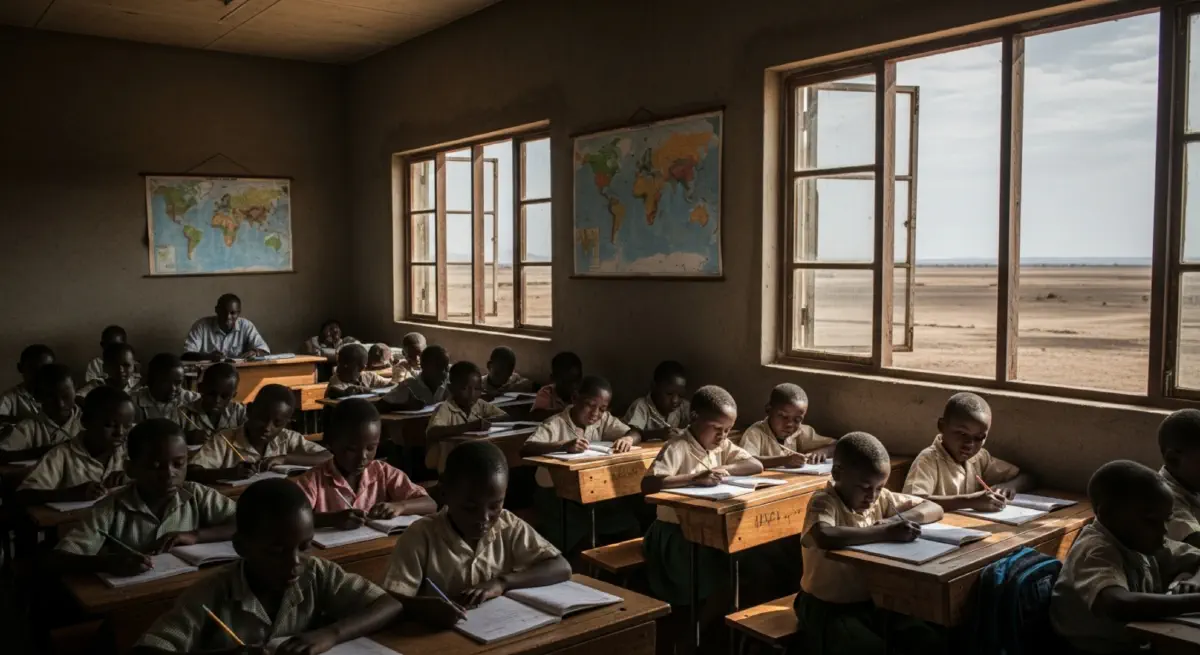
In the spring of 1992, UNHCR field officers surveyed a flat, dry stretch of land in Turkana County, Kenya, 100 kilometers from the South Sudan border. Somali refugees were arriving in numbers that overwhelmed the existing transit arrangements. The camp they established at Kakuma — a Turkana word meaning "nowhere" — was conceived as a short-term facility: tents, basic medical provision, food distribution. Temporary.
As of March 2026, Kakuma houses 212,000 people. Its streets have names. It has a hospital with surgical capacity, a secondary school system, three functioning markets, and a banking service accessible to residents. UNHCR has spent more than $2 billion managing it across three decades. The youngest resident today was born to parents who were themselves born in the camp. The word "temporary" appears in every successive year of UNHCR documentation.
Kakuma is not an anomaly. It is the paradigm case.
The architecture of the global humanitarian response to forced displacement was built on a specific premise: that displacement is a crisis state, an interruption in the otherwise stable pattern of people living where they were born, governed by states that claim them as citizens. The 1951 Refugee Convention that undergirds the system was written for a specific historical moment — postwar Europe, where displacement was both acute and, its architects reasonably assumed, transient. The legal and institutional infrastructure that emerged from 1951 was designed to manage a temporary condition until resolution — return, resettlement, or local integration — could be arranged. What the architects of the system could not anticipate was a world in which the crises generating displacement would outlast not just the temporary camps, but entire childhood generations.
The Numbers That Rewrote the Framework#
The Historic Peak#
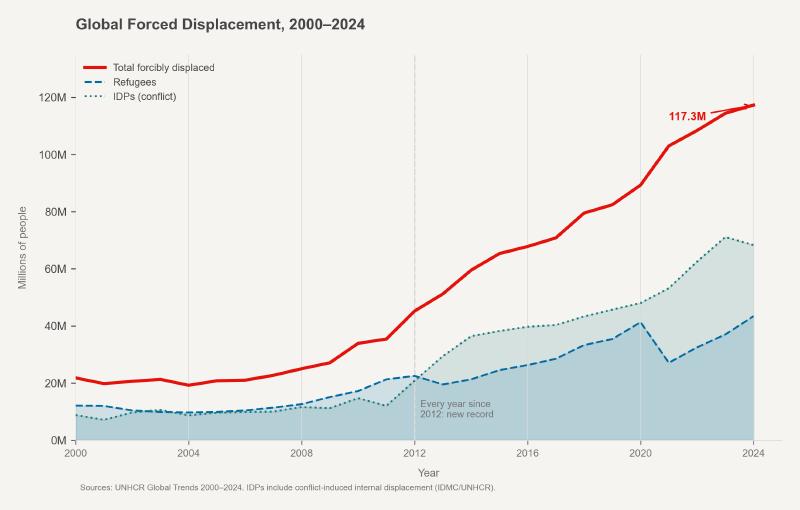
UNHCR's mid-2024 Global Trends report recorded 117.3 million forcibly displaced people worldwide. That figure encompasses refugees (people who have crossed an international border and cannot safely return), asylum seekers (people whose claims for refugee status are pending), and internally displaced persons — IDPs — who have fled their homes but remain within their country's borders. It represents an increase of 8.8 million from the 2023 figure, which was itself a record, which was itself a revision upward from 2022's record.
The 117.3 million figure has not stopped rising. Every single year since 2012 — without exception — the global displacement total has increased. In 2012, the total was approximately 45 million. In the twelve years since, it has more than doubled, at an average annual increase of roughly 6 million people per year. The COVID-19 pandemic did not reduce it. Ceasefires have not reduced it. Every "peace process" of the last decade has left the aggregate unchanged.
The Anatomy of the 117 Million#
The composition of the 117 million matters for what it implies about resolution. UNHCR's breakdown as of mid-2024:
Refugees: 43.4 million people who have crossed international borders and fall under UNHCR's protection mandate. The top five countries of origin — Syria (6.4 million), Afghanistan (6.1 million), Ukraine (6.5 million), South Sudan (2.3 million), and the Democratic Republic of Congo (1.0 million) — account for roughly half the total.
IDPs (internally displaced): 68.3 million people displaced within their own countries. IDPs are technically under the protection of their own governments — the governments that, in many cases, are either the cause of their displacement or incapable of protecting them. Sudan's 2023 civil war generated more than 9 million new IDPs in a single year, the largest single-year internal displacement event since IDMC began systematic tracking.
Asylum seekers: 6.9 million people with unresolved claims, held in bureaucratic suspension in countries that have not yet determined their legal status.
The IDMC separately tracks displacement caused by natural disasters and climate events, adding a further 26.4 million annually displaced by disaster in 2023 — people who do not qualify as refugees or IDPs under international law but who are equally without homes.
Protracted Displacement: The Structural Condition#
UNHCR defines a "protracted refugee situation" as one in which at least 25,000 refugees from a single origin country have been in exile for more than five consecutive years. As of 2024, 78% of all refugees globally live in protracted situations. That figure has been above 70% for every year since 2010.
The five-year threshold is itself generous. Many of the situations that define the current global caseload have been active for decades. Afghanistan has been a source of mass refugee outflow since 1979 — 47 years. Palestinians have been displaced since 1948 — 78 years. Somalis began fleeing the collapse of their state in 1991. Congolese displacement began in meaningful scale in the mid-1990s and has never resolved.
Understanding what "protracted" means in practice requires moving beyond counts to durations. The UNHCR does not publish a global median-duration figure in its annual reports, but analysis of its statistical time series produces an estimate: for refugees whose displacement began before 2010 and who remain in UNHCR's care, the median duration of displacement exceeds 20 years. For those displaced between 2010 and 2016 — the cohort generated by Syria, South Sudan, and the Sahel crises — the median now exceeds 10 years. The word "temporary" has not applied to this population for a long time.
The Displacement Persistence Score#
Raw displacement totals measure a stock, not a trajectory. To capture the extent to which the international system is failing to resolve rather than merely failing to prevent displacement, we need a metric that combines scale and duration. The Displacement Persistence Score (DPS) addresses this:
DPS = (current displaced / peak displaced since 2000) × median years in displacement
A DPS of 1.0 would represent a crisis where the current caseload equals its historical peak, and where the median person has been displaced for one year. A high DPS reflects not just the size of the crisis but its temporal depth — the degree to which it has become a permanent condition rather than an acute one.
Syria produces one of the highest DPS values in the current data. Its current refugee caseload (6.4 million in UNHCR care) is close to its 2019–2020 peak. The median Syrian refugee has now been displaced for more than 10 years. The Syrian DPS captures something that raw counts cannot: that this is not a displaced population in motion toward resolution. It is a displaced population in stasis.
Afghanistan's DPS is arguably higher still, because it combines the enormous 2021–2022 spike following the Taliban takeover with a displacement history that predates most living Afghans' adulthood. An Afghan refugee who fled in 1996 and remains in Pakistan's camps in 2026 has now been displaced for 30 years.
The Architecture of a System Built for Transience#
The 1951 Refugee Convention and its 1967 Protocol define a refugee as someone with a "well-founded fear of persecution" on specific grounds, who is outside their country of nationality and unable to avail themselves of its protection. The definition was progressive for its era. It encoded a legal obligation on signatory states to not return refugees to persecution — the principle of non-refoulement — that remains the cornerstone of international refugee protection.
But the Convention's solution framework was built around three "durable solutions": voluntary repatriation (return to country of origin), local integration (permanent settlement in the country of asylum), and third-country resettlement (transfer to a different country willing to accept permanent settlement). All three solutions assume that displacement is a temporary condition waiting to be resolved. None of them function at the scale the current system requires.
UNHCR's own data on durable solutions in 2023: 696,000 refugees returned to their country of origin voluntarily. 130,000 were resettled to third countries. Local integration data is incomplete, but UNHCR estimates it was negligible at the global scale — most host countries actively prevent permanent settlement. Combined, durable solutions reached roughly 826,000 people in a year when 8.8 million new people were displaced. The system's resolution capacity is approximately one-tenth of its intake rate.
The gap between intake and resolution is not a resource problem alone, though funding shortfalls are real and structural. It is a political problem: host countries do not want permanent immigrants, origin countries do not provide safe conditions for return, and resettlement to third countries has been politically toxic in every major destination country since 2015. The result is a system that warehouses people.
Syria: The Definitive Modern Case#
Syria is, by every measure, the defining displacement crisis of the contemporary era. The 2011 uprising against Bashar al-Assad's government, the subsequent militarization and internationalization of the conflict, and the Assad government's deliberate strategy of depopulating opposition-held areas through siege and aerial bombardment produced the largest single-country displacement since the formation of UNHCR.
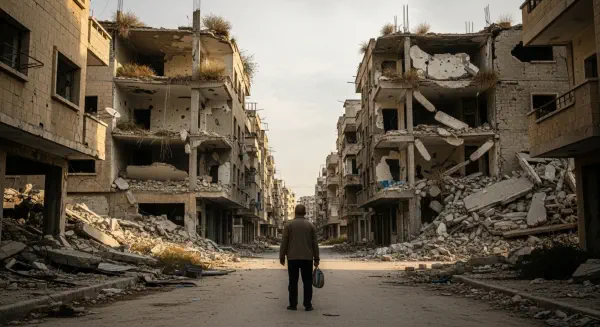
By 2016, Syria had generated 5.5 million registered refugees and 6.6 million IDPs — a combined 12.1 million displaced people from a pre-war population of approximately 22 million. More than half the country's population had been driven from their homes. The physical destruction of Syrian cities — Aleppo, Homs, Raqqa, Deir ez-Zor — was systematic and deliberate, destroying not just housing but the economic infrastructure that would make return viable.
By 2025, after 14 years, Syria's displacement numbers had not meaningfully declined. The refugee population under UNHCR's care stood at 6.4 million. The internally displaced population exceeded 7 million. Fewer than 500,000 refugees had returned in the entire period from 2018 to 2025, and of those, UNHCR documented that a significant share re-fled within six months because the conditions that made them leave — property confiscation, security service targeting, destroyed infrastructure — had not changed.
The DPS for Syria is among the highest in the global dataset. It represents not a crisis in progress but a crisis that has been normalized — processed, institutionalized, and absorbed into the permanent structure of the international humanitarian system. That is not a solution. It is a different kind of problem.
The Word "Temporary" and What It Now Obscures#
In 2024, a child was born in Kakuma camp to parents who were themselves born in Kakuma. She is, in the language of UNHCR's operational documentation, a refugee in a temporary situation. She will receive food rations tied to a refugee registration number, attend a school funded by humanitarian donors, and have access to health care calibrated to crisis provision rather than developmental investment. The word "temporary" will appear in every document that governs her life.
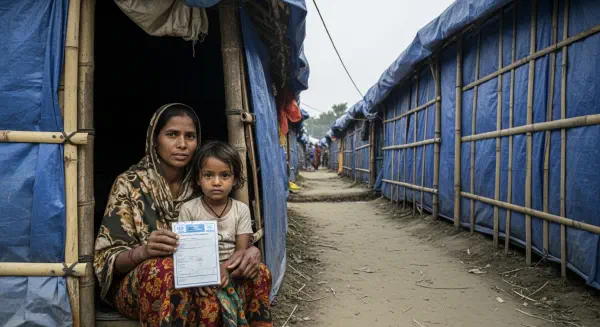
The median refugee worldwide has been displaced for more than 20 years. Kakuma is 34 years old. Dadaab, also in Kenya, opened in 1991 and now hosts 370,000 people; it was declared "temporary" by the Kenyan government in 2016, which ordered its closure, a closure that has not occurred. Cox's Bazar in Bangladesh — the world's largest refugee settlement — opened in 2017 to receive Rohingya fleeing Myanmar's military campaign and has grown to almost one million residents with no viable return pathway.
The word "temporary" is doing a great deal of work that the data no longer supports. What it is obscuring is a structural shift: forced displacement is no longer an interruption in the lives of the people it affects. For a substantial and growing proportion of the world's displaced population, displacement is the permanent condition, and the word "temporary" is the administrative fiction that allows the international system to avoid confronting what it has failed to resolve.
The next post begins to measure what permanent displacement costs — not in human suffering, which resists quantification, but in the concrete arithmetic of host country strain.