Key Takeaways#
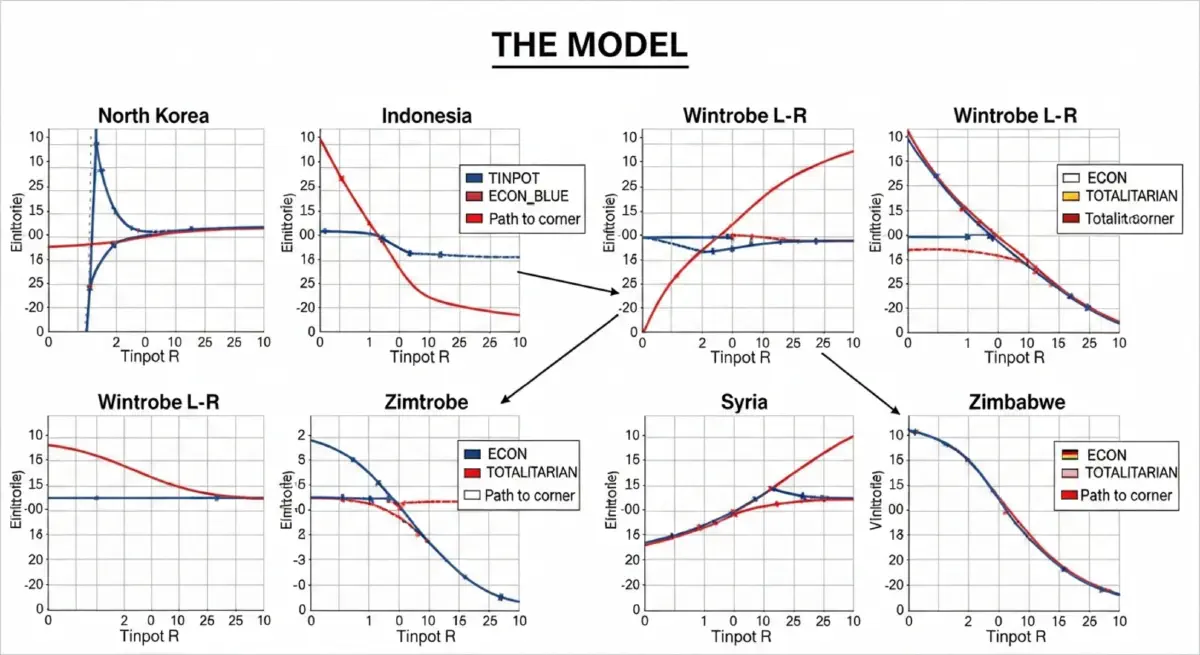
- The Wintrobe model generates testable predictions across dictatorships regardless of geography, ideology, or cultural context. The loyalty-repression trade-off is driven by budget constraints and dictator type — variables that are measurable independently of the specific political system being analyzed.
- North Korea’s Kim dynasty is the purest modern example of a totalitarian system operating at near-complete loyalty-repression coverage: the Public Distribution System purchases loyalty through food rations; the songbun class system provides loyalty sorting at hereditary scale; the nuclear deterrent eliminates the need to buy international legitimacy. The 1990s famine (2–3 million dead) was the budget shock — the response was to narrow the loyalty portfolio to the military alone and let the civilian population absorb the cost.
- Suharto’s Indonesia is the clearest comparison tinpot case. Oil rents distributed through GOLKAR for three decades. The 1997 Asian financial crisis delivered the budget shock. Suharto negotiated, accepted IMF conditions, and fell through street protests — not genocide. Peak transition violence: approximately 1,000–1,200 deaths. The tinpot-totalitarian distinction, which is unobservable before the shock, becomes visible precisely at the moment it matters.
- Assad’s Syria combines both: an initially tinpot-leaning response (offered limited economic concessions in 2011) collapsed when the northern revolutionary coalition, fueled by the agricultural drought’s destruction of rural livelihoods, proved too large to co-opt. The shift to totalitarian instruments — barrel bombs, chemical weapons, systematic torture infrastructure — followed the calculation that repression was cheaper than the loyalty purchase that would be required to settle the conflict.
- Zimbabwe’s hyperinflation collapse represents the Wintrobe model’s endgame: a dictator who has run out of both loyalty instruments and repression capacity simultaneously. When cash becomes worthless, you cannot buy loyalty. When the military is unpaid, you cannot buy repression. ZANU-PF’s generals conducted a de facto internal coup in 2017 — the regime’s loyalty portfolio finally turning against it.
- The model’s policy implication is disturbing: effective aid conditionality requires identifying dictator type before the budget shock, not after. Once a totalitarian is in the crisis phase, the substitution has already begun. The preventive instrument must be the budget constraint itself — not conditionality on how the budget is spent.
The Comparative Landscape#
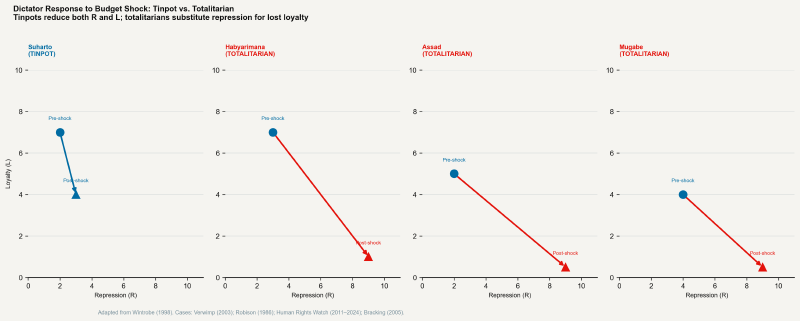
The four cases that follow are not selected to confirm the model. They are the four most data-rich cases of dictatorial budget shock in the post-Cold War period — selected by their documentation quality, not by their outcome. The model’s ability to distinguish tinpots from totalitarians before the shock, using pre-shock behavioral data, is the test.
Four Cases#
North Korea: The Loyalty Ration System#
North Korea’s Kim dynasty represents the Wintrobe model in its most developed institutional form. The Public Distribution System (PDS) — which allocates food rations according to political classification — is a loyalty purchase mechanism operating at the household level nationwide. The songbun class system assigns every citizen a hereditary loyalty rating based on their ancestors’ behavior during and after the Korean War: “loyal core” (approximately 28% of the population), “wavering” (45%), and “hostile” (27%). Class determines ration size, housing allocation, employment access, and educational opportunity.
The 1990s budget shock — Soviet aid withdrawal and the collapse of the barter trade system that had sustained the North Korean economy — delivered a fiscal crisis the regime addressed entirely through loyalty portfolio contraction. The PDS was effectively suspended for the “wavering” and “hostile” classes in the famine years of 1994–1998. An estimated 2 to 3 million people died — not from the shock directly, but from the deliberate loyalty-rationing decision. The military (Songun, military-first) received continued priority allocation. The civilian population that was not in the core loyalty class was, in Wintrobe’s terms, a loyalty asset the regime had calculated it did not need at the current price.
The nuclear weapons programme is a separate loyalty instrument operating at the international level: it makes the regime’s survival robust to external pressure, eliminating the need to maintain international legitimacy through economic performance or human rights compliance. Each nuclear test is a demonstration that the international community’s loyalty-and-coercion instruments cannot reach the regime at reasonable cost.
Suharto’s Indonesia: The Tinpot Template#
Suharto’s New Order regime distributed oil rents through a remarkably similar institutional structure to Habyarimana’s Rwanda. GOLKAR (Functional Groups) was the mass party vehicle; regional transmigration moved Javanese settlers to outer islands, extending the rent-distribution network geographically; PERTAMINA managed oil revenues; and a network of state-owned enterprises, family business groups, and military-linked conglomerates allocated economic access to political loyalists.
The 1997 Asian financial crisis was the budget shock. The rupiah lost 80% of its value in months. The IMF’s structural adjustment program required subsidy removal — including fuel subsidies — that were central to the loyalty distribution architecture.
Suharto’s response is definitively tinpot. He did not attempt ethnic mobilization. He did not expand paramilitary structures. He negotiated the IMF program, attempted to implement it, and fell in May 1998 when street protests — amplified by the economic pain the program imposed — became impossible to suppress without a level of violence that his own military was unwilling to authorize. The economic elite that had been the core loyalty portfolio abandoned him. The transition violence is estimated at 1,000–1,200 deaths.
The contrast with Habyarimana could not be starker: same general model, same budget shock mechanism, different dictator type, different outcome by a factor of approximately 650.
Assad’s Syria: The Pivot Point#
Bashar al-Assad inherited a partially liberalized economy in 2000 and spent his first decade governing modestly — closer to the tinpot end of the spectrum than his father. The Damascus Sunni merchant class, which his father had co-opted through selective business access, was the core loyalty portfolio. Rural Syria — the agricultural south and northeast — was less integrated into the loyalty network.
Between 2006 and 2010, the worst drought in Syria’s recorded history destroyed agricultural livelihoods across the northeast and Hauran plain. An estimated 1.5 million rural workers displaced into urban peripheries around Damascus, Aleppo, and Deraa. Their displacement created a socially excluded population with no loyalty relationship to the regime — precisely the population that became the revolutionary mobilization base.
Assad’s 2011 response began as tinpot — he offered constitutional reforms, released political prisoners, dismissed regional governors. When the northern and rural revolutionary coalition proved too large to co-opt economically (buying their loyalty would have required a redistribution the urban business class would not accept), the response pivoted to totalitarian instruments. The barrel bomb campaign, the systematic use of chemical weapons, the detention-and-torture infrastructure documented by the Caesar photographs — each represents a move along the isoquant toward maximum repression.
By 2024: 500,000+ dead, 13 million displaced.
Zimbabwe: The Model’s Endgame#
Robert Mugabe’s Zimbabwe demonstrates what the Wintrobe model looks like when a dictator runs out of both instruments simultaneously. The 2000 Fast Track Land Reform programme was the last loyalty purchase attempt: seizing commercial farms and redistributing them to war veterans and rural ZANU-PF supporters was an attempt to reconstruct the loyalty base that structural economic decline had eroded.
The programme destroyed the agricultural export sector. Hyperinflation followed: Zimbabwe’s inflation peaked at estimated 89.7 sextillion percent per month in November 2008. When the currency becomes worthless, the loyalty-purchase mechanism fails entirely — you cannot pay a price for a unit of loyalty when the price carries no information. Simultaneously, the military officer corps, whose loyalty had been purchased with land allocations and business access, watched the value of those allocations collapse.
In November 2017, the ZANU-PF generals conducted Operation Restore Legacy — a de facto internal coup that removed Mugabe from power. This is the Wintrobe endgame in its purest form: the loyalty portfolio consuming the dictator. When the instruments fail, the dictator’s own loyalty constituency — the military, the party elite — becomes the source of the final threat.
The Universal Diagram#
flowchart TD
    A["Commodity/resource rent\n(coffee, oil, food rations)"] --> B["Loyalty purchase at scale\n(producer price, rations, contracts)"]
    B --> C["Stable power equilibrium:\nboth R and L maintained"]
    C --> D{"Budget shock"}
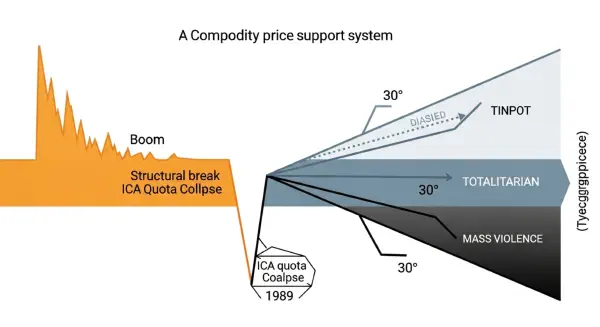
    D -->|"Tinpot response"| E["Accept lower power\nNegotiate, reduce rents\nCoalition contracts"]
    D -->|"Totalitarian response"| F["Find cheaper loyalty input\nEthnic ideology / military priority\nRepression substitution"]
    E --> G["Transition:\nSuharto 1998\nMugabe 2017 (external forced)"]
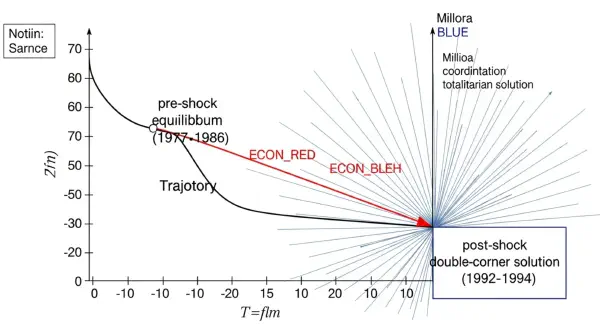
    F --> H["Double-corner solution:\nIDEOLOGICAL loyalty + MAXIMUM repression"]
    H --> I["Mass violence:\nHabyarimana 1994\nAssad 2011-ongoing\nKim 1994-1998 famine"]
The Policy Implication#
The Wintrobe framework’s most uncomfortable conclusion is about timing. By the time a totalitarian dictator enters the crisis phase — the budget shock, the loyalty portfolio contracting, the militia infrastructure being assembled — the substitution has already begun. The window for external intervention that prevents rather than responds to mass violence closes before the mass violence is visible enough to generate the political will for intervention.
The preventive instrument is not conditionality applied to how the budget is spent. It is the structure of the budget constraint itself. A government that derives 70% of its revenues from a single commodity it cannot price, sold on a market it cannot influence, managed by institutions it has no representation in, is a government whose political survival is hostage to decisions made in commodity trading rooms in London and New York.
The series began with a commodity price. It ends with a question about institutional architecture: who decides what a market price is, who absorbs the consequences when it collapses, and what happens to the people inside the political systems that were built to distribute the rent when the rent disappears.
Those questions do not have comfortable answers. They have data.
References#
Wintrobe, R. (1998). The political economy of dictatorship. Cambridge University Press.
Natsios, A. S. (2001). The great North Korean famine. United States Institute of Peace Press.
Haggard, S., & Noland, M. (2007). Famine in North Korea: Markets, aid, and reform. Columbia University Press.
Robison, R. (1986). Indonesia: The rise of capital. Allen & Unwin.
De Châtel, F. (2014). The role of drought and climate change in the Syrian uprising: Untangling the triggers of the revolution. Middle Eastern Studies, 50(4), 521–535. https://doi.org/10.1080/00263206.2013.850076
Human Rights Watch. (2012). Torture Archipelago: Arbitrary Arrests, Torture, and Enforced Disappearances in Syria’s Underground Prisons since March 2011. Human Rights Watch. https://www.hrw.org/report/2012/07/03/torture-archipelago/arbitrary-arrests-torture-and-enforced-disappearances-syrias
Bracking, S. (2005). Development denied: Autocratic militarism in post-election Zimbabwe. Review of African Political Economy, 32(104–105), 341–357.
SIPRI. (2024). SIPRI military expenditure database. Stockholm International Peace Research Institute. https://www.sipri.org/databases/milex
Verwimp, P. (2003). The political economy of coffee, dictatorship, and genocide. European Journal of Political Economy, 19(1), 161–181. https://doi.org/10.1016/S0176-2680(02)00166-0