Key Takeaways#
- Foreign aid to Rwanda averaged approximately $200 million per year in the early 1990s — roughly equal to the country’s total coffee export earnings at the post-collapse price level. Aid was not supplementing the budget. It was replacing the budget.
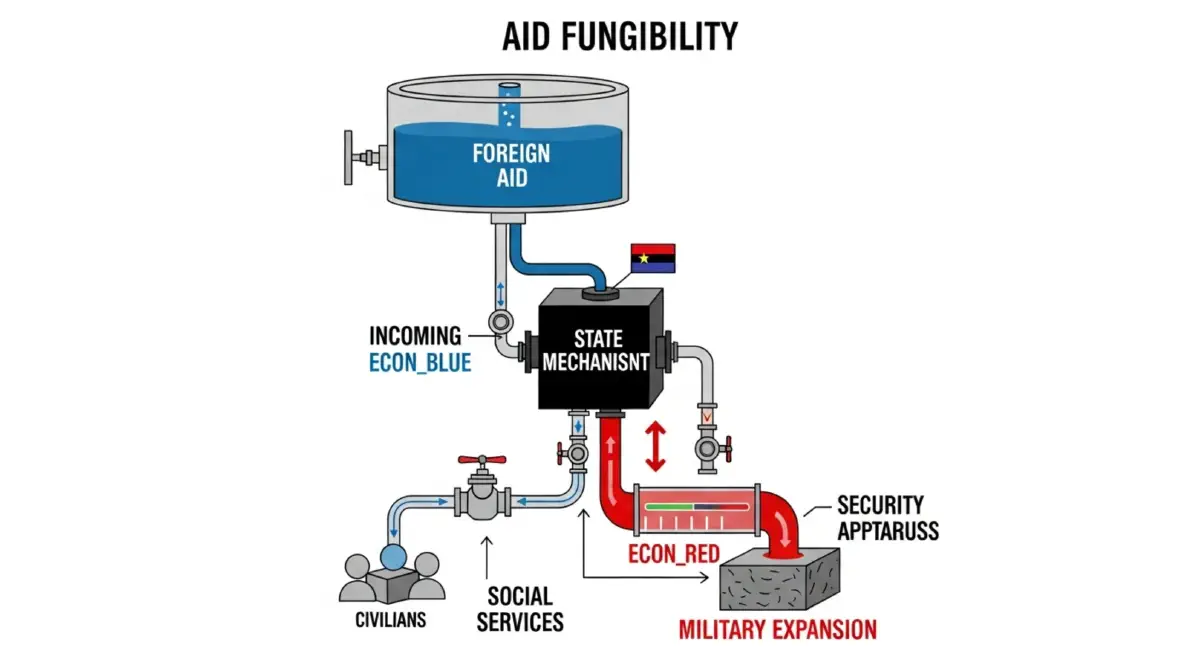
- Aid fungibility means that a dollar of budget support directed to health or education frees a dollar of domestic revenue for military and militia spending. The Habyarimana regime’s weapons procurement from Egypt in 1990–1991, financed partly through pledged tea futures, occurred simultaneously with increased bilateral aid disbursements.
- William Easterly’s critique of aid conditionality applies with particular force to Rwanda: donors attached conditions to disbursements, documented non-compliance, and disbursed anyway. The incentive for the regime was to perform compliance rather than achieve it.
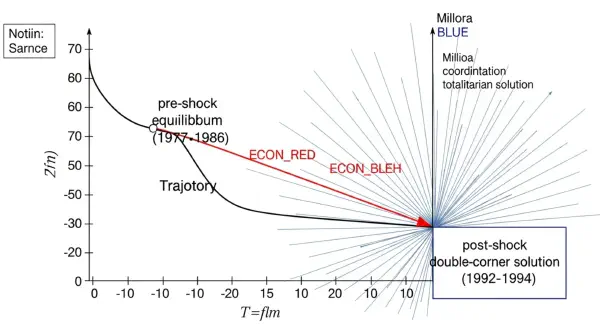
- The Wintrobe model predicts that aid to a totalitarian dictator under budget stress functions as a subsidy to the loyalty-repression production function — not to development. The empirical record of Rwanda’s 1990–1994 aid period is consistent with this prediction.
- The ICTR Media Case (2003) documented that RTLM’s operating costs were financed in part through revenue from state tea plantations — the same plantation system that had been built partly with Belgian development aid. The aid chain from donor to radio station was not invisible. It was institutional.
- The international community’s failure was not primarily one of intelligence — Human Rights Watch and African Rights documented militia expansion from 1992 onward. The failure was structural: the institutional framework for aid delivery had no mechanism for responding to what was being documented.
The Aid Crossover#
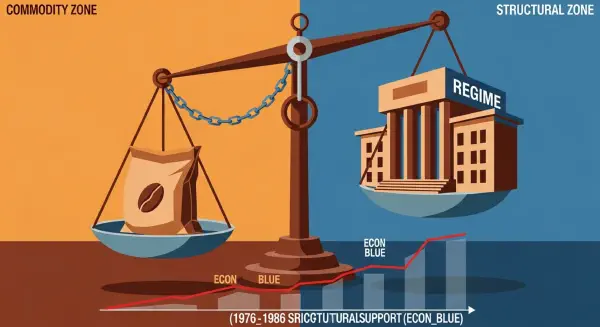
There is a moment in Rwanda’s fiscal history that the standard foreign aid narrative consistently fails to address: the crossover. In the mid-1980s, coffee export revenues and foreign aid inflows were approximately equal contributors to the government’s resource envelope. By 1992, as coffee revenues had collapsed to less than half their peak value, aid had become the dominant external resource — and it was still growing.
Aid Approaches Parity
1985–1988
The crossover begins
Coffee export revenues and foreign aid inflows converge. For the first time, aid is not supplementing the budget — it is competing with commodity income as the primary external resource. World Bank and bilateral donors expand country programs citing Rwanda's "development potential."ICA Collapse — Aid Becomes Dominant
July 1989
The crossover completes
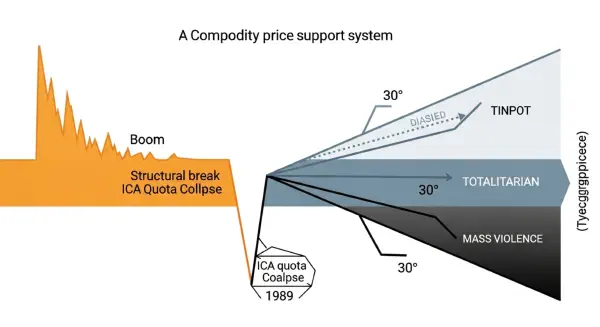
The International Coffee Agreement collapses. World market prices fall 50% within months. Coffee export revenues drop towards one-third of their peak value. Foreign aid — still growing — now constitutes the dominant share of Rwanda's external resource envelope. The regime's budget constraint is intact. Its loyalty portfolio is not.World Bank Structural Adjustment Credit Approved
1990–1991
Conditionality performance begins
The World Bank approves a Structural Adjustment Credit designed to address macroeconomic imbalances and improve public spending efficiency. Simultaneously, the FAR expands from 5,000 to 35,000 soldiers. Egypt sells armaments to Rwanda, payment arranged through pledged tea futures. Fungibility works exactly as the model predicts.IMF Conditions Unmet — Disbursements Continue
1991–1993
The incentive is established
IMF program review processes document non-compliance across multiple conditions in multiple cycles. Standard practice requires suspension. Disbursements continue after renegotiation. The message received: demonstrate enough compliance to maintain the flow. Human Rights Watch publishes its first documented report on Rwandan militia activity in January 1993.UN Rapporteur Documents Genocide Preparation
April 1993
Evidence in the institutional record
UN Special Rapporteur Bacre Waly Ndiaye visits Rwanda. His report to the Commission on Human Rights documents evidence consistent with preparation for mass atrocity. Belgian embassy intelligence reports reach Brussels throughout 1993. RTLM is founded in August — one month after the Arusha Accords are signed — with funding partly from OCIR-Thé revenues.Life Support Ends. The Genocide Begins.
April 6, 1994
The budget constraint had held long enough
Habyarimana's plane is shot down. Within hours, organized killing begins. Between April and July 1994, 500,000 to 800,000 people are killed in approximately 100 days. The interahamwe networks — assembled during the aid-sustained crisis period — execute the operation. No donor disbursement had been suspended. No conditionality trigger had fired.
This is the aid fungibility problem at its most consequential. When a budget-support donor provides $50 million for education expenditure, the recipient government does not necessarily spend $50 million more on education. It spends whatever the political calculus of the regime requires on education — and the $50 million frees up an equivalent amount of domestic revenue that goes elsewhere. In Rwanda’s case, “elsewhere” included: expanding the Forces Armées Rwandaises from 5,000 to 35,000 soldiers between 1990 and 1993; importing military equipment from South Africa, Egypt, France, and Belgium; and funding the interahamwe militia networks in northern communes.
The weapons procurement is documented. Human Rights Watch’s 1994 report identified specific contracts: Egypt sold armaments to Rwanda in 1991, with payment partly arranged through pledged future revenues from state tea plantations. The tea plantation system — built over decades partly with Belgian bilateral aid — was, through this chain of transactions, financing the acquisition of the machetes and firearms that would be distributed to militia in 1994.
The Conditionality Trap#
What donors said they were funding
What the money actually funded
The conditionality performance
Easterly’s Critique, Applied#
William Easterly’s analysis of aid effectiveness — developed across his 2001 book The Elusive Quest for Growth and subsequent empirical work — identifies what he calls the “aid bureaucracy incentive”: donor agencies are rewarded for disbursing funds, not for achieving outcomes. The measurement of success is the loan approval and the disbursement confirmation. Whether the recipient government’s behavior changes is harder to measure and less career-consequential for the program officer signing the disbursement.
Rwanda in 1990–1994 is an almost ideal case against which to test this critique. The documentation of regime violence was available to donors throughout the period:
- Human Rights Watch published its first documented report on Rwandan militia activity in January 1993.
- African Rights published detailed documentation of northern Rwanda massacres in 1992.
- The UN Special Rapporteur on extrajudicial executions, Bacre Waly Ndiaye, visited Rwanda in April 1993 and documented evidence consistent with genocide preparation in his report to the Commission on Human Rights.
- The Belgian government, Rwanda’s largest bilateral donor and former colonial power, received detailed intelligence reports from its embassy throughout 1993.
None of this documentation interrupted the aid flow in any systematic way. The institutional framework for aid delivery — budget cycles, multi-year country strategy frameworks, political relationships between governments — had no mechanism for translating documented evidence of atrocity preparation into disbursement suspension. The checks existed. The institutional response to the evidence they produced did not.
The Tea-Radio-Genocide Chain#
The ICTR Media Case judgment, delivered in December 2003, found Ferdinand Nahimana, Jean-Bosco Barayagwiza, and Hassan Ngeze guilty of genocide, incitement to genocide, and crimes against humanity for their roles in RTLM and the Kangura newspaper. The judgment documented RTLM’s founding and operations in some detail.
RTLM was established in August 1993 — one month after the Arusha Accords were signed. Its founding shareholders included senior Akazu members and MRND party officials. Its operating costs were documented in part as being financed through payments from the Office des Thés du Rwanda (OCIR-Thé) — the tea equivalent of OCIR-Café. The same elite that had managed the coffee rent-distribution system was now directing tea revenues toward the construction of its ideological replacement.
The chain: Belgian development aid (partial) → tea plantation infrastructure → OCIR-Thé revenue → RTLM operating costs → genocide incitement. No link in this chain required any actor to intend the genocide. Each link was a rational decision by actors operating within institutional frameworks that had their own internal logic. The aggregate outcome was the life support of a mass murder apparatus.
References#
Verwimp, P. (2003). The political economy of coffee, dictatorship, and genocide. European Journal of Political Economy, 19(1), 161–181. https://doi.org/10.1016/S0176-2680(02)00166-0
Easterly, W. (2001). The elusive quest for growth: Economists’ adventures and misadventures in the tropics. MIT Press.
Human Rights Watch. (1994). Arming Rwanda: The arms trade and human rights abuses in the Rwandan war. Human Rights Watch Arms Project. https://www.hrw.org/report/1994/01/01/arming-rwanda
African Rights. (1994). Rwanda: Death, despair, and defiance. African Rights.
United Nations Commission on Human Rights. (1994). Report by the Special Rapporteur on extrajudicial, summary or arbitrary executions, Mr. Bacre Waly Ndiaye (E/CN.4/1994/7/Add.1).
International Criminal Tribunal for Rwanda (ICTR). (2003). Prosecutor v. Ferdinand Nahimana et al. (Media Case). ICTR-99-52-T. https://unictr.irmct.org/en/cases/ictr-99-52
World Bank. (1991). Rwanda: Structural adjustment credit — Project appraisal document. World Bank. https://documents.worldbank.org
Prunier, G. (1995). The Rwanda crisis: History of a genocide. Columbia University Press.