Key Takeaways#
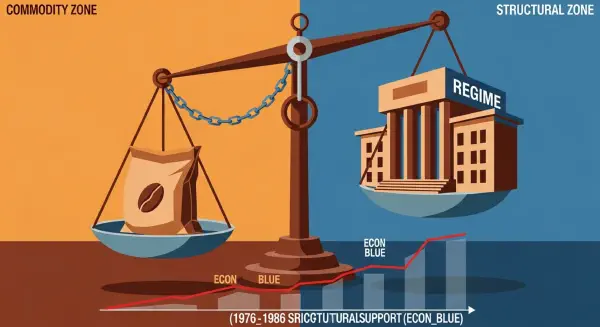
- The International Coffee Agreement’s quota system, which had maintained price floors for producing nations since 1963, collapsed in 1989 when consuming nations — led by the United States under pressure from commercial roasters — withdrew from negotiations. The consequences were absorbed in Central Africa.
- Rwanda’s fiscal deficit expanded from approximately 3% to 12% of GDP between 1988 and 1993. The government’s response was to subsidize the coffee agency rather than cut the producer price — maintaining the loyalty purchase at mounting fiscal cost.
- The IMF structural adjustment program imposed in 1990 required fertilizer subsidy removal and currency devaluation — measures that raised real costs for smallholder farmers at precisely the moment their coffee revenues were collapsing.
- The October 1990 invasion by the Rwandan Patriotic Front from Uganda delivered a simultaneous security shock. Habyarimana now faced a fiscal crisis and a military threat at the same time, from opposite directions.
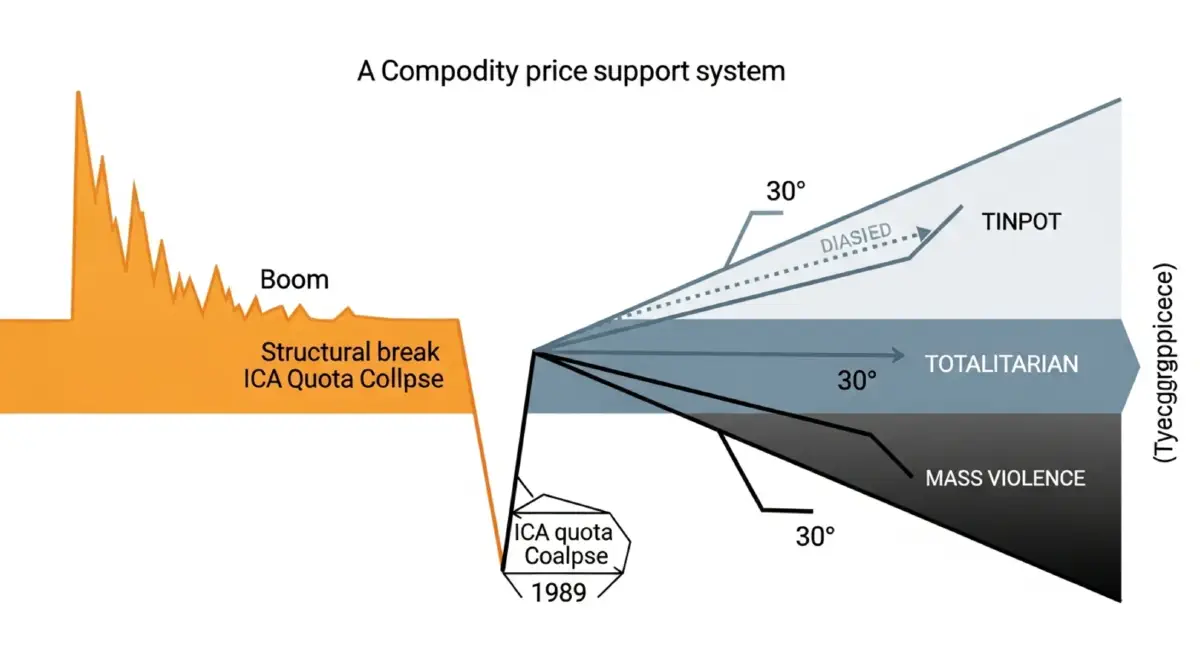
- In the Wintrobe model, the correct rational response to a budget shock depends on the dictator’s type. A tinpot accepts lower power. A totalitarian searches for a cheaper input mix. The regime’s response from 1990 onward — expanding militia networks in high-coffee communes — is consistent only with the totalitarian model.
- The subsidy data is the smoking gun: at peak, in 1990, the government spent RWF 4.6 billion subsidizing OCIR-Café. This was not welfare policy. It was the regime paying its own loyalty invoice when the market stopped paying it.
The Mechanics of Price Collapse#
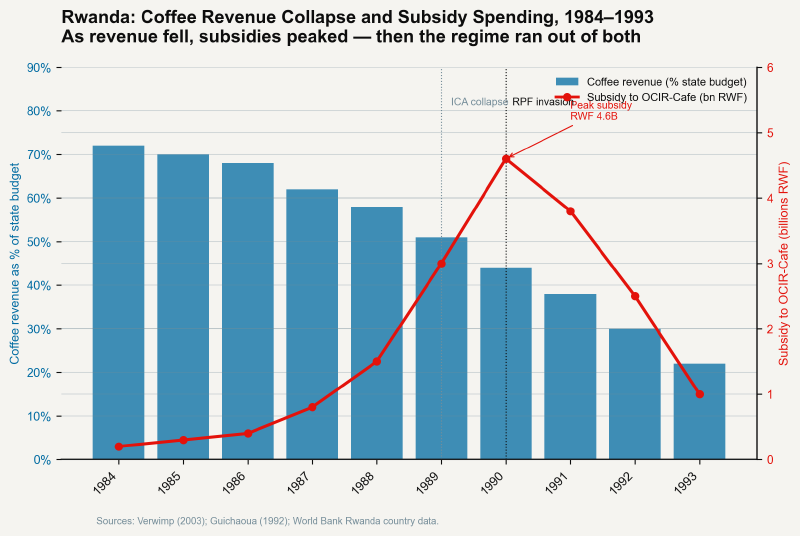
The International Coffee Agreement had operated since 1963 on a simple principle: producing and consuming nations agreed to export quotas that kept world prices within a negotiated band, providing revenue stability for coffee-dependent economies. The United States had been the agreement’s most important consuming member. In 1989, American coffee roasters — seeking lower input costs — lobbied successfully for US withdrawal from quota negotiations. The ICA’s quota system collapsed within months.
The composite indicator price for arabica coffee fell from approximately $2.18 per kilogram in 1986 to $0.78 in 1990 and $0.52 by 1992. For a country in which 60–80% of all foreign exchange earnings came from coffee, this was not sector-specific adversity. It was a sovereign fiscal catastrophe.
The Loyalty Invoice#
1985
Pre-collapse
International Coffee Agreement under pressure
The ICA's quota system faced growing strain as non-member countries sold outside quota. Brazil's harvest failure in 1986 briefly spiked prices — concealing the structural deterioration.1987
Decline begins
Rwanda subsidizes producer price for first time
World price falls sharply. Rwanda government begins subsidizing OCIR-Café to maintain the RWF 120/kg producer price — the minimum farmers require to remain in coffee cultivation. Subsidy estimated at RWF 3 billion. Fiscal deficit begins widening.1989
Structural break
ICA quota collapse; US withdrawal
The International Coffee Agreement's quota system ends. US withdrawal triggered by commercial roaster lobbying for cheaper inputs. Composite arabica price falls 40% in twelve months. Rwanda's foreign exchange revenues collapse. Subsidy cost rises to RWF 3.8 billion.1990
Dual shock
Peak subsidy + RPF invasion
Subsidy reaches RWF 4.6 billion — peak year. IMF structural adjustment program imposed: fertilizer subsidies removed, currency devalued 67%. October: the Rwandan Patriotic Front, a Tutsi-dominated exile army, attacks across the Ugandan border. Rwanda now faces simultaneous fiscal and military crisis.1992
Zero Network exposed
Regime begins systematic township killings
Subsidy falls to RWF 2.5 billion as government can no longer sustain it. Christophe Mfizi publishes his open letter exposing the "réseau zéro" — a shadow network within the regime coordinating militia activities and small-scale ethnic massacres in northern prefectures.1993
Last chance
Arusha Accords; subsidy ends
Arusha Accords signed in August — a power-sharing agreement between Habyarimana and the RPF. Subsidy to OCIR-Café falls to approximately RWF 1 billion and is effectively abandoned. The loyalty-purchase mechanism that had financed the regime for twenty years is functionally exhausted.
The IMF Doubled the Damage#
There is a specific irony in Rwanda’s experience of structural adjustment that the standard critique of the IMF fails to capture. The Fund’s 1990 program was not wrong about Rwanda’s fiscal position — the deficit was real, the currency was overvalued, and fertilizer subsidies were regressive in their distributional effects. What the program could not account for was the political economy of what it was cutting.
The fertilizer subsidies being eliminated were not an agricultural efficiency distortion. They were a second-tier loyalty instrument: part of the system through which commune-level MRND cadres distributed material benefits to coffee-growing households. Cutting them simultaneously with the collapse of the producer price — in communes where coffee was the only cash income — compressed rural livelihoods from two directions at once.
The currency devaluation raised the RWF cost of imported inputs. For farmers already squeezed between falling coffee revenue and higher production costs, the rational response was to redirect land toward food crops and banana cultivation. Habyarimana had already spent years trying to suppress banana cultivation precisely because it represented the farmers’ exit from his loyalty system. The IMF program, in attempting to correct Rwanda’s macroeconomic imbalances, inadvertently accelerated the exit.
What a Tinpot Would Have Done#
The Wintrobe model offers a precise counterfactual. A tinpot dictator facing the 1989–1990 budget shock would have accepted lower power in exchange for personal survival. This would have meant: allowing the producer price to fall, reducing OCIR-Café subsidies, negotiating seriously with the RPF from a position of acknowledged weakness, perhaps accepting the Arusha power-sharing terms as a genuine transition rather than a tactical delay. Power would have declined. The tinpot would have consumed the remaining revenues and governed a smaller patronage network.
The tinpot response: what it would have looked like
Why Habyarimana did not take the tinpot path
The Substitution Logic#
By 1992, the Wintrobe model’s prediction for a totalitarian dictator under budget stress was operating in Rwanda’s northern communes. The “réseau zéro” that Mfizi exposed was not a criminal conspiracy operating outside the party-state. It was the party-state’s response to the loyalty-purchase problem: if you can no longer buy Hutu loyalty with coffee money, you can produce it by making Tutsi existence the threat that Hutu identity is defined against.
Ethnic ideology is, in the Wintrobe framework, a very cheap loyalty input. It requires no material transfer — only narrative infrastructure. RTLM (Radio Télévision Libre des Mille Collines), founded in 1993 with funding partly routed through tea plantation revenue pledges, was the narrative infrastructure. The interahamwe militias, recruited in precisely the communes where coffee income had fallen furthest, were the organizational infrastructure. Both were being constructed while the subsidy was still running — not after it collapsed.
The substitution was not a response to the budget crisis. It was built during it, as preparation for the moment the budget crisis became irreversible.
References#
Verwimp, P. (2003). The political economy of coffee, dictatorship, and genocide. European Journal of Political Economy, 19(1), 161–181. https://doi.org/10.1016/S0176-2680(02)00166-0
Bates, R. H. (1989). Beyond the miracle of the market: The political economy of agrarian development in Kenya. Cambridge University Press.
International Coffee Organization. (2024). Coffee prices: Historical data. ICO. https://www.ico.org/prices/
Guichaoua, A. (1992). Le problème des réfugiés rwandais et des populations Banyarwanda dans la région des Grands Lacs africains. UNHCR.
World Bank. (1991). Rwanda: Structural adjustment credit — Project appraisal document. World Bank. https://documents.worldbank.org
Newbury, C., & Newbury, D. (2000). Bringing the peasants back in. American Historical Review, 105(3), 832–877.
Robison, R. (1986). Indonesia: The rise of capital. Allen & Unwin.
Mfizi, C. (1992). Le réseau zéro (Open letter to the MRND). Kigali.