Key Takeaways#
- Juvénal Habyarimana did not govern Rwanda through ideology or ethnic mobilization during the boom years. He governed through agricultural rent distribution — buying loyalty from 800,000 smallholder families with a price floor for coffee that he controlled.
- The Wintrobe model treats loyalty and repression as substitutable inputs in a production function for political power. A dictator who maximizes power rather than personal consumption is classified as totalitarian. Habyarimana’s policy decisions during the 1976–1979 coffee boom identify him precisely.
- Rwanda’s coffee monitoring system — monitors per commune, criminal penalties for uprooting trees — was not an agricultural program. It was a loyalty enforcement mechanism that prevented farmers from exiting the political relationship.
- During the boom, when extra revenue was available, Habyarimana increased both loyalty (higher producer price) and repression (killing of Kayibanda-era elites). This is the totalitarian signature: surplus allocated to power maximization, not personal enrichment.
- The MRND party structure — in which every Rwandan was compulsorily enrolled — was not an ideology delivery vehicle. It was a rent distribution network. Its organizational density would prove decisive when that function changed.
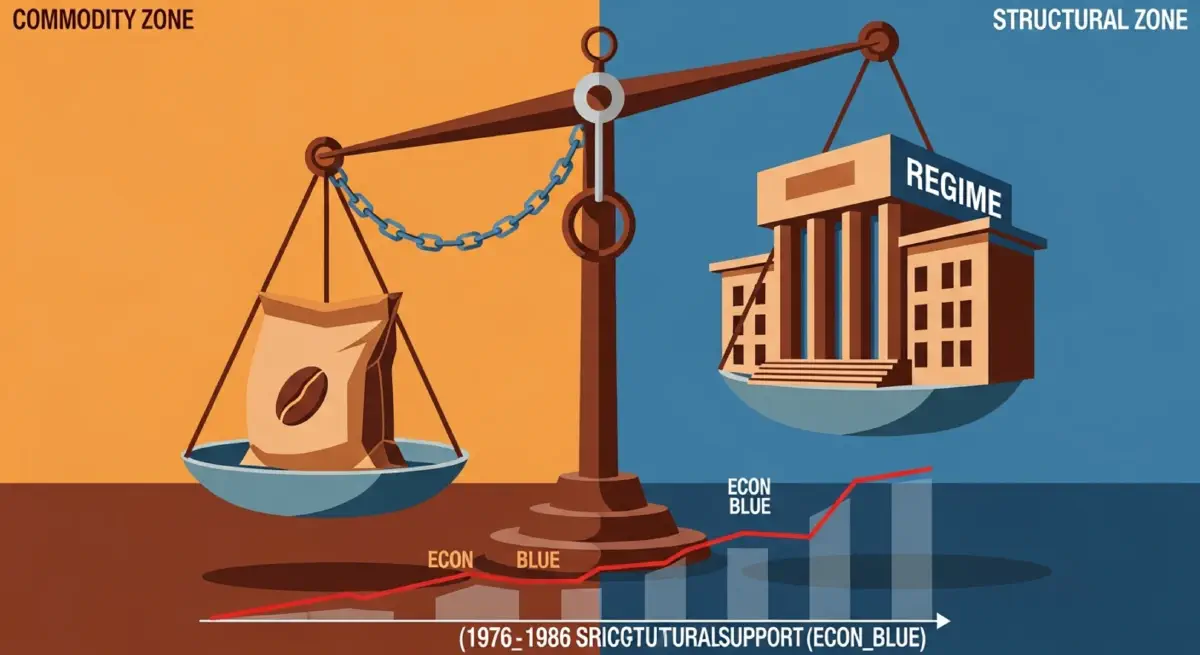
- The supply of loyalty in Wintrobe’s model is positively related to economic performance. When economic performance collapsed, the entire architecture of legitimate political exchange collapsed with it.
A Crop, A Price, A Political System#
On July 5, 1973, General Juvénal Habyarimana, the minister of defense in the Kayibanda government, led a military coup that removed the sitting president, abolished political parties, abolished the legislature, and installed himself as head of state. The official justification was regional favoritism: the Kayibanda regime, drawn predominantly from Gitarama and other southern prefectures, had concentrated state business contracts in the hands of southern Hutu elites at the expense of the northern highlands. The coup’s real logic was economic: Habyarimana came from Gisenyi in the north, where the landed elite (the Abakonde) had survived the 1959 Hutu Revolution with their property intact but without access to the state’s monetary circuits. He came to correct that.
What he inherited was a system built on coffee. Rwanda in 1973 was among the densest agricultural economies in sub-Saharan Africa: 4 to 5 million people, approximately 90% rural, farming an average holding of less than 1.2 hectares at altitudes hostile to most cash crops but exceptionally favorable to arabica coffee. The Belgian colonial administration had introduced forced coffee cultivation in the early 20th century and established the institutional architecture that would outlast colonialism itself: a state marketing board, fixed government-set producer prices, and a monitoring system that linked every farm to the state’s administrative apparatus.
Habyarimana did not dismantle this system. He deepened it.
The Mechanics of Bought Loyalty#
Ronald Wintrobe’s 1998 model of dictatorship provides the analytical framework Philip Verwimp used to explain what followed. The model’s central insight is that loyalty and repression are not opposites — they are substitutes in a production function for political power.
The supply of loyalty from the population (\(L_s\)) is expressed as:
$$L_s = L_s(R,\, P_L,\, P_E)$$where \(R\) is the level of repression, \(P_L\) is the price of loyalty (the reward loyal citizens receive), and \(P_E\) is the performance of the economy. All three partial derivatives are positive: more repression, more reward, or better economic performance each independently increase the supply of loyalty.
The dictator’s objective function is:
$$\max\, U = U(p,\, C)$$subject to a budget constraint that links power (\(p\)) to spending on loyalty, repression, and personal consumption (\(C\)).
Wintrobe identifies two ideal types: the tinpot, who wants just enough power to stay in office and maximizes personal consumption; and the totalitarian, who wants to maximize power and treats consumption as residual. Most real dictators fall between these extremes — but their policy responses to a budget shock reveal which end they are closer to.
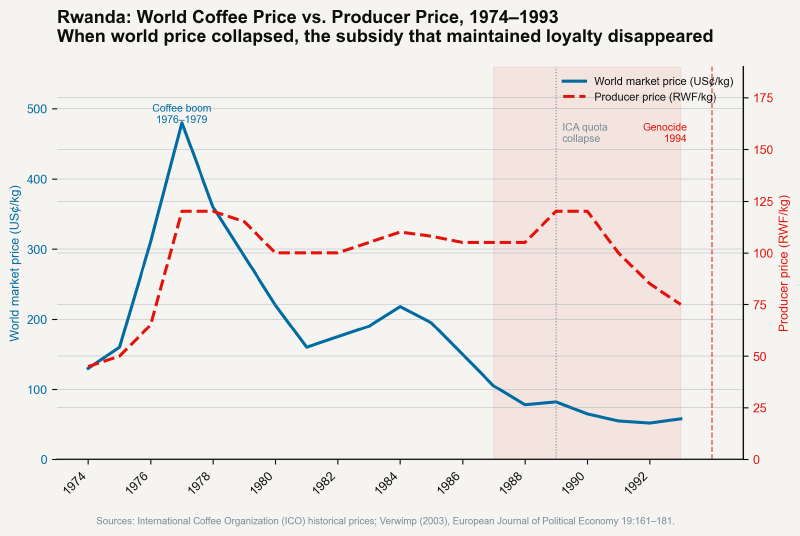
During the 1976–1979 coffee boom, Rwanda’s government enjoyed revenues far in excess of administrative costs. A tinpot dictator would have consumed the windfall. Habyarimana did not. He raised the producer price for coffee from 45 RWF/kg in 1974 to 65 RWF/kg in 1976 and 120 RWF/kg in 1977 — spending part of the surplus to increase the loyalty supply from the smallholder population. Simultaneously, in 1976, he systematically arranged the deaths by starvation of 76 dignitaries and politicians closely associated with the Kayibanda regime. This is the totalitarian signature: surplus resources allocated to both loyalty and repression, simultaneously, to maximize the power accumulation rate.
The Coffee Monitoring State#
In June 1978, Rwanda enacted a law making the uprooting of coffee trees a criminal offense. The same law strengthened the system of commune-level monitors — agents with authority both to advise farmers on cultivation practices and to levy fines for non-compliance. This was not agricultural policy. It was loyalty lock-in: by making exit from coffee cultivation illegal, the regime ensured that 800,000 farming families remained tied to a price relationship it controlled.
The Office des Cultures Industrielles du Rwanda (OCIR-Café) was the institutional mechanism. It purchased coffee from farmers at the fixed government price, processed and exported it, and retained the difference between the world market price and the producer price as state revenue. In years of high world prices, this margin was enormous — 60 to 80% of total state export revenue flowed through OCIR-Café. The money financed the civil service, regional MRND party networks, and the system of clientelism by which local elites received political rents in exchange for mobilizing political support.
The MRND party, created in 1975, made this distribution system explicit. Habyarimana abolished all other political parties and enrolled every Rwandan — by birth, automatically, as a member of MRND. The party was organized at the cell, sector, commune, and prefecture level, mirroring the administrative structure through which coffee monitoring was conducted. Every five years, the president was reelected with 99% of the vote. This was not mass enthusiasm. It was the statistical signature of a loyalty portfolio operating at near-total coverage.
What Money Into Power Looked Like#
When Christophe Mfizi, a close supporter of Habyarimana, wrote his 1992 open letter exposing the “réseau zéro” (zero network), he described the regime’s inner circle in explicitly economic terms: “this group considers the country as an enterprise where it is legitimate to get out as much profit as possible.” His observation was literally accurate. The regime was running an enterprise — and the coffee smallholder was simultaneously its labor force, its tax base, and its loyalty constituency.
The political economy of the MRND was, in Verwimp’s formulation, a system in which the dictator traded off loyalty from farmers against rents. This trade-off had a price: the producer price for coffee was not arbitrary. It was the minimum necessary to maintain the loyalty supply at levels sufficient to sustain the coalition of regional elites, military officers, and party cadres who constituted Habyarimana’s actual selectorate. Below that price, the loyalty relationship would deteriorate. The regime understood this with precision. When the world price began falling after 1987 and the margin shrank, the government did not immediately cut the producer price. It subsidized the gap — paying the loyalty price out of state reserves and foreign aid rather than absorbing the political cost of cutting it.
The subsidy was the last act of a loyalty-purchase strategy. What came after it was something different.
References#
Verwimp, P. (2003). The political economy of coffee, dictatorship, and genocide. European Journal of Political Economy, 19(1), 161–181. https://doi.org/10.1016/S0176-2680(02)00166-0
Wintrobe, R. (1998). The political economy of dictatorship. Cambridge University Press.
Prunier, G. (1995). The Rwanda crisis: History of a genocide. Columbia University Press.
Uwezeyimana, L. (1996). L’agriculture rwandaise, contraintes et perspectives. Editions Universitaires du Rwanda.
Bates, R. H. (1981). Markets and states in tropical Africa: The political basis of agricultural policies. University of California Press.
Mfizi, C. (1992). Le réseau zéro (Open letter to the MRND). Kigali.
Little, P. D., & Horowitz, M. M. (1987). Subsistence crops are cash crops: Some comments with reference to eastern Africa. Human Organization, 46(3), 243–251.