The Dictator's Calculus: How Habyarimana Used Coffee to Buy Power and Genocide to Keep It
Dictators don’t rule by force alone. They manage a portfolio — a precise, rational trade-off between loyalty purchased and repression deployed. Rwanda’s Juvénal Habyarimana ran this portfolio for two decades on coffee money. When the price collapsed, he found a cheaper instrument. Understanding what he did next requires economics, not psychology.
Key Insights#
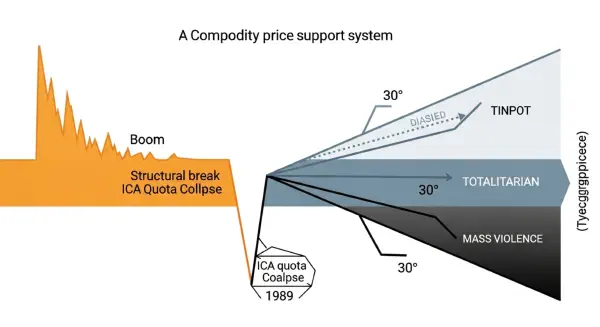
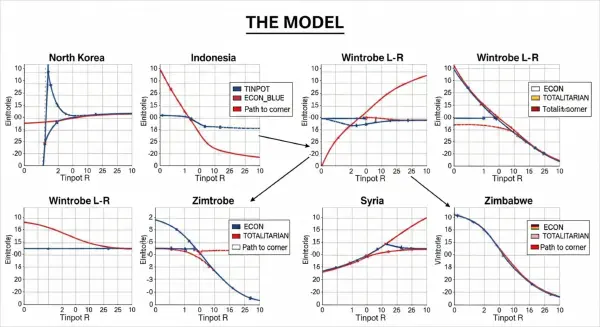
Ronald Wintrobe’s model of dictatorship treats loyalty and repression as substitutable inputs in a production function for political power. A dictator maximizes utility from power and personal consumption subject to a budget constraint. When that budget is interrupted, a tinpot dictator accepts less power; a totalitarian finds a cheaper way to produce it. Habyarimana’s response to the 1989 coffee price collapse identifies him as totalitarian beyond reasonable doubt.
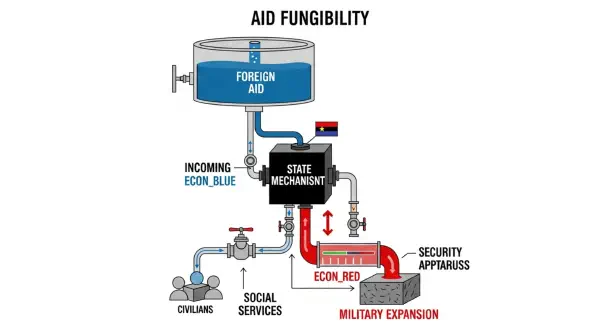
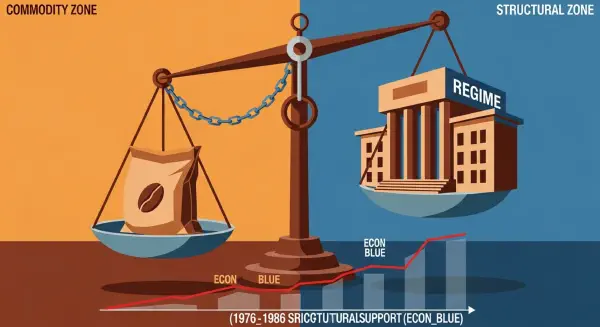
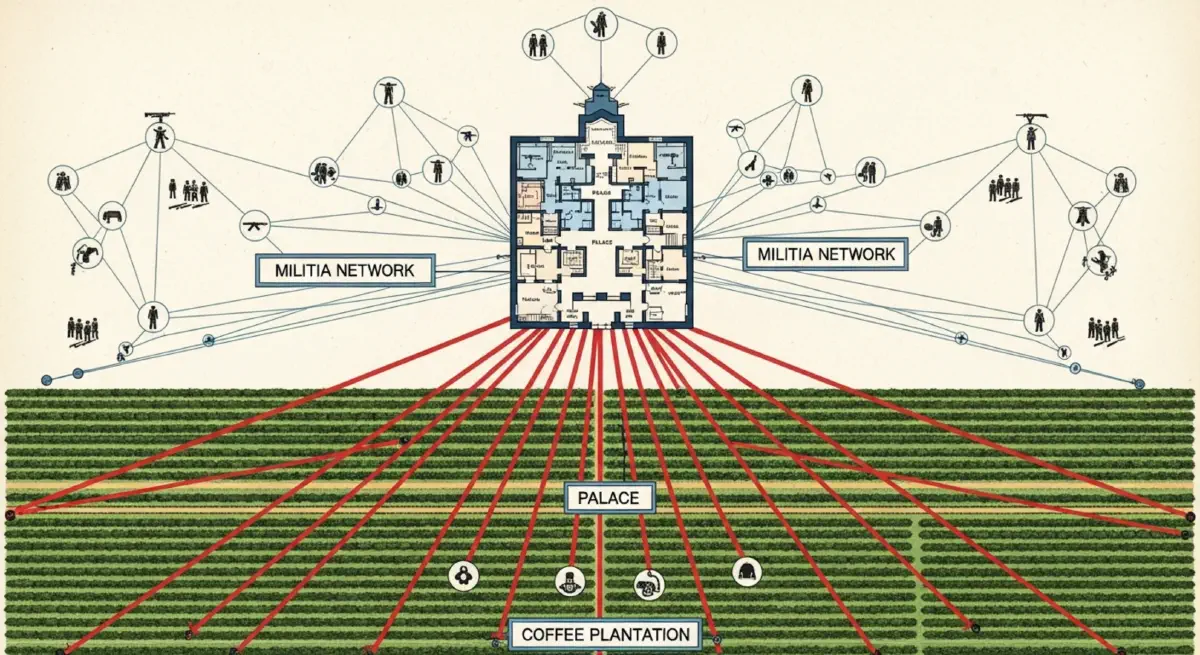
Rwanda derived between 60% and 80% of state revenue from coffee depending on the year and market conditions. The government of Juvénal Habyarimana did not govern Rwanda by taxing its citizens. It governed by extracting a margin between the world coffee price and the price paid to 800,000 smallholder families in the highlands. That margin was loyalty, purchased at scale, distributed through the MRND party network.
When the International Coffee Agreement’s quota system collapsed in 1989 — accelerated by United States withdrawal — the composite arabica price fell from approximately $2.18/kg in 1986 to $0.52/kg by 1992. Rwanda’s fiscal deficit expanded from 3% to 12% of GDP. The government subsidized the coffee agency to the tune of RWF 4.6 billion at the programme’s peak in 1990. It could not sustain those subsidies. The loyalty budget ran out.
Philip Verwimp’s 2003 statistical analysis of commune-level data is the forensic proof connecting the economic model to the genocide. Controlling for Tutsi population share, communes with higher coffee land concentration experienced more intense killing. The mechanism runs through political economy: the organizational infrastructure built to distribute coffee rents became, without modification, the organizational infrastructure to coordinate mass violence.
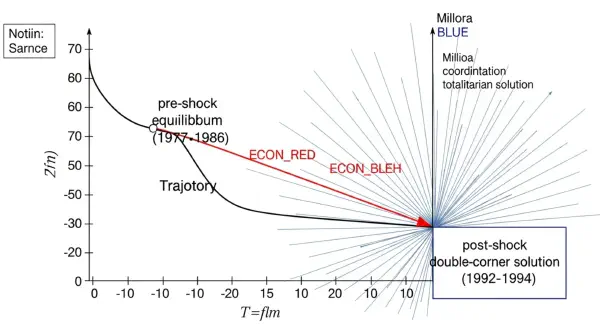
The double-corner solution — the Wintrobe model’s prediction for when a totalitarian dictator loses his economic loyalty-purchase capacity — is exactly what Rwanda produced between 1990 and 1994. Ethnic ideology replaced economic distribution as the loyalty mechanism. Its cost to the dictator was near zero. Its cost to Rwanda was 800,000 lives in 100 days.
References#
Verwimp, P. (2003). The political economy of coffee, dictatorship, and genocide. European Journal of Political Economy, 19(1), 161–181. https://doi.org/10.1016/S0176-2680(02)00166-0
Wintrobe, R. (1998). The political economy of dictatorship. Cambridge University Press.
Prunier, G. (1995). The Rwanda crisis: History of a genocide. Columbia University Press.
Desforges, A. (1999). Leave none to tell the story: Genocide in Rwanda. Human Rights Watch. https://www.hrw.org/legacy/reports/1999/rwanda/
International Coffee Organization. (2024). Coffee prices: Historical data. ICO. https://www.ico.org/prices/
Guichaoua, A. (1992). Le problème des réfugiés rwandais et des populations Banyarwanda dans la région des Grands Lacs africains. UNHCR.
Mfizi, C. (1992). Le réseau zéro (Open letter to the MRND). Kigali.
Newbury, C., & Newbury, D. (2000). Bringing the peasants back in: Agrarian themes in the construction and corrosion of statist historiography in Rwanda. American Historical Review, 105(3), 832–877.
Olson, M. (2000). Power and prosperity: Outgrowing communist and capitalist dictatorships. Basic Books.
Bates, R. H. (1981). Markets and states in tropical Africa: The political basis of agricultural policies. University of California Press.
Uwezeyimana, L. (1996). L’agriculture rwandaise, contraintes et perspectives. Editions Universitaires du Rwanda.
International Criminal Tribunal for Rwanda (ICTR). (2003). Prosecutor v. Ferdinand Nahimana et al. (Media Case). ICTR-99-52-T. https://unictr.irmct.org/en/cases/ictr-99-52