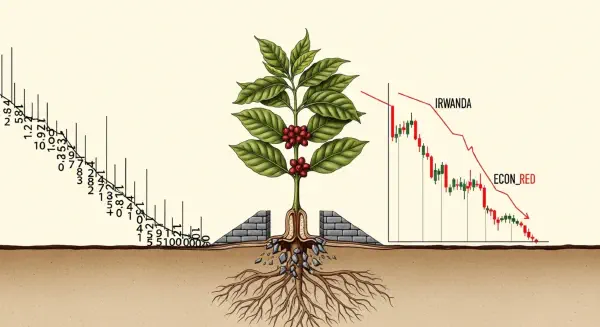
In 1960, Nigeria became independent. It inherited a colonial civil service, a federal constitution, and a groundnut export economy that, while fragile, represented what development economists of the era called a promising smallholder base. Three years later, oil was found in the Niger Delta. By 1980, petroleum accounted for 82% of government revenues. Today, six decades after independence, Nigeria is the poverty capital of the world by absolute headcount: 104 million people living below the international poverty line, in a country that has received more than $1 trillion in oil revenues since production began. The oil did not cause the poverty. The specific institutional structure that oil created — the rentier state — did. And that structure is not an accident of Nigerian politics. It is a predictable output of a universal mechanism.
Key Takeaways#
- The rentier state, first theorized for Iran by Hossein Mahdavy in 1970, is defined by the inversion of the normal fiscal relationship between citizens and government: the state extracts rent from natural resources and distributes it to citizens (or to key factions), rather than taxing citizens and being held accountable for how that revenue is spent.
- Michael Ross’s landmark 2001 statistical analysis of 100+ countries found that petroleum wealth has a robust negative effect on democratic governance — an effect that holds across regions, time periods, and income levels. The rentier logic is not regional or cultural. It is structural.
- A government that does not depend on taxation does not depend on the consent of the governed. The slogan “no taxation without representation” identifies a causal mechanism, not just a political slogan: taxation creates an accountability relationship that commodity rents systematically dissolve.
- Nigeria’s non-oil tax revenue in 2022 was approximately $15 per capita — among the lowest globally. For comparison, Germany collects roughly $18,000 per capita in non-commodity taxes per year. The difference is not economic only. It reflects who the government is structurally required to answer to.
- Rentier states are not uniformly unstable. Gulf states like Kuwait and the UAE demonstrate that high commodity dependence can coexist with political stability — but only by purchasing stability through spending, not building it through accountability. The stability is contingent on the price remaining high.
- The commodity price cycle is therefore also a political cycle. What looks like a democratization movement, a corruption scandal, or a military coup in a high-CFDI country is frequently a fiscal adjustment event in institutional clothing.
The State That Does Not Need You#
To set up the core mechanism, consider the simplest version of the political economy of governance. A government needs revenue to function. In a modern economy, most of that revenue comes from taxing economic activity: income taxes, corporate taxes, VAT. Taxation requires a legal and administrative apparatus capable of identifying taxpayers, assessing liability, and enforcing collection. It also requires a degree of legitimacy: a population that recognizes the state’s right to collect and spends enough energy contesting tax policy through political channels rather than simply evading.
This creates what political scientists call the fiscal contract. The state collects tax; it provides services; citizens evaluate whether the services are worth the tax; political competition occurs over who can deliver the best ratio of services to cost. Accountability emerges not from civic virtue but from the self-interest of each party in the transaction.
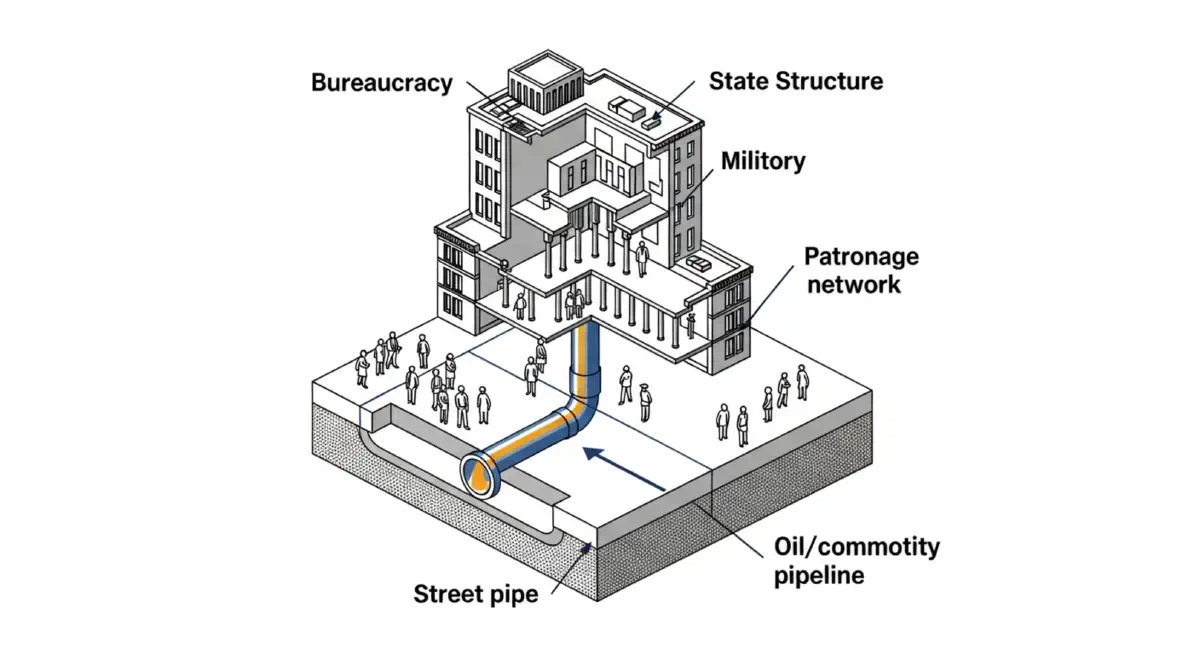
Commodity rents break this contract before it forms. When a government can finance itself by selling oil or copper or coffee margins — by collecting a rent on something extracted from the ground, not produced by its citizens’ labor — it does not need a functional tax system. It does not, therefore, need a state administration capable of engaging each citizen as an economic actor. It needs a state capable of managing extraction, distributing rents to the coalition that keeps it in power, and suppressing those outside that coalition. This is a far simpler and cheaper state to operate.
The Ross Finding and What It Actually Measures#
Michael Ross’s 2001 paper, “Does Oil Hinder Democracy?” is one of the most replicated findings in comparative politics. Using data from 113 countries between 1971 and 1997, Ross found that a one-standard-deviation increase in mineral wealth was associated with a 3.5-point decrease in the Polity democracy score — an effect roughly equivalent to moving a country from the governance quality of Portugal to that of Malaysia. The effect held in every regional sub-sample tested.
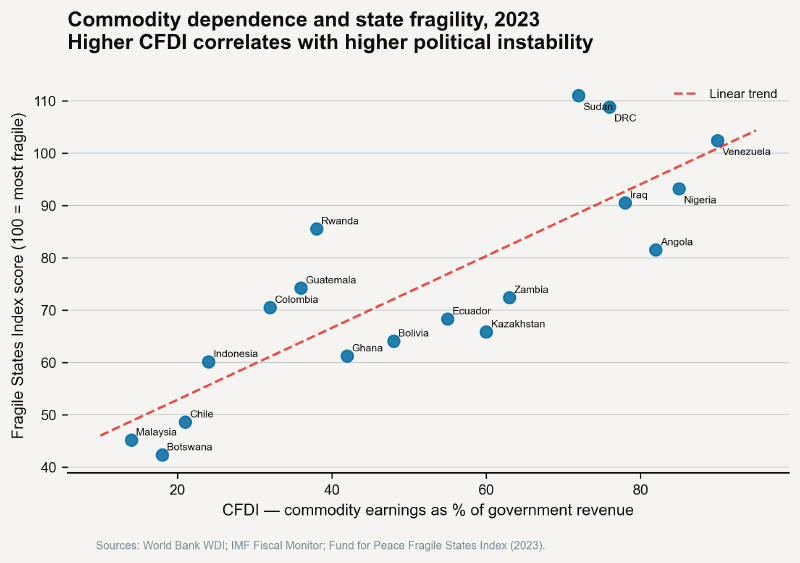
Ross distinguished three mechanisms. The first is the “rentier effect”: governments use low taxes and high spending to reduce citizen demand for participation in governance. The second is the “repression effect”: oil wealth funds the security apparatus that can suppress political opposition without accountability. The third is the “modernization effect”: high commodity dependence stunts the development of the middle-class commercial economy, the urban professional sector, and the civil society organizations that historically drive democratic transitions.
All three operate simultaneously in most high-CFDI states — and they are self-reinforcing. Cheap consumer goods funded by oil rents reduce the economic pressure on citizens to demand better governance; a well-funded security apparatus raises the cost of organizing opposition; a thin commercial economy provides few organizational bases outside the state from which opposition can grow.
Nigeria: The Trillion-Dollar Lesson#
Nigeria is the single most instructive case because the counter-factual is recoverable. The country had a functioning agricultural export economy at independence — cocoa, groundnuts, palm oil — distributed across multiple crops, regions, and smallholder populations. The regional governments that competed for federal allocations in the first decade after independence were, of necessity, competing partly on their capacity to develop agricultural productivity. The incentive structure was not ideal, but it pointed toward economic development.
Oil changed the incentive structure completely. Federal oil revenues, allocated to states through a formula that was opaque, contested, and repeatedly revised, became the dominant political prize. Success in Nigerian politics came to mean success in capturing oil allocations. The agriculture ministry atrophied. Groundnut pyramids — the literal stacks of export sacks that once symbolized northern Nigeria’s economy — disappeared from Kano by the mid-1970s. Nigeria, a food exporter at independence, became a food importer.
The figures are stark. In 1970, agriculture accounted for roughly 48% of Nigerian GDP. By 1980, that share had fallen to 22%. Non-oil export earnings, which had exceeded oil earnings at independence, fell to less than 3% of total exports by 1980. The Dutch Disease — the phenomenon whereby commodity revenues appreciate the real exchange rate, making manufactured and agricultural exports uncompetitive — operated with near-textbook precision. The commodity rent did not supplement the economy. It replaced it.
The Kuwait Comparison: Stable and Unaccountable#
Not all rentier states are unstable. Kuwait, the UAE, and Saudi Arabia demonstrate that high commodity dependence can produce political stability — but the stability is purchased rather than earned. Gulf governments combine near-total commodity dependence with generous citizen subsidies (gasoline prices close to zero, near-universal public employment, no income tax), a foreign labor force that is excluded from citizenship benefits, and robust security apparatus funding. The result is a population economically dependent on the state and politically disinclined to challenge it.
This is stable, but it is not resilient. The stability is contingent on the oil price remaining sufficient to fund the social contract. During the 2015–2016 oil price collapse, Saudi Arabia ran a fiscal deficit of 15% of GDP — funded by drawing down sovereign reserves accumulated during the $110-per-barrel era. Kuwait’s reserves, carefully managed in the Kuwait Investment Authority since 1953, provided a buffer. In Nigeria, which spent its equivalent windfall on recurrent expenditures, no comparable buffer existed.
The Price of Stability That Isn’t#
The rentier trap is most clearly visible not during commodity booms, when the system appears to function, but during busts, when it reveals its structure. Every commodity collapse in the past 40 years has produced the same sequence in high-CFDI countries: fiscal contraction, payment arrears to government employees and contractors, weakening of security force loyalty when wages go unpaid, political fragmentation as regional elites compete for diminishing rents, and — in the most extreme cases — violence.
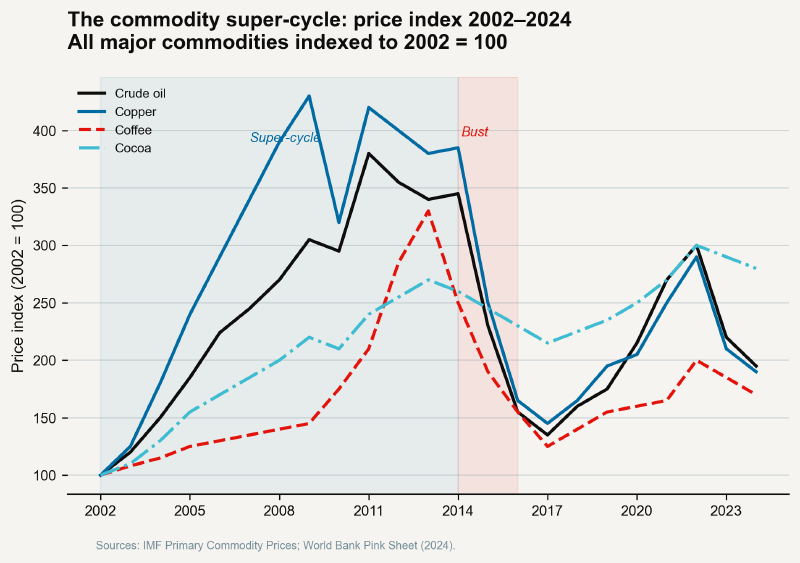
The commodity cycle is, therefore, a political cycle with a lag. Governments borrow against future commodity revenues during booms, locking in commitments they cannot meet during busts. The debt contracts the boom enables become the instruments of political constraint during the bust — which is why the commodity curse and the debt trap, examined in the previous series, are not separate phenomena. They are the same phenomenon at different stages of the same cycle.
The question Part 3 addresses is what the bust actually looks like in three countries that came through the same super-cycle at the same time, with the same starting vulnerabilities, and did not build the institutional buffers in time to absorb the shock.
References#
Ross, M. L. (2001). Does oil hinder democracy? World Politics, 53(3), 325–361. https://doi.org/10.1353/wp.2001.0011
Mahdavy, H. (1970). The patterns and problems of economic development in rentier states: The case of Iran. In M. A. Cook (Ed.), Studies in the economic history of the Middle East (pp. 428–467). Oxford University Press.
Beblawi, H., & Luciani, G. (Eds.). (1987). The rentier state. Croom Helm.
Karl, T. L. (1997). The paradox of plenty: Oil booms and petro-states. University of California Press.
Sala-i-Martin, X., & Subramanian, A. (2003). Addressing the natural resource curse: An illustration from Nigeria (IMF Working Paper No. 03/139). International Monetary Fund. https://doi.org/10.5089/9781451856934.001
Collier, P. (2007). The bottom billion: Why the poorest countries are failing and what can be done about it. Oxford University Press.
Ross, M. L. (2012). The oil curse: How petroleum wealth shapes the development of nations. Princeton University Press.
Fund for Peace. (2023). Fragile States Index 2023. https://fragilestatesindex.org/data/