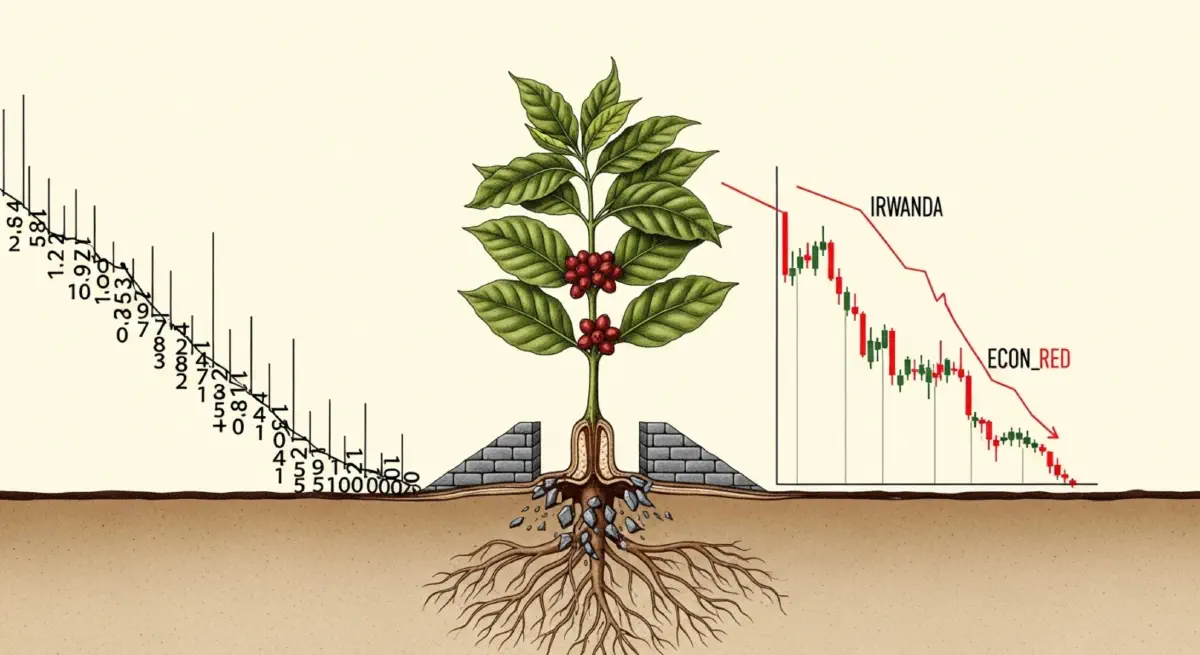
On April 6, 1994, a surface-to-air missile struck the plane carrying Rwandan president Juvénal Habyarimana on approach to Kigali airport. Within hours, roadblocks were erected across the capital. Within days, approximately 800,000 people were dead. The internationally accepted framing of what followed is ethnically legible: majority Hutu against minority Tutsi, a hatred centuries in the making, ignited by a single act of political violence. The framing is not wrong. It is incomplete. Researchers working with commune-level agricultural and mortality data have identified a variable no ethnic framing accounts for: the amount of land under coffee cultivation. The communes where coffee dominated the economy were, on average, the sites of more intensive killing — not less.
Key Takeaways#
- Rwanda derived between 68% and 75% of its total export earnings from coffee in the late 1980s. When the International Coffee Agreement’s quota system collapsed in 1989 and prices fell 65%, the country’s fiscal architecture collapsed with it.
- The Habyarimana regime’s survival mechanism was the distribution of agricultural rents to political clients. When the rents evaporated, the regime switched strategies — from economic distribution to ethnic mobilization.
- Philip Verwimp’s statistical analysis of commune-level data found that higher coffee land concentration was a positive predictor of genocide severity, controlling for Tutsi population share. The mechanism runs through political economy, not ethnicity alone.
- The Commodity Fiscal Dependency Index (CFDI) measures primary commodity earnings as a percentage of government revenue. Rwanda’s pre-collapse CFDI was approximately 70. Every country above 60 on this index today has experienced a political crisis following a commodity price shock since 2000.
- The 1989 quota collapse was not a market accident. The United States withdrew from the International Coffee Agreement in part under pressure from commercial roasters who wanted lower prices. The consequences were absorbed in the highlands of central Africa.
- Understanding the commodity curse requires understanding that commodity prices are not natural phenomena. They are outcomes of institutional arrangements designed and maintained by actors with specific interests.
A Government That Did Not Tax Its Citizens#
To understand why a fall in coffee prices can end in mass killing, you need to understand what coffee was in Rwanda’s political economy — and what it was not.
Rwanda in the 1980s was a deeply rural country. Approximately 90% of the population farmed; the majority of those farmers grew coffee alongside subsistence food crops. Coffee was not a luxury export managed by a corporate enclave. It was the smallholder economy. An estimated 800,000 families, across virtually every commune in the country’s southern and central highlands, depended on coffee income for cash — for school fees, for medical costs, for the input purchases that kept farms productive.
For the Habyarimana regime, coffee served a second function. The government controlled coffee marketing through the Office des Cultures Industrielles du Rwanda (OCIR-Café), which set farmer gate prices, managed export logistics, and channelled the difference between the world price and the price paid to farmers into state revenues. This margin — the commodity rent — was the regime’s operating budget. It paid for the civil service, the military, the regional party networks, and the system of clientelism through which the MRND party bound local elites to the national hierarchy. Habyarimana did not govern Rwanda by taxing its citizens’ incomes. He governed it by extracting a margin from what they grew.
This is the structural feature that made the 1989 price collapse catastrophic rather than merely difficult. When the International Coffee Agreement’s export quota system broke down — after consuming nations, led by the United States, withdrew from negotiations — the composite indicator price fell from a peak of approximately $2.18 per kilogram in 1986 to $0.78 in 1990 and $0.52 by 1992. The margin between world price and farm gate price collapsed with it. OCIR-Café’s revenue dried up. The state’s operating budget contracted sharply.
The Arithmetic of Collapse#
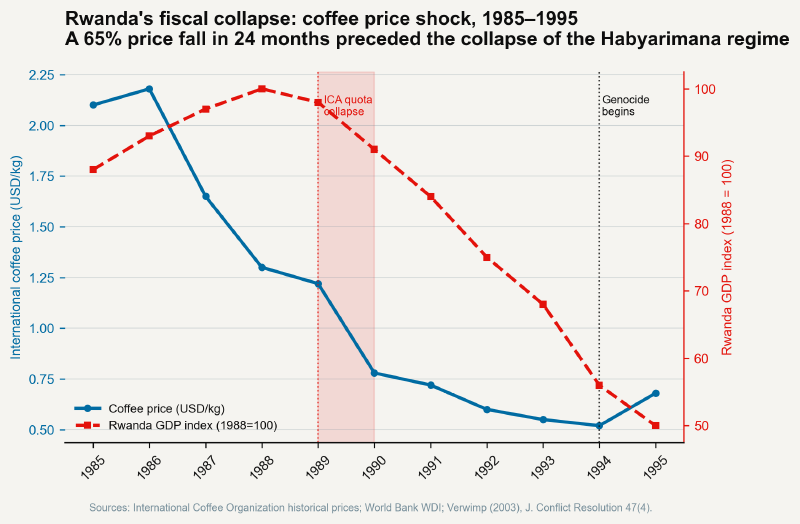
Between 1988 and 1993, Rwanda’s GDP per capita fell from approximately $360 to $250 — a real decline of more than 30% in five years. The government’s fiscal deficit expanded from roughly 3% to 12% of GDP over the same period. An IMF structural adjustment program, imposed in 1990, required the elimination of fertilizer subsidies and a currency devaluation — measures that raised the real costs facing coffee smallholders at the precise moment their revenues were collapsing. The combination was arithmetically punishing: revenues fell, input costs rose, and the government’s capacity to buffer either trend evaporated.
Habyarimana faced what political scientists call a selectorate crisis: the coalition of regional elites, military officers, and party operatives who kept him in power expected material rewards in return for their loyalty. When those rewards became unavailable, loyalty became contingent. The October 1990 invasion by the Rwandan Patriotic Front — a Tutsi-dominated exile army operating from Uganda — intensified the pressure. External security threats and internal fiscal collapse arrived simultaneously.
The regime’s response was to construct a new basis for political coalition — one that did not require money. The akazu, the hardline circle around Habyarimana’s wife, began developing and distributing the Hutu Power ideology through radio stations and pamphlets from late 1990 onward. Researchers have documented the expansion of interahamwe militia networks in precisely the communes where coffee income had fallen furthest. The shift was not random. It was a political strategy for retaining power when the economic strategy had failed.
The Data Habyarimana Understood#
Philip Verwimp’s 2003 analysis in the Journal of Conflict Resolution remains the most rigorous quantitative treatment of what followed. Working with commune-level data on coffee land area (from agricultural surveys), Tutsi population share (from census data), and genocide mortality (from survivor testimony and administrative records), Verwimp found that coffee land concentration was a statistically significant positive predictor of killing intensity even after controlling for the share of Tutsi residents in a commune.
The finding is counterintuitive until you trace the mechanism. Communes with high coffee concentrations were precisely the places where OCIR-Café’s marketing structure had the deepest organizational penetration — where local officials and party cadres were most directly embedded in the distribution of coffee rents. When those rents disappeared, these were also the places where the regime’s alternative mobilization strategy was most efficiently deployed. The organizational infrastructure for distributing rents became, without structural modification, the organizational infrastructure for coordinating violence.
This is not a claim that economics caused the genocide. The ideology, the historical construction of ethnic identity under Belgian colonial classification, the specific political decisions made by specific individuals in April 1994 — all of these were necessary conditions. The claim is that the price of coffee, set in commodity markets managed by institutions headquartered in London, Geneva, and Washington, was also a necessary condition. The distal trigger was financial.
Introducing the Commodity Fiscal Dependency Index#
The CFDI, used throughout this series, is defined simply: primary commodity export earnings as a share of total government revenue, expressed as a percentage. Rwanda in 1989 scored approximately 70 — meaning the government’s ability to function, pay its employees, maintain its security forces, and service its debts depended on a price set in commodity markets it had no influence over.
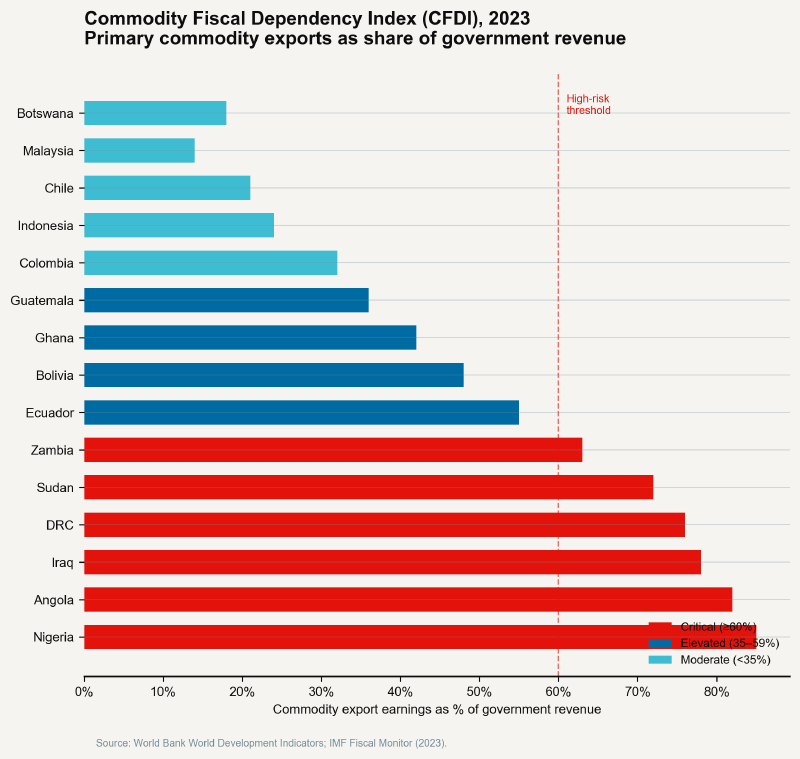
Every country currently above 60 on this index has experienced a political crisis in the five years following the most recent commodity price shock. Nigeria’s 2015–2016 recession coincided with the rise of Boko Haram to effective territorial control in the northeast. Sudan’s al-Bashir regime survived three decades on oil rents and fell within months of South Sudan’s secession removing 75% of those rents. Zambia defaulted in 2020 after copper prices halved from their super-cycle peak. The pattern is not coincidental.
What the Price of Coffee Tells You About the Price of Everything#
The commodity curse is sometimes described as a paradox: the countries richest in natural resources are among the poorest governed. It is not a paradox. It is a system. The mechanism that connects a commodity price collapse in Geneva to a genocide in Rwanda’s highlands is the same mechanism that connects an oil price fall in Houston to a coup in Caracas, a copper price fall in London to a default in Lusaka. What varies is the speed. What does not vary is the transmission channel: a government that cannot pay its political coalition must find another way to hold it together.
Rwanda’s 1994 catastrophe is the most lethal documented instance of this mechanism in the post-Cold War period. It is not the only instance, and it is not the oldest. The more important question — the one this series will spend four more instalments attempting to answer — is whether the mechanism is escapable, and if so, under what conditions and at what cost.
The answer, it turns out, is yes. But the conditions are specific, the window is narrow, and the political incentives work almost entirely against the outcome that the data says is necessary.
References#
Verwimp, P. (2003). Testing the double-genocide thesis for central and southern Rwanda. Journal of Conflict Resolution, 47(4), 423–442. https://doi.org/10.1177/0022002703254207
International Coffee Organization. (2024). Coffee prices. ICO. https://www.ico.org/prices/
Uvin, P. (1998). Aiding violence: The development enterprise in Rwanda. Kumarian Press.
des Forges, A. (1999). Leave none to tell the story: Genocide in Rwanda. Human Rights Watch.
World Bank. (2024). Rwanda: GDP per capita 1980–2000. World Development Indicators. https://databank.worldbank.org
Karl, T. L. (1997). The paradox of plenty: Oil booms and petro-states. University of California Press.
Mamdani, M. (2001). When victims become killers: Colonialism, nativism, and the genocide in Rwanda. Princeton University Press.